Cargèse: The Greek Village of Corsica, Complete 2026 Guide
There is only one village in France where the Byzantine liturgy is still celebrated today alongside the Roman Catholic mass. Only one village where two churches face each other, separated by barely a hundred meters, each turned toward its own spiritual horizon. Only one village that keeps alive, more than three hundred and fifty years after the arrival of its founders, the heritage of a Greek people who took refuge in Corsica in the 17th century. This village is Cargèse. Here is our complete guide to this unique place, halfway between Ajaccio and Porto, in the Gulf of Sagone.
Cargèse, a village like no other
There are a few villages in Corsica that, quietly, carry within them a history so singular that they tell something unique to those who take the time to stop there. Cargèse is probably the most atypical of them all. It is not a classic Corsican village. Nor is it a Greek village in the strict sense. It is a Greek village of Corsica, a category apart, a rare cultural creature, unique in France.
At the end of the 17th century, under increasing Ottoman pressure in the Eastern Mediterranean, 730 Greeks from Vitylo (in the Mani region of the Peloponnese) fled their homeland and sought refuge with the Republic of Genoa. The year is 1676. The Genoese, who controlled Corsica at the time, granted them a territory in the west of the island, around the former hamlet of Paomia. There, these Greeks founded their new community, which they would develop for more than three centuries until creating, a few kilometers away, the current village of Cargèse.
Cargèse is a lesson in cultural coexistence. Two communities (one Greek, one Corsican) that eyed each other with suspicion for more than a century before learning to live together. Two religious rites (the Byzantine and the Latin) that are still celebrated today a hundred meters apart, without merging but without rejecting each other. It is a lesson in historical patience, carried in stone by a small village of twelve hundred inhabitants.
Today, Cargèse has about 1,200 year-round inhabitants. The Greek community has largely intermarried with the Corsican population over the centuries, but the religious traditions have been preserved with rare fidelity. The Greek Byzantine Catholic rite is still celebrated every Sunday in the Saint-Spyridon church by an ordained Greek priest, with Orthodox chants that date back centuries.
This guide takes you on a journey to discover this unique place: its history, its two churches, its beaches, its culture, and its local spots. A village that deserves much more than a simple stopover on the road from Porto.
Where to find Cargèse
Cargèse occupies a privileged position on the west coast of Corsica, in the Gulf of Sagone, halfway between Ajaccio and the magnificent Gulf of Porto.
Distances and access
- From Ajaccio: 50 km, about a 1-hour drive via the D81.
- From Porto: 30 km, 45 minutes via the D81 (via Piana and the Calanques).
- From Calvi: 130 km, 3 hours via the coastal or inland road.
- From Corte: 100 km, 2 hours via the Vergio Pass.
- Airport: Ajaccio-Napoléon-Bonaparte (60 km, 1h 10m).
A prime seaside location
Cargèse is built on a promontory overlooking the sea, offering an exceptional view of the Gulf of Sagone and the surrounding mountains. The village is protected from prevailing winds, which partly explains why the Greeks chose it as their permanent site in the 18th century after several moves. It is also an ideal base for visiting the Calanques of Piana (a UNESCO World Heritage site) and the Scandola Nature Reserve.
To continue your exploration of the west Corsican coastline, check out our guide to the 20 most beautiful wild beaches in Corsica.
The history of the Greeks of Cargèse since 1676
To understand Cargèse, you must understand the history of its founders. It is a Mediterranean epic of rare richness.
The origin: the Mainots of Vitylo
In the 17th century, the Mani region (in the Peloponnese, in southern Greece) was populated by the Mainots, a warrior people known for their fierce independence from the successive empires that dominated the region. Under increasing Ottoman pressure and religious persecution of Orthodox Christians, part of the population of the town of Vitylo decided, in 1675, to seek refuge elsewhere.
Their leader, Ioannis Stephanopoli, began negotiations with the Republic of Genoa. An agreement was reached: Genoa granted them a territory in Corsica (then a Genoese possession) in exchange for their commitment to defend the island as a "soldier people."
Arrival in Corsica: March 1, 1676
On March 1, 1676, a caravan of 730 Greeks (men, women, children) landed at Paomia, on the west coast of Corsica. There they founded a village with their own Orthodox church, their agricultural lands, their language, and their traditions.
The beginnings were difficult. The local Corsicans, who had not been consulted on this settlement, viewed the arrival of these foreigners with suspicion. Tensions quickly arose over land, livestock, and resources. These tensions turned into actual armed clashes in the following decades.
A century of internal exile
In 1731, during the Corsican revolt against Genoese rule, the Greeks (loyal to Genoa) were forced to abandon Paomia. They took refuge in Ajaccio, where they lived for more than forty years in difficult conditions.
It was only in 1774, this time under French rule, that Count Charles Louis de Marbeuf (military governor of Corsica) allowed them to return to the west coast. He founded the current village of Cargèse for them, a few kilometers from Paomia, at its present site. This date of 1774 marks the official rebirth of the Greek community in Corsica.
Gradual integration
In the 19th century, the integration of the Greeks with the Corsican population happened gradually. Mixed marriages increased. A tacit agreement was established: the two communities lived side by side, each with its own church, its own rites, and its own traditions. It is from this era that the two current churches date, built in the 19th century intentionally facing each other.
What makes Cargèse fascinating is not just the Greek origin of its inhabitants. It is the fact that three and a half centuries later, this identity is still preserved, not as a folkloric curiosity, but as a living religious and cultural practice. The Byzantine liturgy is sung there every Sunday. It is a rare lesson in cultural fidelity.
Cargèse today
Today, the Greek Orthodox community of Cargèse numbers about 300 faithful. Most inhabitants of Greek descent carry still-recognizable surnames: Stephanopoli, Papadacci, Corticchiato, Frimigacci. The village is de facto bilingual: Corsican and French in daily life, Greek in the liturgy and traditional festivals.
The two churches face to face
The absolute symbol of Cargèse is its two churches that face each other, separated by barely a hundred meters, on two small hills overlooking the village. This configuration, unique in France, is direct architectural testimony to the coexistence of the two religious communities.
A dialogue in stone
Once in Cargèse, one must take the time to walk from one to the other, in just a few minutes, observing how each facade looks toward the other church. It is not an architectural coincidence. It is an intentional, accepted dialogue, carved in stone.
The two churches date from the 19th century. The Latin church was completed in 1817, the Greek church in 1852. They were built in parallel, each by its own community, with different architects but with the same concern: not to dominate the other. They are roughly the same size, the same height, and share the same sobriety.
In Cargèse, no church overlooks the other. Neither poses as superior. They are two sisters, or two cousins, who decided to share the same horizon. This mutual respect, carved into the architecture, is probably the strongest message this village conveys to its visitors.
The Latin church of Saint-Chartier
The Latin church, or the church of Saint-Chartier (Saint Charles Borromeo), is the place of worship for the Roman Rite Catholic community in Cargèse. It is located on the south hill of the village.
Architecture
Built between 1817 and 1828, the church of Saint-Chartier is an elegant example of Corsican neoclassical style. It features a sober limestone facade, a triangular pediment, and a detached bell tower on the side. The interior is also beautifully sober, with a single nave and an apse choir.
Decorations
The interior frescoes and paintings were mostly created in the 19th century. They depict classic biblical scenes and Catholic saints. The marble high altar is particularly well-crafted.
Services
The Roman Catholic mass is celebrated on Saturday evening and Sunday morning. It is open to the public during services, or otherwise according to the times posted at the entrance.
The Greek church of Saint-Spyridon
The Greek church of Saint-Spyridon is the beating heart of the Greek community of Cargèse. It is located on the north hill, facing the Latin church.
Byzantine architecture
Built between 1852 and 1870 by the Greek community, with donations from the diaspora, the Saint-Spyridon church features architecture that blends Byzantine influences with Corsican neoclassical style. Its iconostasis (the wall separating the nave from the sanctuary, adorned with icons) is particularly remarkable.
The icons
The interior of the church is richly decorated with Byzantine icons, some of which date back to the 17th century and were brought by the founders from Vitylo. These icons are classified as Historical Monuments and form one of the most important Byzantine iconographic collections in France.
Among the most remarkable pieces:
- The miraculous icon of the Virgin and Child, brought from the Peloponnese in 1676.
- A series of 18th-century icons painted in Corsica by Greek iconographers.
- The great 19th-century iconostasis, carved and painted.
The Byzantine liturgy
This is probably the highlight of the visit. Every Sunday morning at 10:30 AM, the Catholic liturgy of the Greek Byzantine rite is celebrated by a priest ordained according to the Eastern rite. Chants in Ancient Greek, incense, prostrations, communion under both species (bread and wine): it is a spiritual and aesthetic experience unique in France.
Attending the Byzantine liturgy at Saint-Spyridon on a Sunday morning is a temporal and cultural journey into one of the world's oldest Christian rites. The chants, the icons, the incense, the light filtered through the stained glass: everything creates a meditative and solemn atmosphere that you cannot find anywhere else in mainland France.
Byzantine festivals
The Greek community celebrates several specific Byzantine festivals:
- Byzantine Easter (sometimes on a different date than Roman Catholic Easter), with a nighttime procession and candles.
- Saint Spyridon (December 12), patron saint of the church and a major village festival.
- Byzantine Epiphany (January 6), with the blessing of the water.
- Feast of the Virgin (August 15), shared with the Roman Catholic Corsicans.
The ruins of Paomia, the first Greek village
About 4 kilometers from Cargèse, in the inland hills, lie the ruins of Paomia, the first Greek village founded in 1676. A place filled with emotion for anyone wishing to understand the history of the Greek community in Corsica.
What remains
Since the abandonment of the village in 1731, Paomia has gradually returned to ruins. Today one can still see:
- The foundations of several Greek dry-stone houses.
- The remains of four chapels, one of which (Saint-Nicolas) is still identifiable.
- Agricultural terraces still visible in the landscape.
- A beautiful panoramic view of the Gulf of Sagone.
How to get there
From Cargèse, take the small road that winds northeast. The site is marked. Plan for a 30- to 45-minute walk through the maquis to reach the main ruins. Best done with sturdy shoes, a hat, and water during the summer.
The Omigna Tower
South of Cargèse, on the Pointe d'Omigna, stands a beautiful Genoese tower that dominates the Gulf of Sagone.
Features
Built in the 16th century by the Genoese to monitor the coasts against Barbary raids, the Omigna Tower is round, made of local stone, and stands about 15 meters high. Today it is partially in ruins but remains accessible and impressive.
To learn more about these structures, check out our guide to the 10 most beautiful Genoese towers in Corsica.
Access
The tower is accessible via a marked trail from Peru beach, a walk of about 30 minutes. The panorama from the top encompasses the entire Gulf of Sagone all the way to the Calanques of Piana to the north.
The beaches of the Gulf of Sagone
Cargèse is also a beautiful seaside destination. The Gulf of Sagone features several quality beaches, just minutes from the village.
Peru Beach
The closest beach to Cargèse (2 km south). Clear sand, crystal-clear water, framed by the red rocks characteristic of the gulf. Family-friendly and accessible. Ideal for a late-afternoon swim.
Chuini Beach
4 km south of Cargèse. A long beach of fine sand, less crowded than Peru. Several beach huts in season.
Menasina Beach
A small, intimate cove south of Cargèse, surrounded by pine forests. A bucolic setting, ideal for a quiet swim away from the crowds.
Stagnoli Beach
Further south towards Sagone, a long family beach with restaurants and water sports equipment rentals.
The Calanques of Piana
25 minutes north of Cargèse, the Calanques of Piana (a UNESCO World Heritage site) offer spectacular landscapes: red rocks sculpted by erosion, secret coves accessible by boat, and some of the most impressive panoramas in Corsica.
Gastronomy and addresses
Cargèse's cuisine blends classic Mediterranean influences (fish, seafood, olive oil) with Corsican traditions (charcuterie, cheeses).
Our favorite spots
- A Volta: a local institution, authentic Corsican cuisine, terrace with a view of the gulf.
- Le Cabanon Bleu: feet in the sand at Peru, seafood cuisine, relaxed atmosphere.
- Le Continental: on the main square of Cargèse, a traditional Corsican brasserie.
- Le Grec: as the name suggests, it offers Greek specialties as a nod to the village's history. A rarity in Corsica.
- La Roseraie: a chic hotel-restaurant on the heights, with a romantic setting.
Producers
Cargèse and its surroundings are home to several artisanal producers:
- Olive oil: several mills in the hills produce high-quality oil.
- Honey: local beekeepers with exceptional maquis honey.
- Cheeses: several high-altitude sheep farms produce tomme and brocciu.
- Wine: the Sagone AOC vineyard is nearby, with several family estates.
To learn more about Corsican gastronomy, consult our complete guide to Corsican AOC wines, our guide to Corsican cheeses, and our guide to Corsican AOP charcuterie.
Religious and cultural festivals
The Cargèse calendar is marked by several unique festivals, a blend of Greek Byzantine and Corsican traditions.
Byzantine Easter
A major festival for the Greek community. A night-time candlelit procession around the Saint-Spyridon church, Byzantine chants, and celebrations until midnight. A unique spiritual and aesthetic experience.
Saint-Spyridon (December 12)
Patronal feast of the Greek church. Solemn mass, procession, community celebrations.
Byzantine Epiphany (January 6)
Blessing of the waters in the port of Cargèse; a Greek priest throws a cross into the sea, and a young diver retrieves it. A very visual and moving ritual.
Assumption (August 15)
A Catholic feast common to both communities. A procession that brings both parishes together, with festive celebrations throughout the village. Check out our article dedicated to Ferragosto in Corsica.
Cargèse in Music Festival
Every summer, a music festival enlivens the village with Corsican polyphonic concerts, Byzantine music, and jazz. The blend of genres is a reflection of the very identity of Cargèse.
Where to stay in Cargèse
Cargèse offers several types of accommodation to suit all budgets.
Charming hotels
- Hôtel Punta e Mare: 4-star with sea view, pool, and an intimate atmosphere.
- Le Continental: a historic hotel in the town center.
- La Roseraie: a hotel-restaurant on the heights with a romantic setting.
Rentals and Airbnb
A great selection of villas with pools and sea views on the heights of Cargèse. Expect to pay between 1,000 and 3,000 euros per week in high season depending on the location and capacity.
Camping
Camping Torraccia: a family-friendly campsite in a pine forest near the beaches. Camping U Roi: more rustic, but authentic.
Bed and Breakfast
Several charming bed and breakfasts in the village's old houses, ideal for immersing yourself in the local atmosphere.
The TAFANELLI collection for Cargèse
Cargèse is a village where clothing must respect the dual identity of the location: both Mediterranean seaside (the beaches, the gulf) and intensely cultural (the churches, processions, and Byzantine festivals). Our collection finds a special resonance in Cargèse.
Our essentials for Cargèse
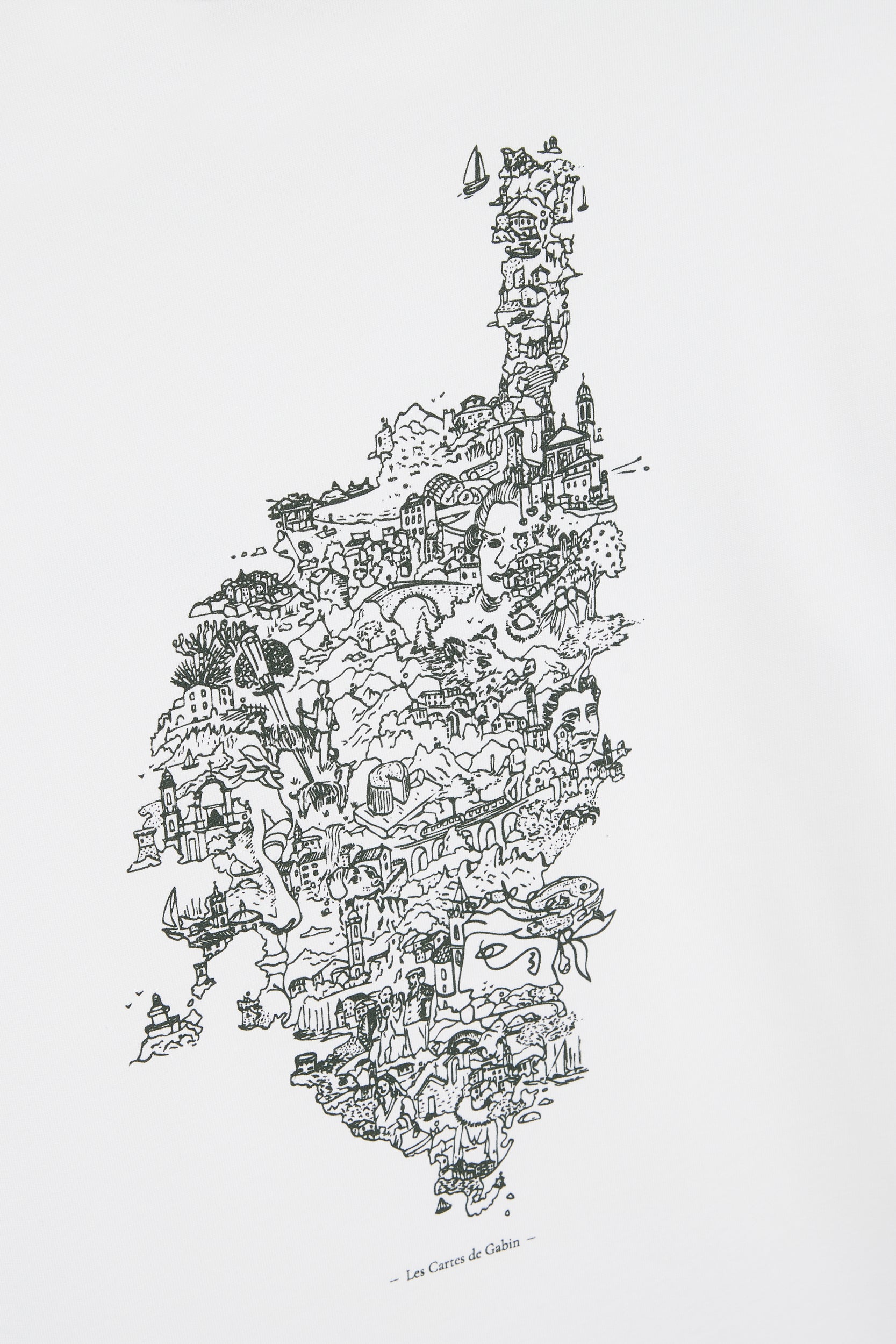
- The new La Trinità t-shirt: the Corsican landscape trinity, perfectly in tune with the meditative and communal spirit of the village.
- The Corsica 1755 t-shirt: a tribute to the Paolian history of Corsica, particularly appropriate in a region that has experienced so many political crossings.
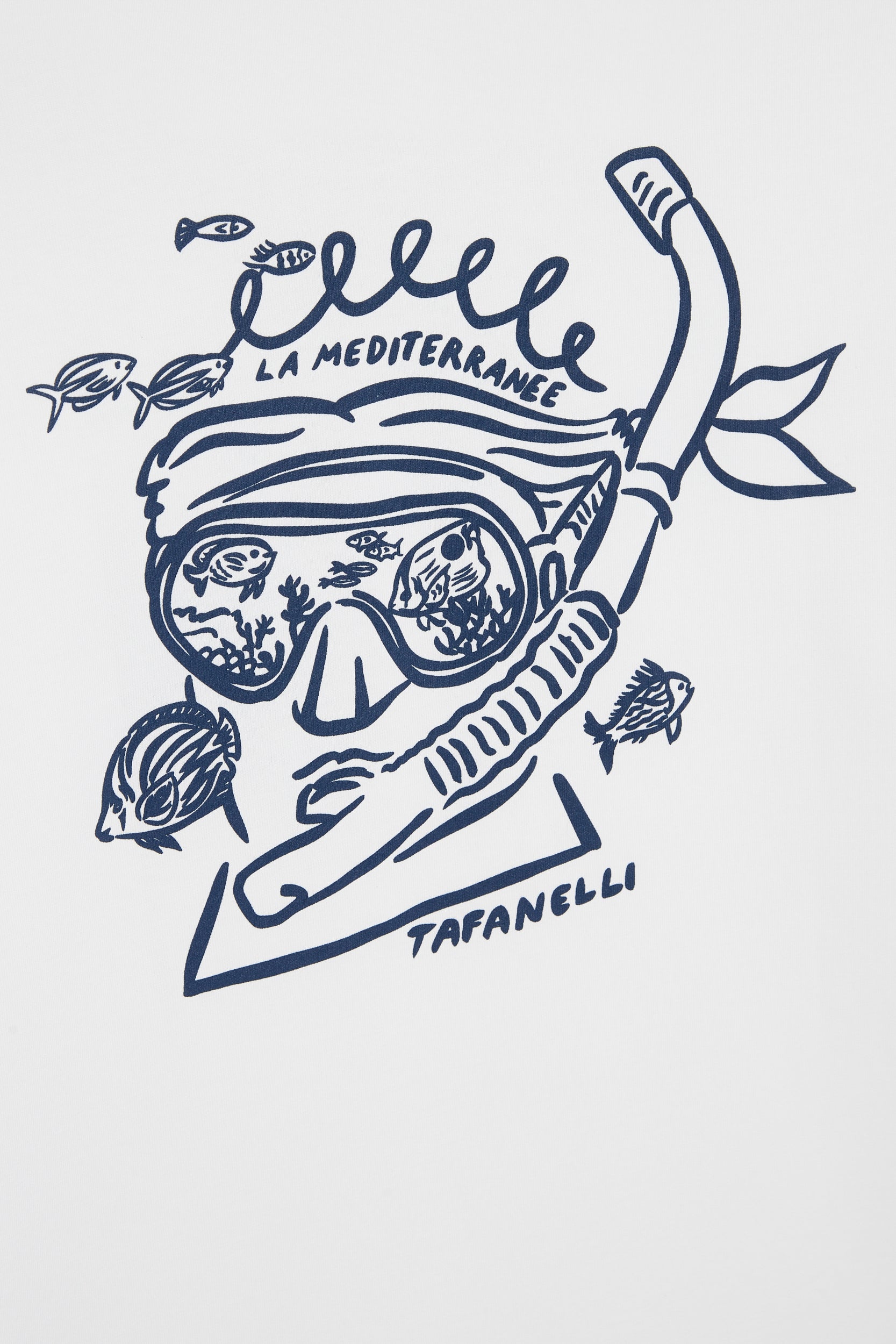
- The Mediterranean Diver t-shirt: for days swimming in the Gulf of Sagone.
- The Corsica Shark Cap: essential for the hike to Paomia or the Omigna Tower under the sun.
- The Corsican Bandana: a versatile, discreet, and signature accessory.
Cargèse teaches us that identity is not fixed. That you can be Greek, Corsican, and French all at once. That you can carry several legacies within yourself without betraying them. This is probably the most Corsican lesson of all: identity is never a prison; it is always a dialogue. Our TAFA pieces are designed with this spirit in mind.
Continue exploring
To extend your exploration of cultural Corsica and the west coast:
- Ajaccio: complete guide 2026
- Paghjella: Corsican polyphony on the UNESCO list
- The 10 most beautiful Pisan chapels in Corsica
- The 10 most beautiful Genoese towers in Corsica
- The 10 most beautiful perched villages in Corsica
- Mare, Muntagna, Machja: the Corsican landscape trinity
- The Moor's Head: history of the Corsican flag
- August 15 in Corsica: Ferragosto and Assumption
In Corsica, the customer becomes a friend.
A DOPU,
TAFA