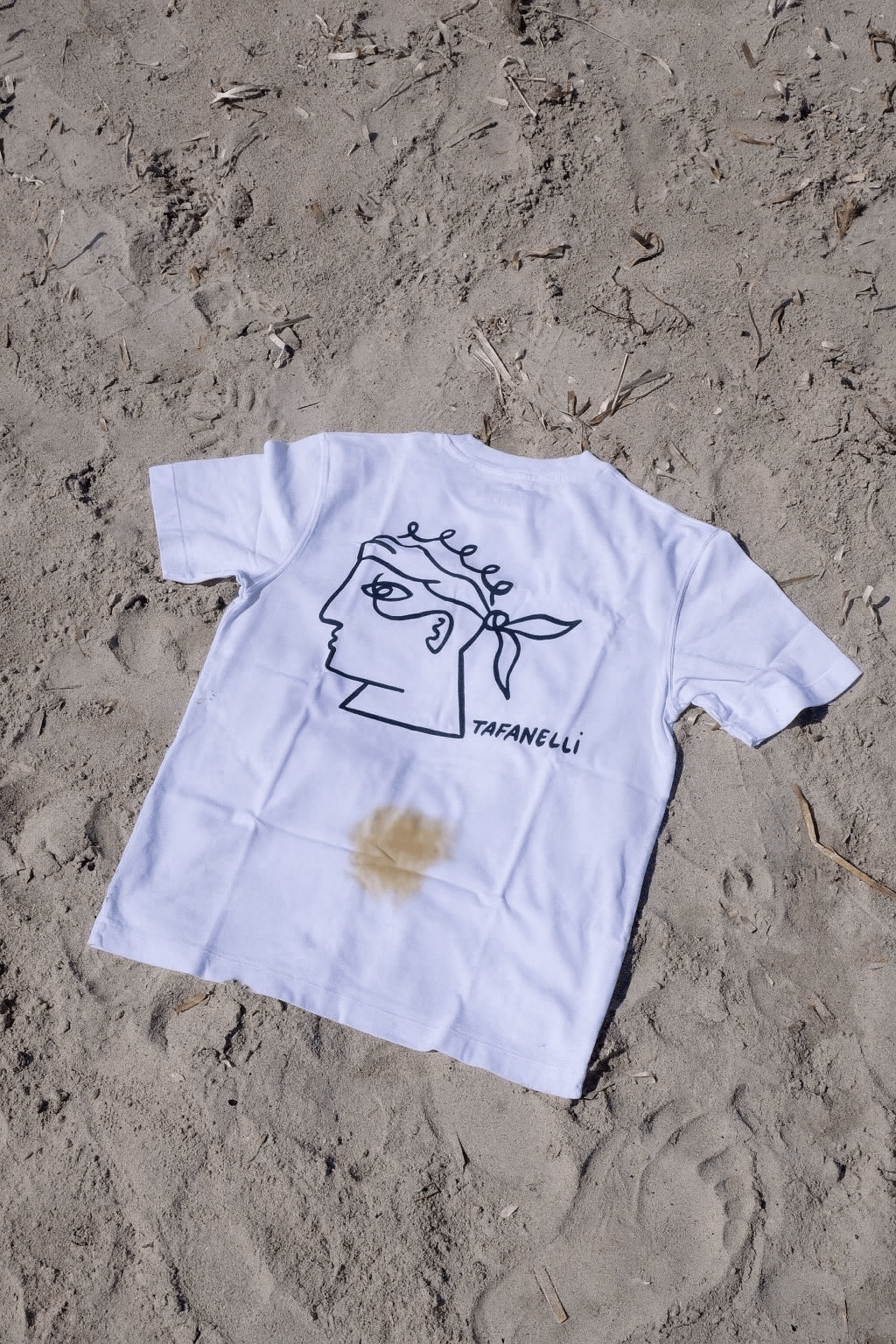
How to remove a stain from a t-shirt without damaging the fabric or the design
A stain on a t-shirt isn't a tragedy; it's a test of patience. Dense, untreated cotton reacts to everything it’s subjected to, and screen printing even more so. The most common mistake isn't using the wrong product: it’s rubbing, and doing so too quickly. Here is the complete method, stain by stain, and what changes when the dirt lands on the design.
The first step: absorb, never rub
If the stain is fresh, do not wash it. Absorb it.
Dab with a clean, dry cloth without pressing down, changing the part of the cloth you use each time. Rubbing, even gently, does exactly the opposite of what you are trying to achieve: it pushes the substance into the weave of the cotton and spreads it over a larger surface.
Once the excess has been removed, run a little cold or lukewarm water over the area. Never hot. Heat sets most organic stains into the fiber, often irreversibly.
A fresh stain does not require force; it requires speed and gentleness. A dry stain doesn't require force either; it requires time.
Fabric or screen print: identify before acting
Before any treatment, look at where the stain is located. On the bare cotton, or on the printed design.
A screen print is not a surface impression like a transfer: it is a layer of ink deposited on the fiber and then heat-set. It is sturdy, but it doesn't like abrasion, harsh solvents, or direct heat.
Simple rule: on the fabric, you can massage. On the design, dab only.
The basic method, in five steps
This solves the vast majority of cases, without any specific product.
1. Absorb
Use a clean, dry cloth, dabbing. Remove everything you can before introducing water.
2. Moisten
Use cold or lukewarm water only on the area. No need to soak the entire garment: the wider the wet area, the greater the risk of water rings during drying.
3. Soap
Marseille soap, natural stain-removing soap, or failing that, a little mild dish soap. Apply directly to the stain. On bare fabric, massage slowly between your fingers, without twisting. On the design, dab.
4. Let it sit
Ten to fifteen minutes. This is the step everyone skips, and it’s the one that does the work. The soap needs time to penetrate the fiber. Patience replaces force.
5. Rinse and evaluate
Rinse with lukewarm water, area by area. If the stain has faded without disappearing, repeat. Two or three gentle passes are better than one harsh one.
An effective, ink-safe home mixture: a teaspoon of baking soda, a tablespoon of white vinegar, a glass of lukewarm water. Apply with a clean cloth, dabbing, let sit for ten minutes, then rinse with clear water.
Stain by stain: the right treatment
- Grease, oil, sauce. Do not get it wet under any circumstances. Immediately sprinkle with Fuller's earth or pure talcum powder. Let it absorb for several hours, ideally overnight. Brush off dry, then wash at 30°C.
- Red wine. Absorb, then cover with coarse salt, which will draw out the liquid. Rinse with cold water. If a pink trace remains, use hydrogen peroxide diluted one part to three parts water, tested first on a hidden seam.
- Coffee, tea. Use cold water immediately, then mild soap. For an old mark, a mixture of white vinegar and lukewarm water in equal parts.
- Sweat and yellow rings. A paste of baking soda and lemon juice in equal parts, let sit for thirty minutes, rinse with cold water. Several passes may be necessary.
- Blood. Cold water exclusively, never lukewarm. Hot water coagulates and sets the stain permanently. Rinse with cold running water, then use Marseille soap.
- Grass. Dab with a cloth soaked in pure white vinegar, let act for fifteen minutes, then soap it up.
- Ink. Dab with a cotton ball soaked in 70% rubbing alcohol, placing an absorbent cloth under the fabric so that the ink migrates downwards and not to the sides. Strictly forbidden on screen prints.
- White deodorant. Rub the fabric against itself while dry, or run a clean nylon stocking over the mark. Water, at this stage, makes the problem worse.
In all cases, work from the edge of the stain towards the center. The reverse spreads it.
What should be avoided at all costs: bleach and all chlorinated stain removers. They discolor cotton, weaken the knit, and attack the ink’s color. On untreated organic cotton, the simplest products are those that best respect the material.
On screen prints: what you should never do
When the stain lands on the design, four things are prohibited.
- Rubbing. Abrasion cracks the ink. A screen print that splits cannot be repaired.
- Using a solvent. Alcohol, acetone, industrial stain remover: they dissolve the pigment as easily as the stain.
- Applying direct heat. No iron, no hair dryer, no tumble dryer on a stained design.
- Brushing. Even with soft bristles, even delicately.
The only authorized gesture is dabbing, using lukewarm water and mild soap, pressing without moving the cloth. If the stain persists after three attempts, it is better to live with it than with a damaged design.
The subject is treated in detail in our guide on how to wash a screen-printed t-shirt.
Heat, the mistake that makes a stain permanent
This is the most common trap, and it snaps shut after the fact.
You wash it, the stain seems gone, you put the t-shirt in the dryer or iron it. It reappears, darker, and this time it will not come out. The heat has "baked" the organic residues into the fiber that the washing hadn't completely removed.
The rule is therefore: systematic air-drying after stain removal, and checking while dry before any ironing. If the mark has disappeared, you can iron at a low temperature, inside out, with a protective cloth, and never directly on the design.
See also: how to iron a t-shirt without damaging the design.
Dried and old stains
A stain that has dried is not lost; it simply needs to be rehydrated before being treated.
Moisten the area with lukewarm water, let the fiber relax for a few minutes, then apply mild soap. Massage, let sit, rinse. Repeat. Two or three complete cycles are sometimes necessary.
The important thing is to never force it between passes. In workshops, before dyeing, fabric is washed, rinsed, and then rested. It is the same logic at home: let the cotton breathe between two steps.
Rinsing and drying without creating water rings
A water ring is not a fatality; it is a mechanical consequence: it appears where the wet zone meets the dry zone, and where residues concentrate while drying.
- Rinse thoroughly, until the water is perfectly clear. Incomplete rinsing is the primary cause of water rings.
- Slightly widen the wet area when rinsing, so the transition is blurred rather than sharp.
- Wring out by hand without twisting. Twisting deforms the knit.
- Dry flat on a clean towel, in the open air, in the shade. The cotton naturally regains its shape and density.
This slow drying is part of the treatment, not the finish.
Prevention rather than repair
The best stain remover remains the one you don't need to use.
- Wash inside out, at 30°C, with a mild detergent without optical brighteners.
- No tumble dryer, ever.
- No iron on the design.
- Store folded, away from direct light, which slowly but surely oxidizes the ink.
- Treat any stain within the hour if possible. Time is the only factor you won't make up for.
Our t-shirts are made of 280-gram premium organic cotton, pre-washed, made in France, with hand-applied screen printing. This construction is built to last, provided it is maintained accordingly.
What a remaining mark says
Sometimes, despite everything, a shadow remains.
It is not necessarily a defect. On a garment made to be worn for a long time, every mark corresponds to something: a meal, a gesture, a moment. The goal has never been to make a t-shirt look new, but to preserve the fiber.
It is the same respect as that of the craftsman for his material: neither brutal, nor mechanical, just patient.
To discover our pieces, browse the t-shirt collection or our entire wardrobe.
Frequently asked questions
How to remove a stain from a t-shirt without damaging it?
Absorb first with a dry cloth, without rubbing. Moisten with cold or lukewarm water, apply mild soap directly to the stain, let sit for ten to fifteen minutes, then rinse. Repeat if necessary rather than increasing pressure. Always air dry.
Why shouldn't you rub a stain?
Rubbing pushes the substance into the weave of the cotton and spreads it over a larger area. On a screen-printed design, it cracks the ink. The right gesture is dabbing, from the edge of the stain towards its center.
Can you remove a stain from a screen print?
Yes, but only by dabbing, with lukewarm water and mild soap. No rubbing, brushing, solvent, or direct heat. If the stain persists after three attempts, it is better to accept it than to ruin the design.
Why did my stain come back after washing?
Because it hadn't completely gone, and the heat from the dryer or iron baked the remaining residues into the fiber. After removing a stain, always air dry and check while dry before ironing.
How to remove a grease stain from a t-shirt?
Do not get it wet. Sprinkle with Fuller's earth or pure talcum powder, let absorb for several hours, brush off dry, then wash at 30°C. Water applied to a grease stain makes it penetrate more deeply.
How to remove a blood stain from a t-shirt?
Use cold water exclusively. Lukewarm or hot water coagulates the proteins and sets the stain permanently. Rinse with cold running water, then apply Marseille soap and let it sit.
How to remove an old, dry stain?
Rehydrate the area with lukewarm water, let the fiber relax for a few minutes, then apply mild soap, massage, let sit, and rinse. Two or three complete cycles are often necessary. Never force it between passes.
Can you use bleach on a stained t-shirt?
No. Bleach and chlorinated stain removers discolor cotton, weaken the knit, and attack the ink's color. On untreated organic cotton, the simplest products remain the most effective.
How to avoid water rings after stain removal?
Rinse until the water is perfectly clear, slightly widen the wet area so the transition is blurred, wring out by hand without twisting, and dry flat in the open air. Incomplete rinsing is the primary cause of water rings.
At what temperature should a stained t-shirt be washed?
30°C maximum, inside out. Any hotter, and the heat sets the organic residues and puts stress on the screen-printed ink.
To go further
- How to wash a screen-printed t-shirt
- How to iron a t-shirt without damaging the design
- Cleaning yellow rings on a white t-shirt
- Reviving the colors of cotton clothing
- Why not to wash high-end t-shirts too often
- Avoiding micro-holes in a cotton t-shirt
- Avoiding lint on a cotton sweatshirt
A well-maintained garment keeps its color, feel, and memory. That is the best reason to buy fewer and choose them better.
A DOPU,
TAFA
When passing through Corsica, the customer becomes a friend.