The Sanguinaires Islands: The complete guide to Ajaccio's red archipelago
Four dark red porphyry islets at the entrance to the Gulf of Ajaccio, a lighthouse that inspired Alphonse Daudet, a forgotten lazaretto, and a sunset that no one forgets. In 1959, they almost built a cable car and a housing development on the islands. Here is what they really are, and how to see them.
Four islets and a rock
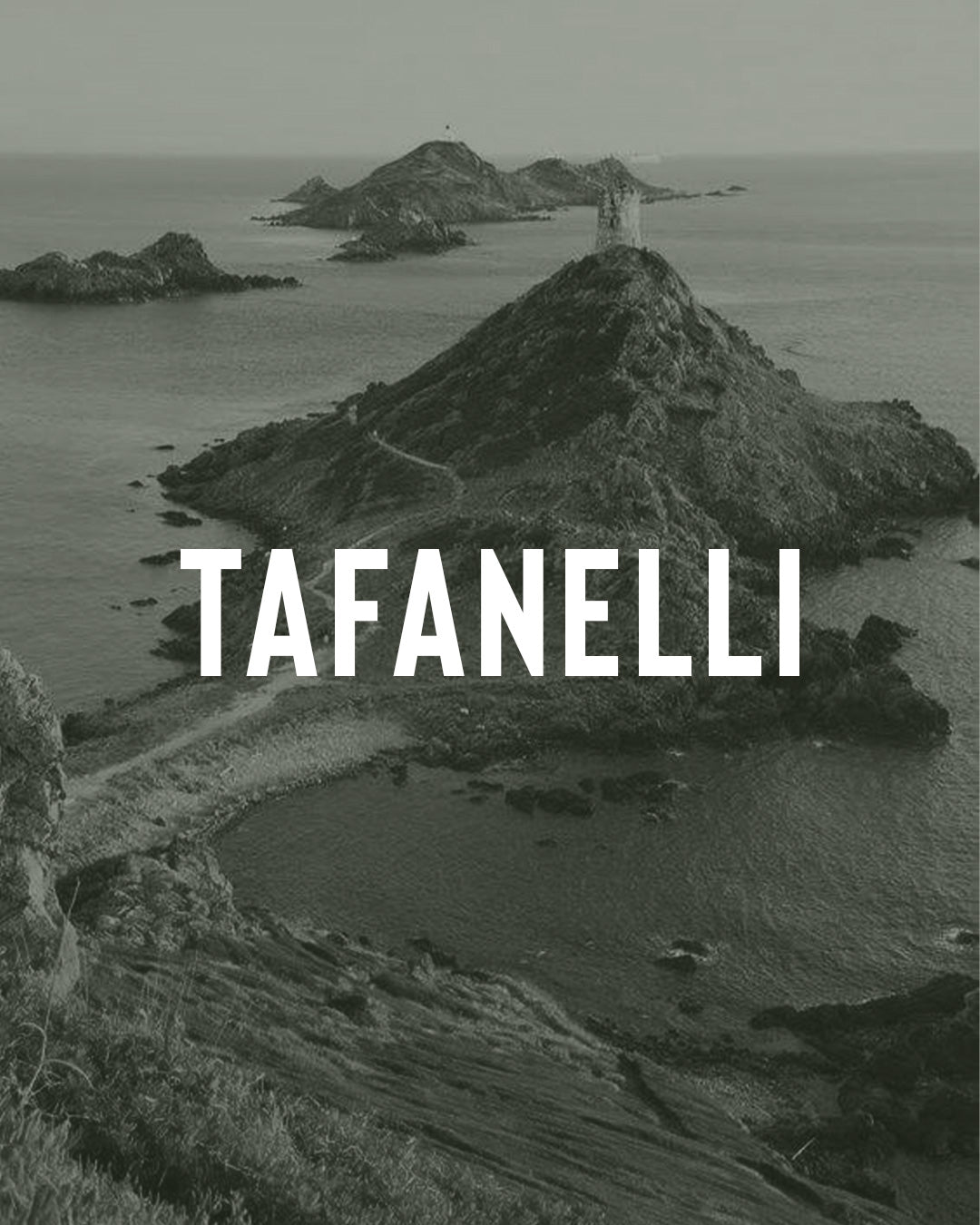
We say "the Sanguinaires" as if it were a single place. In reality, the archipelago, Ìsuli Sanguinarii in Corsican, is made up of four dark red porphyry islets, lined up at the entrance to the Gulf of Ajaccio, in the extension of the Parata peninsula.
In order, moving away from the coast:
- I Porri, the leek islet, 31 meters high. It owes its name to the wild leek that grows there in abundance.
- U Sbiru, a bare 13-meter rock, wedged between Porri and the Cormorans.
- The Cormorans islet, also called Isolotto or Isulu di l'Oca.
- Cala d'Alga, 30 meters.
- Mezu Mare, known as the Grande Sanguinaire. This is the main one, the one that bears the lighthouse, the semaphore, and the ruins. The only one that can be visited.
The whole area, with the Pointe de la Parata, covers 405 hectares.
These are not islands you go to. They are islands you look at, and only one where you land.
Where the name "Sanguinaires" comes from
That is the question everyone asks, and there is not one answer but five. None has definitively won.
The light
The most widespread and beautiful explanation: the crimson light that bloodies the rocks just before the sun falls into the sea. Anyone who has seen it once finds the explanation sufficient.
Frankenia
Botanical hypothesis. Frankenia laevis, a small plant with pink flowers, whose leaves turn bright red in autumn. Seen from a distance, it tints the rocks.
Snowdrops
Same logic, with their pink flowers.
Sagone
The most historically serious, and least romantic, hypothesis. Ancient maps mention the "sagunarie" islands, and a 1595 map names them Sagonares insulae, or "the islands that announce Sagone." Sailors who passed them knew they were approaching the bishopric of Sagone. Abraham Ortelius calls them "Sangianare isole" on his 1573 and 1584 maps, and Leandro Alberti does the same in 1567.
Coral fishermen
The darkest one. Coral fishermen returning from Africa, put in quarantine on the island, were nicknamed i sanguinari, the men with black blood.
Choose whichever you like. In Corsica, a name that has five origins is a name that has been much used.
The lighthouse, and Daudet
The current lighthouse dates from 1870. It succeeded an initial building from 1844, the project for which had been born six years earlier: it had taken all that time to transport the stones and materials to this rock.
It stands at the highest point of Mezu Mare, 80 meters above the sea. It was automated in 1985, the year the last inhabitant left the island. It has been protected as architectural heritage since 2003.
The Sanguinaires lighthouse
In 1869, Alphonse Daudet stayed on the island and found the material there for one of the best-known texts in his Letters from My Windmill: The Sanguinaires Lighthouse.
In it, he describes the solitude of the lighthouse keepers, the wind, the rotating lamp, and that impression of being at the end of the world one kilometer from the city. It is this text that made these rocks known far beyond Corsica, and which explains why a reader from Lyon or Lille has heard of them without ever having visited.
A little further south is the semaphore, commissioned in 1865 and decommissioned in 1955, replaced by the one at La Parata, which is easier to access.
The Parata Tower and the forgotten towers
The Parata Tower is the silhouette everyone photographs. It dominates the headland at 55 meters in altitude, in ruins, with the archipelago behind it.
It was built in 1550-1551 by Giacomo Lombardo, a Genoese master mason. Twelve meters high, seven and a half meters in diameter at the platform, two superimposed vaulted rooms. In the Genoese archives, it bears a name that says everything about its function: Sanguinera di Terra, the Sanguinaire of the land.
It remained the property of the Ministry of War until 1838, the year the peninsula was ceded to the commune of Ajaccio. In 2021, damaged by bad weather, it was selected by the Heritage Mission, which granted 49,000 euros for its restoration.
The two missing or forgotten towers
There was a twin at sea. The Sanguinera di Fuori, or di Mare, built in 1590 at the highest point of the Grande Sanguinaire. It was demolished in the nineteenth century to make room for the lighthouse.
A third remains, more discreet: the torra di Castelluchju, a small defensive square tower from the second half of the eighteenth century, at the extreme south of Mezu Mare. It is in good condition but difficult to access, and it is not, strictly speaking, a Genoese tower.
The lazaretto: nine years of quarantine
This is the most forgotten part of the history of these islands, and one of the most revealing.
In 1806, Mezu Mare became a health station. A lazaretto was built there, intended for the quarantine of coral fishermen returning from Africa. Before setting foot on the island continent, they had to wait there, on that pebble, until it was certain they were not bringing back illness.
The building operated for only nine years. The lazaretto was then transferred to Aspretto, in the port of Ajaccio, in 1847.
All that remains is the pentagonal base, between the semaphore and the lighthouse. You walk past it without knowing.
1959, the year we almost lost it all
Here is the fact that almost no one knows, and which should appear on a sign at the entrance to the site.
In 1959, the Sanguinaires Islands were sold to a real estate company. The project: to subdivide the islets and install a cable car connecting the Pointe de la Parata to the Grande Sanguinaire.
Take a second to imagine. Cables over the gulf, cabins over the water, and buildings on the red porphyry.
The project never happened. The Departmental Council of Southern Corsica subsequently acquired the entire site.
Protection came later, patiently:
- November 2008: integration into the Network of Grands Sites de France.
- March 2017: award of the Grand Site de France label.
- Natura 2000 classification and natural zone of ecological, faunistic, and floristic interest.
What you see today is not a landscape that preserved itself. It is a landscape that people refused to sell.
What grows and what flies
The islets look arid. They are not.
More than 150 plant species grow on Mezu Mare alone. It is a rare density for such a small surface area, and the island is home to rare plants, some of which are absent from the rest of Corsica.
- Arborescent vegetation is dominated by mastic, low and pressed by the wind, adapted to sea spray.
- You find the fly-catching arum, a spectacular and uncommon plant.
- Wild leek abounds, to the point of having given its name to the I Porri islet.
As for birds, the archipelago is a refuge for marine species, notably the yellow-legged gull and the puffin. This is the main reason for the classification, and the reason why you cannot land just anywhere.
How to visit
The Pointe de la Parata, on foot and for free
It is the simplest access, and the most beautiful for the sunset. A groomed trail leads to the Genoese tower, with the archipelago in front. Count on about thirty minutes round-trip, without difficulty, but almost always windy.
The site is very busy in summer. Arrive early, or come off-season.
Mezu Mare, by boat
Shuttles and sea excursions depart from the port of Ajaccio and allow you to disembark on the Grande Sanguinaire, the only accessible island. You walk up to the lighthouse, go along the semaphore and the remains of the lazaretto.
Bring water, good shoes, and a hat: there is no shade.
The chapel
At the entrance to the peninsula is the Parata chapel, built in 1954. Mass is still celebrated there every Sunday.
The rules
- Classified site and Natura 2000. Stay on the trails.
- Three of the four islets cannot be visited. They are nesting zones.
- No waste remains on site.
The sunset
It is the reason most people come, and it must be said simply: it lives up to the hype.
The sun falls exactly on the axis of the archipelago. The porphyry, already red, turns crimson. The tower is silhouetted in black. And for a few minutes, you understand the most romantic etymological hypothesis without needing it explained to you.
Some practical advice:
- Arrive an hour before. The parking lot fills up quickly and the walk takes time.
- Stay after. The twenty minutes that follow the disappearance of the sun are often the most beautiful, and there is no one left.
- The wind rarely dies down. Bring a jacket, even in August.
Frequently Asked Questions
How many Sanguinaires islands are there?
Four islets: Mezu Mare, known as the Grande Sanguinaire, the Cormorans islet, Cala d'Alga, and I Porri. To which is added the 13-meter-high rock, U Sbiru.
Why are they called Sanguinaires?
Several hypotheses coexist: the crimson light of sunset on the red porphyry, the color of frankenia in autumn, or a deformation of "Sagonares insulae," the islands that announce Sagone, a name noted on sixteenth-century maps.
Can you visit the Sanguinaires islands?
Only Mezu Mare, the Grande Sanguinaire, is accessible, by boat from Ajaccio. The other islets are protected nesting zones and cannot be visited. The Pointe de la Parata, however, is accessible on foot and for free.
Is the Sanguinaires lighthouse Daudet's?
Yes. Alphonse Daudet stayed there and was inspired by it in 1869 for the short story "The Sanguinaires Lighthouse," published in Letters from My Windmill. The current lighthouse dates from 1870 and succeeded an initial building from 1844.
When should I go for the sunset?
All year round, but arrive an hour before the announced time. The site is very busy in July and August. Spring and autumn offer the same light with far fewer people.
Is the Parata Tower Genoese?
Yes. It was built in 1550-1551 by Giacomo Lombardo, a Genoese master mason, and was called the Sanguinera di Terra. It is now in ruins and has been the subject of a restoration program.
Why this subject matters to us
At TAFANELLI, we draw what makes up the island's memory. The Sanguinaires occupy a place there that nothing can replace, and not just for the postcard.
What stops us in our tracks is 1959. These islands almost became a subdivision with a cable car. The decision hung by a thread. Someone said no, and the landscape that thousands of people come to look at every evening exists thanks to that refusal.
We always forget that. We think that beautiful places are beautiful because no one touched them. That is wrong. They are beautiful because someone fought so that they wouldn't be touched.
There is also the lighthouse, and what it tells. Daudet came, he wrote about keepers alone facing the wind, and that text did more for Corsica than many campaigns. An island of red porphyry that became a literary site because a man spent a few weeks there.
Finally, there is what we look for in every drawing: that precise moment when the light changes everything. Here, it lasts twenty minutes, it happens once a day, and it is never photographed as well as it is seen.
Read also: the complete guide to Ajaccio, the ten most beautiful satellite islands of Corsica, and the island's Genoese towers.
Passing through Corsica, the client becomes a friend.
A DOPU, TAFA
Sources: Grand Site des Îles Sanguinaires et Pointe de la Parata, Grand Site de France; City of Ajaccio; Franck Cervoni, Images de la Corse, 120 cartes des origines à 1831; heritage inventory, Sanguinaires islands lighthouse; Natura 2000 and ZNIEFF 940004131; Alphonse Daudet, Letters from My Windmill.