The Tour de Corse: history of the rally of ten thousand corners
Born in 1956 from the idea of two enthusiasts, it became the most demanding rally in the world championship, the only one entirely on asphalt, and the one drivers dreaded the most. It is also here, on a road above Corte, that Group B came to an end on a May morning in 1986. Here is its story, and what remains of it today.
1956, two men and an idea
The Tour de Corse was born in 1956, from the desire of two car enthusiasts: Count Peraldi and Doctor Jean Sermonard.
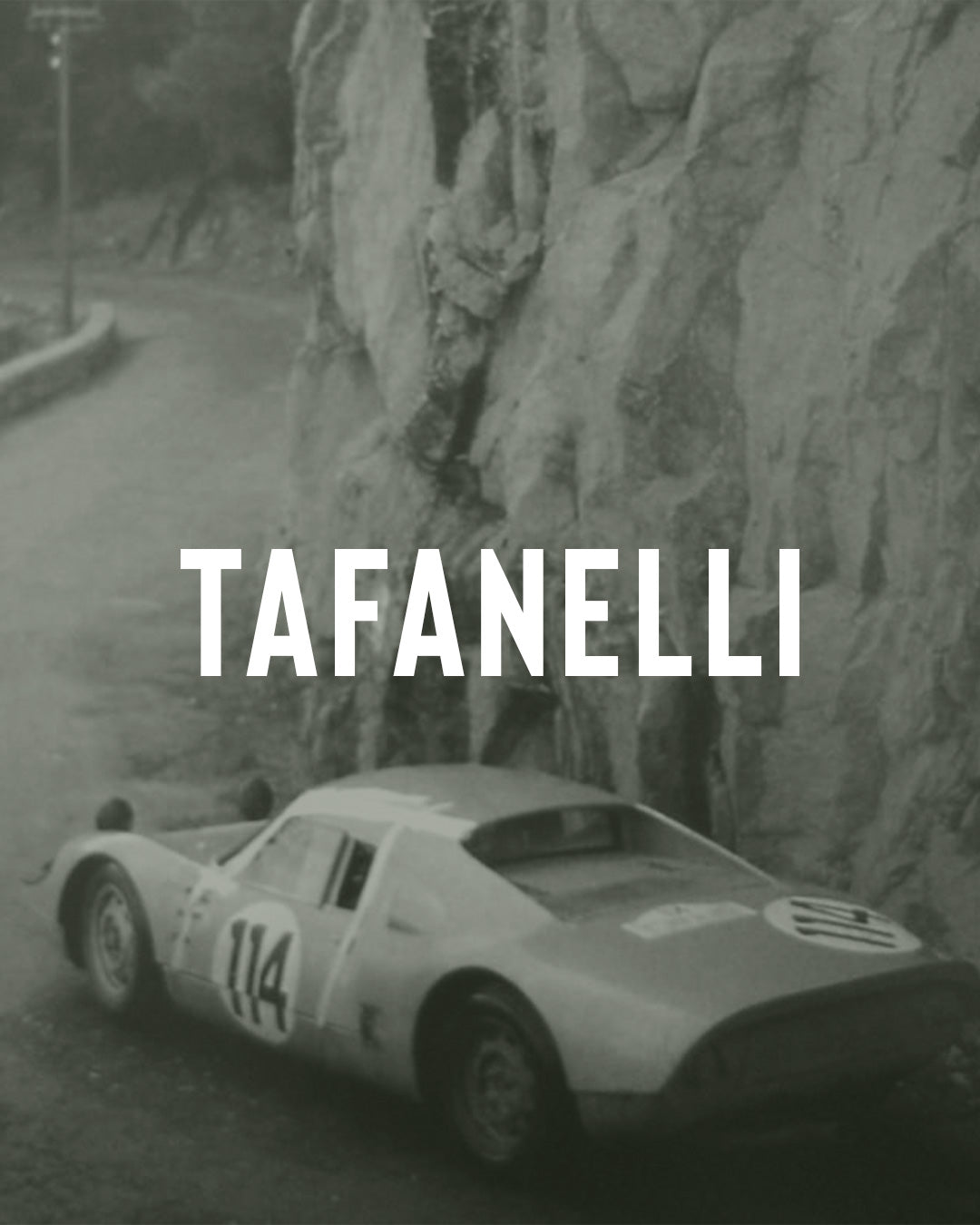
The idea was simple and a bit crazy: to have cars race on the island's roads just as they were. No circuit, no modifications. The Corsican road network, with its switchbacks, low walls, ravines, and trees lining the asphalt, became the playground.
No one suspected then that this local event would become one of the most dreaded appointments in world motorsport.
The route was never designed for racing. It was the race that adapted to the island.
Why "the ten thousand corners"
The nickname appeared at the start of the 1960s, and it is far from a marketing gimmick. It describes a physical reality.
Corsican mountain roads link curves together without respite. On a special stage, a crew can spend several tens of minutes without ever hitting a real straight line. No time to breathe, no stretch where you can let your guard down.
The consequences are known to all drivers who have raced it:
- Extreme mental fatigue. Concentration never wanes.
- Motion sickness for co-drivers, a real and documented phenomenon in this event.
- No margin for error. To the right, the rock face; to the left, the abyss; and often, the reverse.
This is what made its reputation. A rally where pure speed counts for less than lucidity.
The only rally entirely on asphalt
In a world championship dominated by gravel, snow, and ice, the Tour de Corse held a place apart: it was the event held entirely on tarmac.
This changes everything. The setups, the tires, the driving style. Excellent gravel drivers got lost here, while others, more road-oriented, found their terrain.
It joined the World Rally Championship in 1973, the inaugural year of the WRC, and remained there until 2008. After a hiatus between 2009 and 2014, it returned to the world calendar in 2015.
May 1985, May 1986: the end of Group B
This part must be told, because it goes far beyond Corsica and changed world motorsport.
In the mid-eighties, the Group B category authorized rally cars of considerable power, with minimal weight and no real limit on development. These were the fastest machines ever entered in a rally. They were fascinating, and they were frightening.
1985
Italian driver Attilio Bettega was killed at the Tour de Corse, his Lancia sliding off the road and hitting a tree.
May 2, 1986
A year later, almost to the day, Finn Henri Toivonen and his American co-driver Sergio Cresto were leading the rally at the wheel of a Lancia Delta S4. Toivonen had won eleven of the first seventeen special stages and had a lead of over five minutes.
On the second day, the car left the road, hit a tree below, and caught fire. Both men were killed. Toivonen was twenty-nine.
The decision came almost immediately: Group B was banned at the end of the 1986 season. An entire category of world motorsport ended because of what happened on a Corsican road.
Bruno Saby inherited the victory, the first of his career in the world championship. No one, on that day, felt like celebrating.
Even today, in the rally community, they simply talk about "Corsica '86." There is nothing more to add.
The great names of the event
The Tour de Corse has built and revealed entire careers.
Didier Auriol remains the tutelary figure of the event, the one who won it the most often and who built his reputation there. Bernard Darniche and Jean Ragnotti wrote the great French chapters there in the seventies and eighties. Later, Sébastien Loeb and then Sébastien Ogier added their names to the list.
As for the machines, the event is inseparable from certain silhouettes: the Lancia Stratos, the Renault 5 Turbo, the Lancia 037, the Delta Integrale, the Peugeot 205 and 306 Maxi. Cars that you can still recognize today by their silhouette alone.
What remains of it today
The Tour de Corse is no longer on the world championship calendar. The 2026 WRC schedule features fourteen rounds, from Monte-Carlo to Saudi Arabia, and Corsica is not among them.
But the event has not disappeared. It has transformed into the Tour de Corse Historique, and that is perhaps the best thing that could have happened to it.
The principle: vintage cars, those that created the legend, return to race on the roads that made them famous. A touring rally in five stages, it passes through some of the island's most beautiful towns every year.
This is not display-window nostalgia. These are real cars, driven fast, on real timed special stages.
The 2026 edition, from October 3 to 10
The 26th edition of the Tour de Corse Historique will be held from Saturday, October 3 to Saturday, October 10, 2026.
What you need to know:
- 400 crews are entered, split between the competition category and the regularity category.
- Five stages, touring across the island.
- For comparison, the 2025 route stretched over about 1,000 kilometers, including nearly 400 timed ones.
- The organization is based in Porto-Vecchio.
Among the entries announced by the organizers this year, Didier Auriol and Yoann Bonato at the wheel of a Lancia Delta Integrale. For those who know the history of this event and this car, the lineup speaks for itself.
Previous editions highlighted the Lancia 037 in 2024, and the Renault 5 Turbo in 2025.
How to attend
It's free, it's outdoors, and it's one of the few sports where you find yourself just a few meters from the machines. A few common-sense rules are in order.
- Arrive very early. Roads close several hours before the passage. Once the special stage is closed, you cannot enter or leave.
- Stand exactly where the marshals tell you, never anywhere else. Do not stand on the inside of a turn, at the exit of a fast curve, or in escape zones. That is where cars fly off.
- Plan for the entire day. Water, walking shoes, a windbreaker. In October, in the mountains, the weather changes quickly.
- Check the official route before leaving. It is published beforehand by the organization, along with the road closure times.
- Take your trash with you. These special stages pass through remarkable natural sites.
One last piece of advice: October is one of the most beautiful months on the island. The light is low, the colors change, and the perched villages traversed by the rally have never looked better.
Frequently asked questions
Why is the Tour de Corse called the "rally of the 10,000 corners"?
Because its mountain special stages link curves together without interruption. The nickname appeared in the 1960s and describes a reality: on this rally, there are almost no straight lines.
Is the Tour de Corse still part of the World Championship?
No. It was a WRC round from 1973 to 2008, then from 2015 to 2019. It is not on the 2026 calendar, which includes fourteen rounds. The event survives in the form of the Tour de Corse Historique.
When does the 2026 Tour de Corse Historique take place?
From October 3 to 10, 2026, for the 26th edition. Five touring stages, approximately 400 crews entered.
What happened at the 1986 Tour de Corse?
On May 2, 1986, Henri Toivonen and his co-driver Sergio Cresto died in an accident in their Lancia Delta S4 while leading the event. This accident, one year after that of Attilio Bettega in the same rally, led to the banning of the Group B category at the end of the season.
Can you attend the rally for free?
Yes, the special stages are accessible to the public without a ticket. You must arrive before the road closures and strictly respect the zones indicated by the marshals.
On what surface is the Tour de Corse run?
Entirely on asphalt, which made it a unique case in a world championship largely contested on gravel.
Why this subject matters to us
At TAFANELLI, we design what makes up the island's memory. The Tour de Corse occupies a special place in it, and not just because we love old machinery.
What strikes us is that this rally never built anything. No circuit, no stands, no infrastructure. It simply took the roads that existed, the ones people use to go to the village, and turned them into one of the most demanding theaters in world sport.
An island without means becoming an international benchmark by using what it already has. We have encountered this story before, with wine, with the maquis, with the charcuterie. It's always the same.
And then there is the other side, the one that cannot be told lightly. Two men died here in 1986, another the year before, and the whole world understood that day that we had gone too far. Corsica did not ask to carry this memory. It carries it anyway, just as it carries the rest.
There is a sense of justice in the fact that today it is the vintage cars that are returning. They are no longer racing against death. They are returning to salute the roads that made them.
Passing through Corsica, a customer becomes a friend.
A DOPU, TAFA
Sources: official website of the Tour de Corse Historique, communications from the organization; 2026 FIA World Rally Championship calendar; Motor Sport Magazine and Autosport archives on the 1986 edition; historical documentation on the creation of the event in 1956.