L'Île-Rousse: The Complete 2026 Guide to Paoli's Town
It is the only town in Corsica to have been founded by Pasquale Paoli himself, in 1758, to provide independent Corsica with a port that would escape the control of Calvi, which remained loyal to Genoa. L'Île-Rousse (Isula Rossa in Corsican) takes its name from the red porphyry rocks of its Pietra Island, watched over by its iconic lighthouse. The second-largest town in Balagne after Calvi and a bustling seaside resort in season, it blends a Mediterranean atmosphere, historical Paoline roots, and the gentle charm of the Corsican seaside. Here is our complete 2026 guide to L'Île-Rousse.
L'Île-Rousse, Paoli's resort
Some towns are born by accident. Others grow slowly over the centuries. L'Île-Rousse was deliberately founded on a specific day (April 25, 1758) by a specific man (Pasquale Paoli) for a specific reason (to give independent Corsica a port on the western coast). This history, rooted in a bold political act, explains the town's unique character: an atmosphere that is both seaside and historical, regular and luminous architecture, and a direct link to the Paoline legacy.
Today, L'Île-Rousse has about 3,500 year-round residents, but that can rise to over 20,000 in the peak summer season. It is the second-largest town in Balagne after Calvi, but with a very different character: more contemporary, more seaside-oriented, and livelier. Where Calvi plays the card of the historic Genoese citadel, L'Île-Rousse plays that of the chic resort open to the sea, with its beaches, cafes, and market.
L'Île-Rousse is Corsican seaside life at its gentlest. No mass tourism, no excess, just a small, bright town that has kept its soul despite decades of tourism. You come for the beach, and you stay for the atmosphere.
This town is also a major entry point to Corsica: its port welcomes Corsica Ferries and Corsica Linea ferries from Nice, Toulon, and Marseille year-round. Many visitors set foot here for the first time, and many return every summer.
Where to find L'Île-Rousse
L'Île-Rousse occupies a strategic position on the northwest coast of Corsica, in the micro-region of Balagne.
Distances and access
- From Calvi: 25 km, 30 min via the RN197 (or 40 min by Trinichellu, the Balagne small train).
- From Bastia: 75 km, 1h30 via the RN197.
- From Ajaccio: 145 km, 3h drive.
- From Corte: 65 km, 1h30 via the San Colombano pass.
- From Saint-Florent: 45 km, 1h.
- Airport: Calvi-Sainte-Catherine (30 km, 30 min).
- Ferries: Nice (5h30), Toulon (10h), Marseille (12h). Corsica Ferries, Corsica Linea, and La Méridionale.
A unique geography
L'Île-Rousse is built on a promontory facing a small archipelago of red porphyry rocks that give the town its name. These rocks, dominated by the Pietra lighthouse, form a visual ensemble that is unique in the Mediterranean. They are connected to the town by a pedestrian causeway, allowing you to walk there on foot.
The town is protected to the east by the Agriates Desert and to the south by the hills of Balagne, opening to the west onto the bay of Calvi and to the northern horizon toward the Italian Ligurian coast on clear days.
The history of L'Île-Rousse since 1758
L'Île-Rousse is arguably the Corsican town with the most precise, the most dated, and the most deliberate history. It did not grow slowly; it was planned.
A political foundation
In the mid-18th century, Corsica was at war for its independence against Genoa. General Pasquale Paoli, leader of independent Corsica since 1755, sought to equip his country with modern infrastructure. One of the major problems of the Corsican northwest: the region's only port, Calvi, remained loyal to Genoa and refused to welcome Corsican ships.
Paoli therefore decided to found a new port city, a few kilometers from Calvi, on an empty site dominated by the Pietra Island. The town was officially founded on April 25, 1758. It was named Isola Rossa (the red island) in reference to the porphyry rocks. The urban plan is regular, almost orthogonal, with a large central square (the current Place Paoli), straight streets, and an artificial port.
The Paoline spirit
L'Île-Rousse is the only Corsican town to bear the direct urban imprint of Paoli. Its architecture reflects Enlightenment ideals: regularity, light, and rational order. It is a "new town" in the 18th-century sense, in contrast to the perched medieval villages and fortified Genoese citadels.
Walking in L'Île-Rousse is walking in a political project. Every street, every square, every facade bears the mark of a man who wanted to bring Corsica into modernity. It is perhaps one of the few towns in France where you can read political ideals directly into the urban fabric.
Post-1769
After the Corsican defeat at Ponte Novu in 1769 and the final annexation to France, L'Île-Rousse continued to develop but lost its status as a republican capital. In the 19th century, it became a popular holiday resort for wealthy continental visitors. The 20th century saw the addition of modern tourism development, with the first hotels, the Balagne railway line, and the expansion of the marina.
To learn more about the Paoline legacy, check out our guide to Corte, the historic capital of Corsica and our article on the 10 Napoleonic sites in Corsica.
The Pietra lighthouse and island
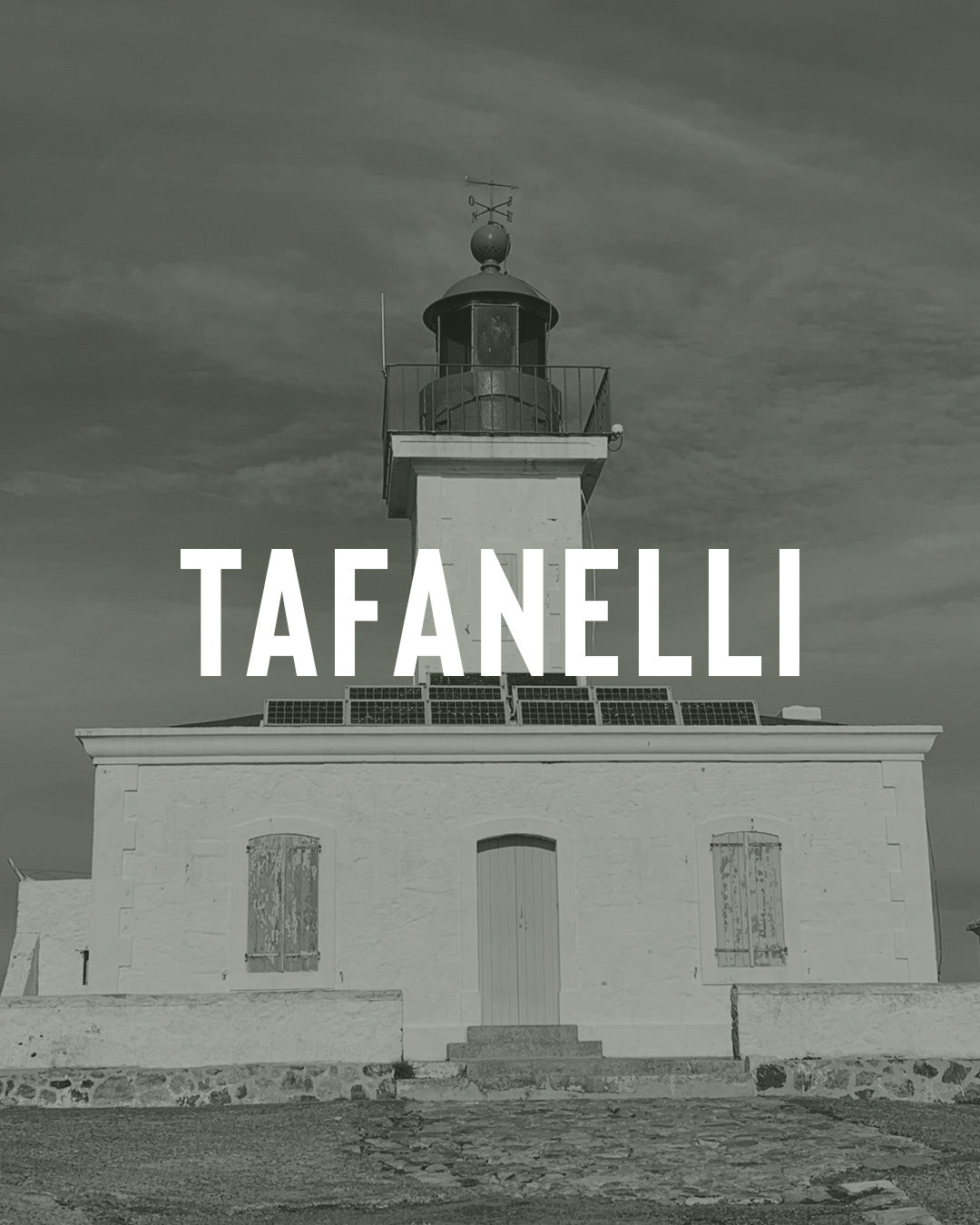
The absolute emblem of L'Île-Rousse, the Pietra lighthouse, stands on its red promontory, connected to the mainland by a causeway. It is probably one of the most photographed landscapes in Balagne, especially at sunset.
The lighthouse
Built in 1857, the Pietra lighthouse is 18 meters tall. It is built on the tip of the island, about 40 meters above sea level. Its light carries over 30 kilometers. It is still an active lighthouse today, maintained by the French lighthouse authority (Phares et Balises). It is not open to the public, but the promenade around it offers one of the most beautiful experiences in L'Île-Rousse.
To learn more about this monument, see our article dedicated to the Pietra lighthouse.
The Pietra island
The island itself is actually a peninsula, connected to the town by a pedestrian causeway built in the 19th century. It is composed of red porphyry rocks eroded by the sea, with small, secret coves accessible to swimmers. The walk around the island takes about 30 minutes on foot from the city center.
Sunset
The sunset viewed from the Pietra island is probably the most beautiful moment of the day in L'Île-Rousse. The sun descends directly into the sea, with the red rocks igniting in the foreground and the silhouettes of the ferries returning to port in the background. Experience it at least once in summer.
Sunset on the Pietra is a local ritual. Every evening in summer, dozens of people gather on the rocks, silent or almost so, to witness the show. It is one of the rare moments when L'Île-Rousse is truly calm, despite the high season.
Place Paoli and the covered market
The beating heart of L'Île-Rousse is undoubtedly Place Paoli. This large, square plaza, shaded by old centenary plane trees, is lined with cafes, restaurants, and most notably, the famous covered market.
The statue of Paoli
At the center of the square, a bronze statue of Pasquale Paoli, inaugurated in 1954 for the bicentenary of independent Corsica. It depicts the general standing, in a serene and solemn pose. It is the visual landmark of the entire town.
The covered market
Built at the end of the 19th century in a neoclassical style, the covered market of L'Île-Rousse is one of the most beautiful markets in Corsica. It is held every morning of the week (except Monday out of season), from 7 a.m. to 1 p.m. You will find:
- Seasonal fruits and vegetables (tomatoes, eggplant, zucchini, figs, peaches).
- Corsican PDO charcuterie: coppa, lonzu, prisuttu, figatelli directly from producers.
- Farmhouse cheeses: brocciu, tomme, calenzana.
- Fresh fish caught that day.
- Maquis honey, PDO olive oil from Balagne, artisanal jams.
To learn more about Corsican products, check out our guide to Corsican charcuterie and our guide to Corsican cheeses.
The square's cafes
Around the square are several iconic cafes: Le Grand Café, Le Sélect, L'Escale. Having a coffee or a pastis under the plane trees of Place Paoli is an essential experience in L'Île-Rousse.
Strolling through the old town
Beyond Place Paoli, the old town of L'Île-Rousse is a quadrilateral of regular alleyways, typical of Paoline urbanism. This regularity is reminiscent of certain colonial Spanish or French cities of the 18th century.
Iconic streets
- Rue Napoléon: the main shopping street, with its boutiques, restaurants, and terraces.
- Rue Notre-Dame: quieter, with some beautiful old houses.
- Cours Paoli: the great promenade, particularly lively at the end of the day.
The Church of the Immaculate Conception
Built in 1893 in a neo-baroque style, this church is the main place of worship in L'Île-Rousse. It houses several remarkable works and hosts the town's major religious occasions (weddings, baptisms, patronal festivals).
The beaches of L'Île-Rousse and surroundings
L'Île-Rousse is a seaside resort par excellence. Here are the iconic beaches accessible from the town.
Marinella Beach
This is the main beach of L'Île-Rousse, located directly at the eastern entrance to the town. Light sand, clear water, and guaranteed summer excitement. Several beach bars offer dining and deckchairs. Accessible on foot from the city center.
Bodri Beach
Our favorite. 5 km east of L'Île-Rousse, Bodri beach is wilder and more preserved. White sand, turquoise water, shaded pine forest. Accessible by car (parking) or by Trinichellu (Bodri stop) from L'Île-Rousse. Family-friendly atmosphere.
Lozari Beach
Over 2 kilometers long, 8 km to the east. Windy in the afternoon (ideal for windsurfing), very long and wide. Several beach bars and restaurants. Accessible by car.
Ostriconi Beach
15 km east of L'Île-Rousse, Ostriconi beach marks the entrance to the Agriates Desert. Wild, almost desert-like, with sand dunes, a river mouth, and an exceptional panorama. Visit for a full day of nature.
To learn more, see our complete guide to the Agriates Desert.
Algajola Beach
8 km to the west, toward Calvi, in front of the small medieval village of Algajola. Fine sand, clear water, picturesque setting with the citadel in the background.
The Trinichellu, Balagne's small train
Do not leave L'Île-Rousse without having taken the Trinichellu, the small train of Balagne. It is arguably one of the most beautiful coastal rail journeys in Europe.
The journey
The Trinichellu connects L'Île-Rousse to Calvi in about 40 minutes, running along the coast right at the water's edge. It serves several intermediate stops (Bodri, Lozari, Algajola, Sant'Ambroggio), making it the best way to get between Balagne beaches without a car.
A legendary train
The Trinichellu is a narrow-gauge train built in the late 19th century. Its small colorful carriages, coastal landscapes, and leisurely pace make it an essential tourist ritual of Balagne. Ideal for families.
Practical info
- Departure: L'Île-Rousse station, on Place de la Gare.
- Frequency: several trains per day in season, increased frequency in July-August.
- Fare: about 6 euros for a one-way L'Île-Rousse-Calvi ticket.
- Booking: not necessary, but arrive early during peak season.
Boat trips and activities
L'Île-Rousse is an excellent starting point for discovering the Corsican coast by boat.
Trip to Scandola and Girolata
From the port of L'Île-Rousse, several companies offer the iconic excursion to Scandola and Girolata, a UNESCO World Heritage site. A full day, with swimming, lunch in Girolata, and an afternoon return. Book at least 48 hours in advance during peak season.
Boat rentals
Several rental companies in L'Île-Rousse offer boats with or without a license. Ideal for a day trip along the coast, with a picnic break in a secluded cove.
Scuba diving
Several diving clubs offer trips to the seabeds of Balagne and the Scandola Reserve. Renowned sites include: La Revellata, Punta di Spanu, and the Île de la Pietra itself.
To learn more about the surrounding area, check out our article dedicated to Punta di Spanu and Sant'Ambroggio.
Kayaking, paddleboarding, and jet skiing
Rentals are available directly on Marinella beach during the season. Guided trips are possible to the Île de la Pietra or toward Bodri.
Our favorite addresses
Here is our selection of great eateries and spots in L'Île-Rousse.
Restaurants
- Le U Fanale: seaside fish restaurant with a direct view of the Pietra lighthouse. Reservations essential in the evening.
- Le Pasquale Paoli: a local institution serving uncompromising traditional Corsican cuisine. Located on the square of the same name.
- A Siesta: creative Mediterranean cuisine, lovely terrace, chic-casual atmosphere.
- La Marinella: toes in the sand, simple and good food, ideal for a beach lunch.
- La Route du Sel: wine bar-restaurant with a curated selection of Balagne wines and PGI charcuterie.
Cafés and bars
- Le Grand Café: an institution on the Place Paoli with a 20th-century resort vibe.
- Le Sélect: the local favorite café, open all day long.
- Chez Charlie: a cocktail bar with a sea view, lively at the end of the day.
Delis and wine shops
- U Casinu: a selection of farmhouse Balagne cheeses (tommes) and PGI charcuterie.
- La Cave de Balagne: a comprehensive selection of AOC Calvi and Corsican wines.
- L'Orangerie: artisanal Corsican products (jams, honey, biscuits).
When to visit L'Île-Rousse
L'Île-Rousse can be visited year-round, but each season has its own appeal.
Spring (April-June)
The best time. Mild temperatures (18 to 25°C), the sea is warm enough for swimming by June, deserted beaches, reasonable prices. The maquis is in bloom. Ideal for hiking around the town.
Summer (July-August)
High season. Crowded, festive atmosphere, high prices, reservations mandatory. But also concerts, fireworks, and night markets. Book accommodation at least 3 months in advance.
Autumn (September-October)
The second best time. Temperatures remain mild, the sea is warm, and the crowds thin out. Ideal for combining beach time with discovering the Balagne region.
Winter (November-March)
A quieter town; most tourist shops close, but the town’s authentic charm returns. Perfect for a relaxing weekend focused on local producers and gastronomy.
Where to stay in L'Île-Rousse
There is a wide range of accommodation options, from campsites to 4-star hotels.
Charming and 4-star hotels
- Le Splendid: a historic hotel facing the Pietra lighthouse.
- Santa Maria: a 4-star hotel on the seafront with a pool and a family atmosphere.
- Cala di l'Oru: a beautiful hotel with a pool and spa.
- Le Grand Hôtel: a historic institution facing the lighthouse.
Rentals and Airbnb
A very wide selection in the historic center and along the coast. Expect to pay between 800 and 2,500 euros per week in high season depending on the size and location.
Camping
Camping Le Bodri: located on Bodri beach, family-friendly and comfortable. Camping Les Oliviers: 5 minutes from the center, in a shaded olive grove.
Surroundings
To combine sea and countryside, there are several charming bed and breakfasts in the nearby perched villages (Corbara, Speloncato, Sant'Antonino). Our retail partners Bout du Monde and U Nichjaretu in Calvi, as well as Chez Léon in Cateri, are easily accessible from L'Île-Rousse.
The TAFANELLI wardrobe for L'Île-Rousse
L'Île-Rousse is particularly well-suited to our wardrobe. Gentle, luminous, and halfway between a beach and a Mediterranean village, it calls for understated and sturdy pieces that work just as well for a sunset aperitif as they do for a boat trip to Scandola.
Our must-haves for L'Île-Rousse
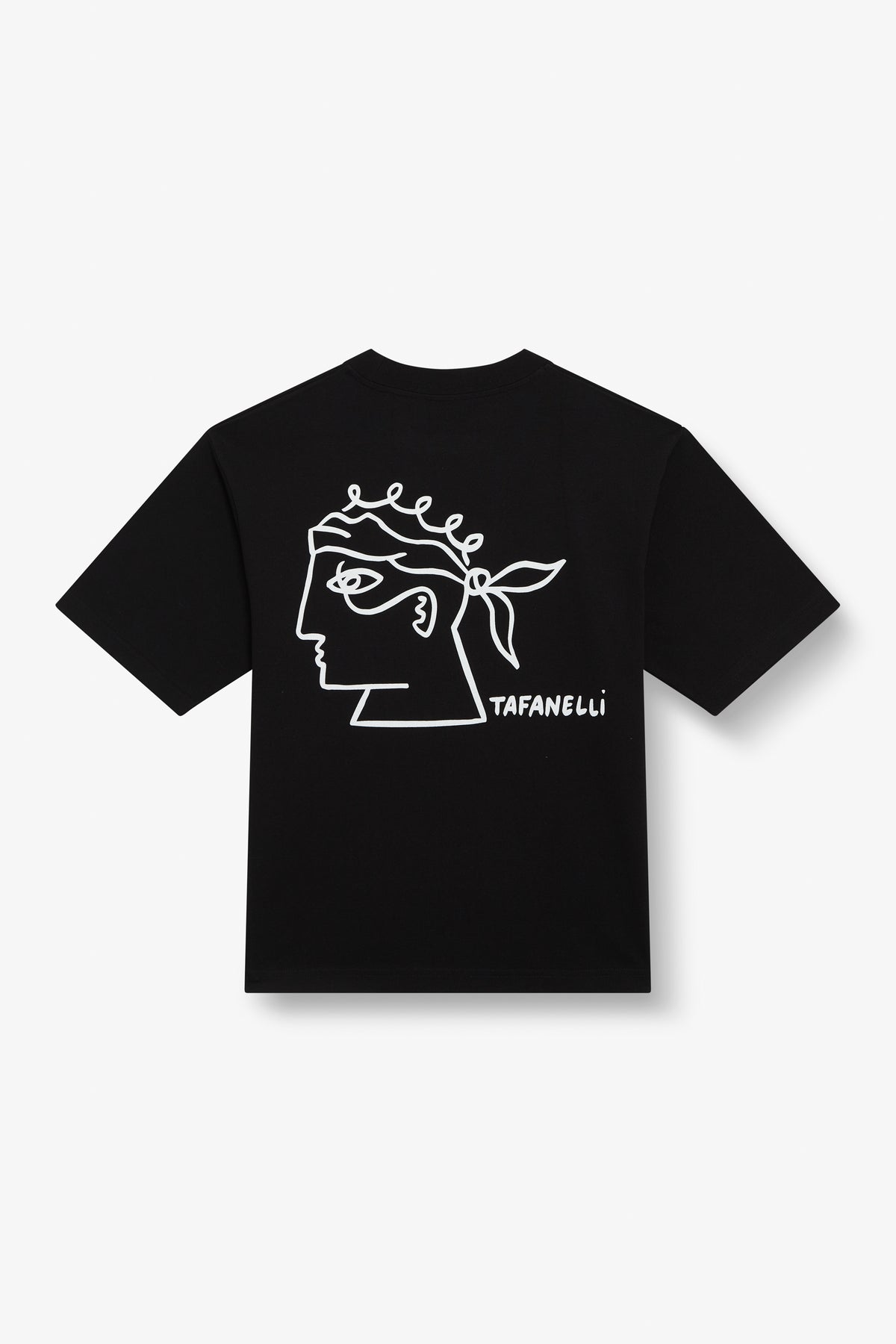
- The Corsica 1755 t-shirt: a direct tribute to Paoli, essential in the town he founded.
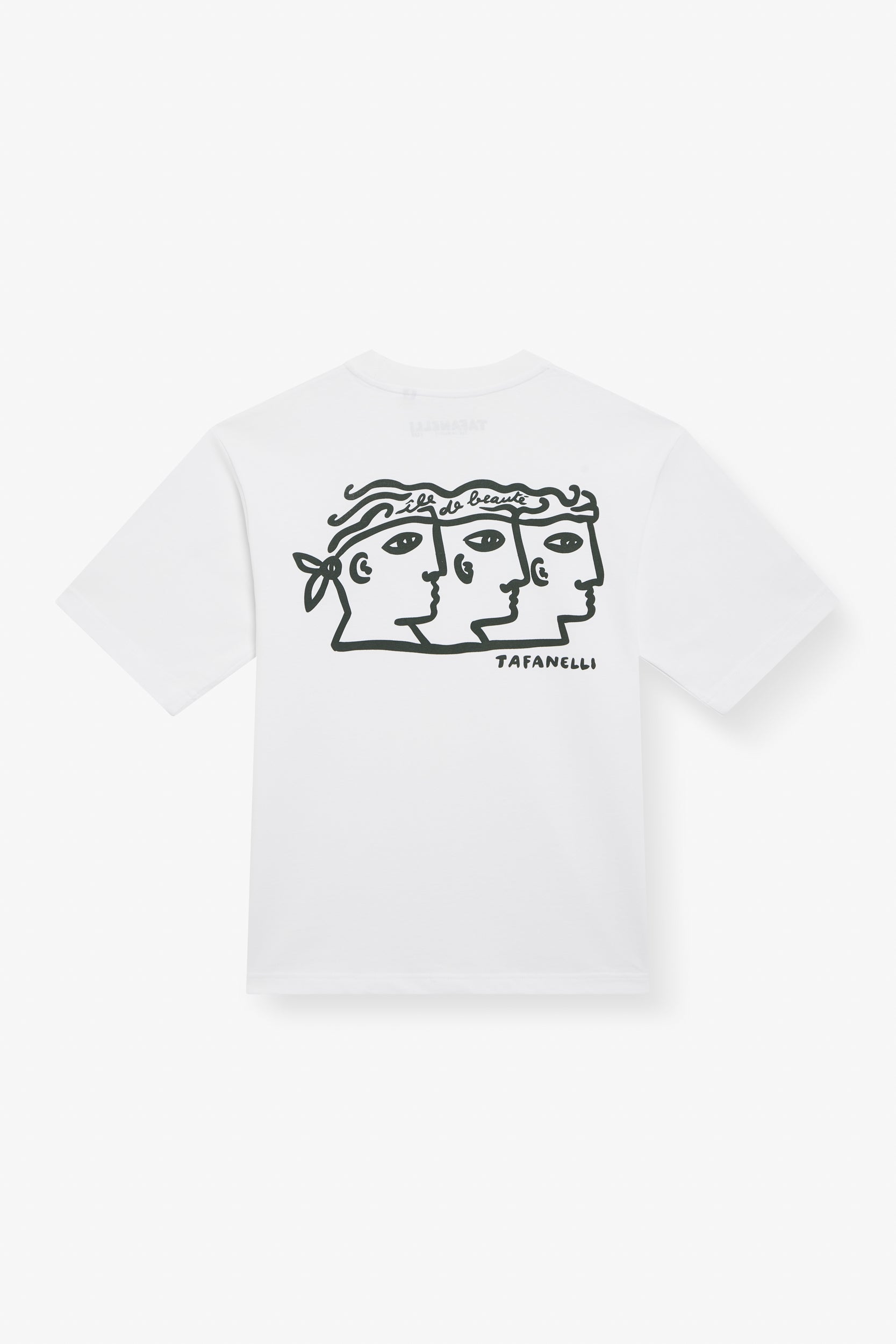
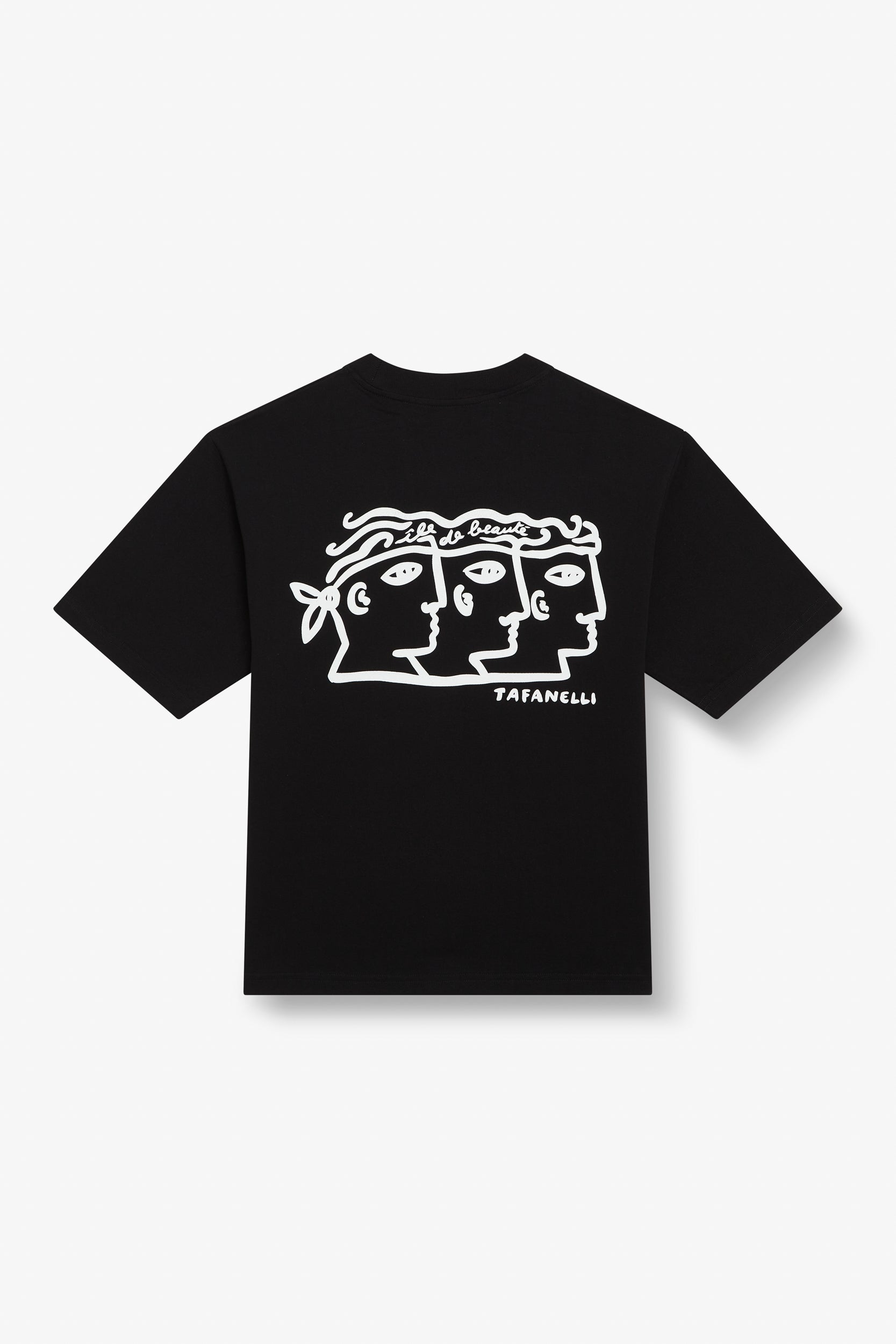
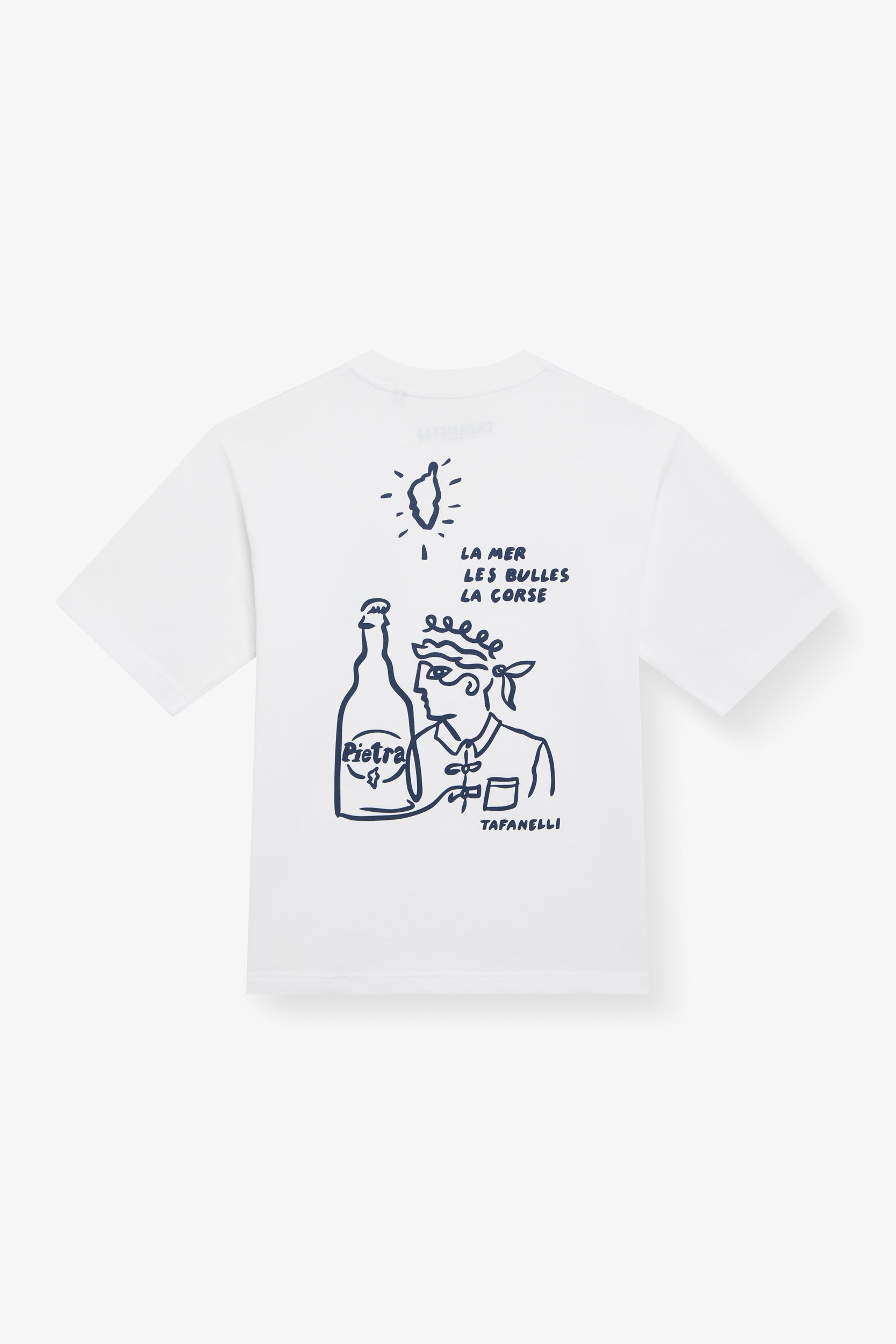
- The new La Trinità t-shirt: the Corsican landscape trinity, perfectly in sync with this Balagne region where sea, mountain, and maquis meet.
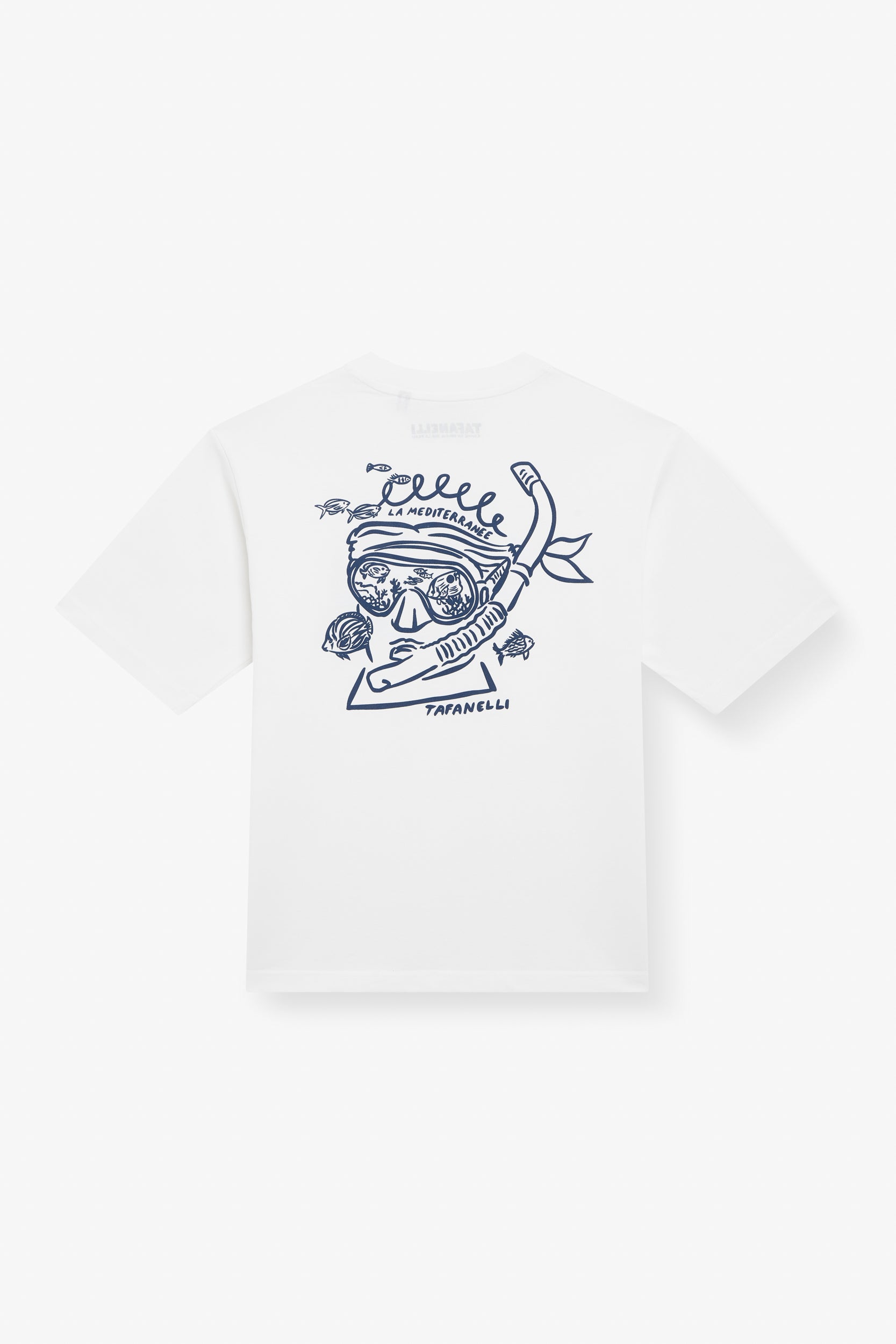
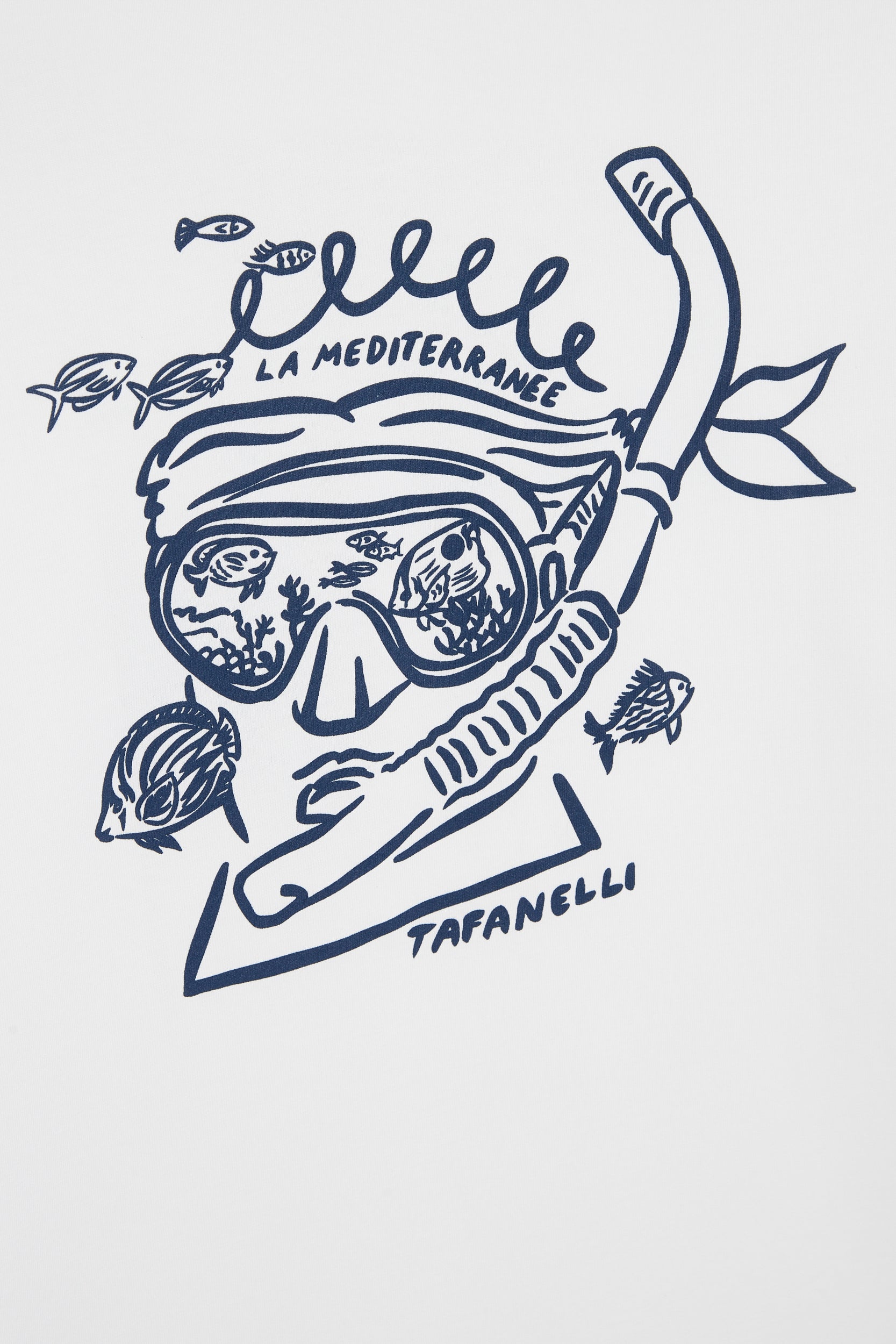
- The Mediterranean Diver t-shirt: 280g/m² cotton made in France, with an impeccable fit for boat days and dinners at U Fanale.
- The Corsica Shark Cap: a must-have for boat trips to Scandola.
- The Corsican Bandana: our signature accessory, popular in the nearby perched villages.
L'Île-Rousse is the town where the TAFA wardrobe truly makes sense. A town that has nothing to prove, playing the Mediterranean gentleness without ostentation. Our pieces are worn there naturally, from the morning market to the sunset on the Pietra.
Find our complete collection at our Balagne retailers (Bout du Monde and U Nichjaretu in Calvi, Chez Léon in Cateri) or on our online store.
Continue exploring
To deepen your exploration of the Balagne region and northern Corsica:
- Balagne complete guide 2026
- Calvi complete guide 2026
- The Pietra lighthouse
- Punta di Spanu and Sant'Ambroggio
- Chez Léon Cateri and Hôtel U San Dume
- The 10 most beautiful perched villages in Corsica
- The Agriates Desert
- The 10 most beautiful Genoese towers in Corsica
- The 10 most beautiful Pisan chapels in Corsica
- Corte, historical capital of Corsica
- Mare, Muntagna, Machja: the Corsican landscape trinity
When visiting Corsica, the customer becomes a friend.
A DOPU,
TAFA