The Corsican mouflon: a muvra, the animal that chose to return to the wild
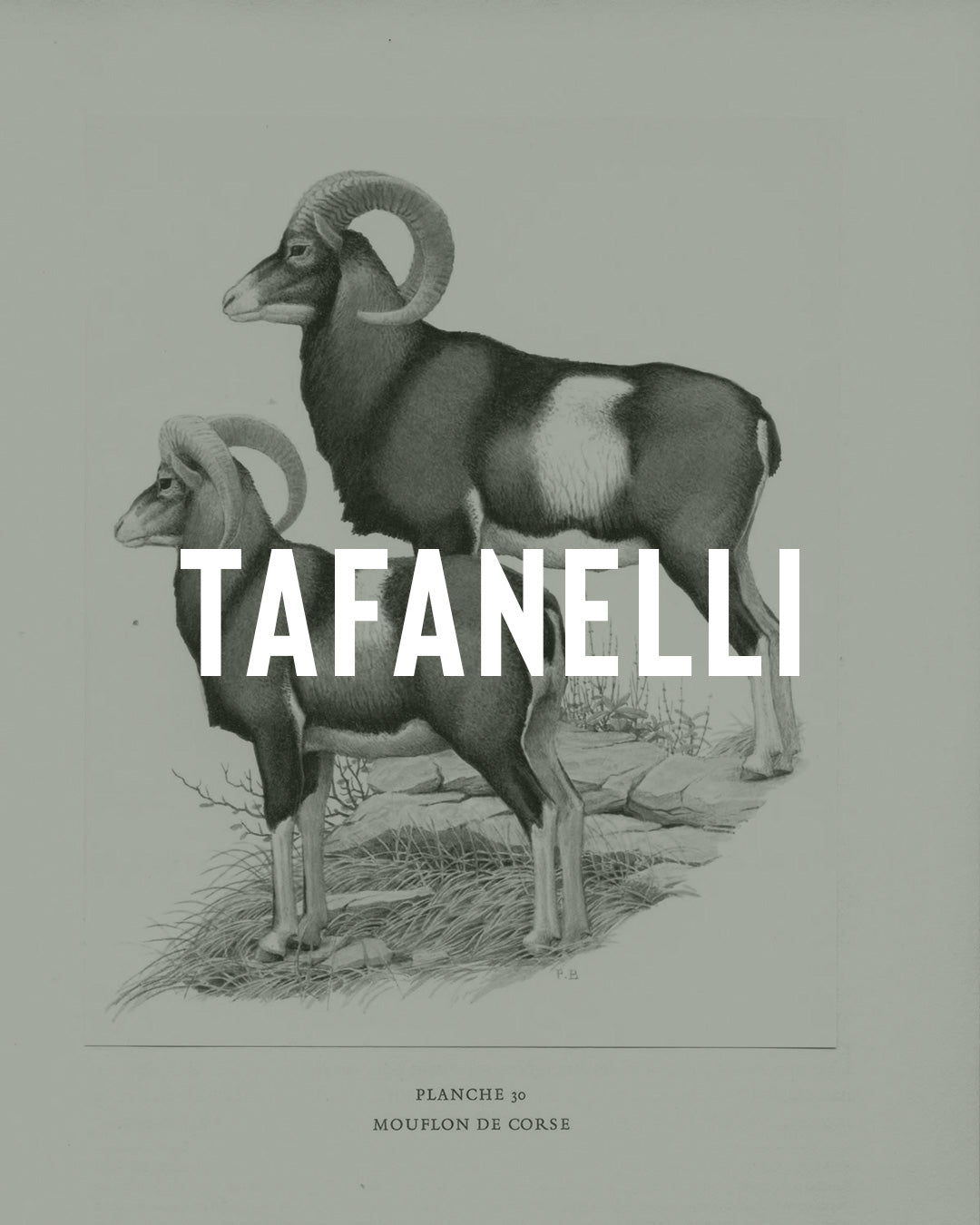
It is the emblem of the Corsican mountains; it appears on logos, crests, and is the name of one of the island's most well-known groups. And yet, its history is the opposite of what one might imagine: the Corsican mouflon is not a wild animal that became rare. It is likely a domestic sheep that left humans several thousand years ago and never returned. About a thousand remain.
A muvra, u muvrone: the name before the animal
In the Corsican language, the female is called a muvra, and the male u muvrone.
These two words do not come from French. It is the other way around. They descend from the late Latin mufrō, itself of pre-Latin origin, and it is they that gave rise to the Italian muflone, and then the English mouflon.
In other words: when someone from the mainland says "mouflon," they are unknowingly speaking a word that came from these mountains, older than classical Latin.
Its current scientific name is Ovis gmelini musimon, with the island population noted as var. corsicana. It is a subspecies endemic to Corsica and Sardinia.
The sheep that went back into the mountains
Here is what almost no one knows, and it is by far the most beautiful part of the story.
The work of paleontologist François Poplin, beginning in 1979, subsequently taken up and confirmed by research from Jean-Denis Vigne in 1992, established that the mouflon was not present in Corsica before the Neolithic era.
This means that it did not arrive on its own. It was brought by the first breeders in the form of domestic sheep, at a time when humans were settling on the island with their flocks.
Then some of these animals left the enclosures and sheepfolds. They went up. And they never came back down.
It is not a wild animal that humans domesticated. It is a domestic animal that regained its freedom, and kept it for several thousand years.
Scientists call this feralization: the return to a wild state of a domesticated species. Over generations, left to the mountains, predators, and winter, the Corsican mouflon reacquired a phenotype similar to its distant wild ancestors: the spiral horns, the fawn coat, the nervous disposition, and the ability to live on slopes where nothing grows.
It was not returned to nature. It went back there all by itself.
For an island that has spent its history defending its autonomy, it is hard to find a more fitting animal emblem.
How to recognize it
From a distance, it is sometimes confused with a wild goat or an escaped sheep. Up close, there is no mistaking it.
- The male's horns: massive, curled in a spiral toward the back and then forward. This is the signature of the muvrone. They grow throughout their life and bear growth rings that allow one to estimate their age.
- The female: smaller, generally hornless or with very short horns.
- The coat: fawn-brown, darker in winter, with a light-colored belly and hindquarters.
- The "saddle": a light patch on the flank, very visible in adult males during winter.
- The build: not like that of a sheep. A lean, muscular animal, built for steep slopes and scree.
- The behavior: extremely wary. It spots you long before you see it, and it leaves without a sound.
The rut takes place in the fall, and that is the only time you can hear the clash of horns from two males fighting in the mountains. A sharp sound that carries far in the silence of the valleys.
Cinto, Bavella, Cagna: the last three territories
The Corsican mouflon now occupies only a fraction of the island. Historically, two population clusters remain, separated from one another:
- The northern cluster, the Monte Cinto massif, around the Asco and Tartagine hunting and wildlife reserves.
- The southern cluster, the Bavella massif, around the reserve of the same name.
In 2020, a third cluster was created on the Cagna massif in the far south, using animals from the Bavella population. The goal is simple: to no longer rely on two isolated pockets, where the disappearance of one would mean the loss of half the species.
These reserves, managed or co-managed by the French Office for Biodiversity, have been at the heart of scientific monitoring of the mouflon since 1977. Fifty years of counts, tagging, and telemetry monitoring for a population that would fit into a single village.
Observations are also reported outside these clusters, particularly in neighboring forest massifs linked to the Cinto sector. If you come across a mouflon, report it: these sightings provide real data for population monitoring.
A thousand individuals, and a protection order
The figures say it all.
In 1827, there were more than 2,000 mouflons in Corsica. Today, the island population is estimated at about a thousand individuals, spread across the Cinto and Bavella clusters.
On March 1, 2019, a decree placed the Corsican mouflon under national protection. The motivation is explicit: the Cinto population is considered to be in a vulnerable situation, and the Bavella population in danger.
The threats are known and cumulative:
- Poaching, which has never completely ceased.
- Competition for food with domestic herds on the same summer pastures.
- Health risks, as a population of one thousand is very vulnerable to an epizootic disease.
- Stray or uncontrolled hunting dogs, which destabilize the herds.
- Genetic isolation between the two clusters, which do not meet.
- Increasing disturbance linked to mountain tourism.
It is forbidden to kill, capture, keep, or intentionally disturb them.
The continental paradox, and why they are not the same
This is the information that makes everyone uncomfortable, and it must be stated precisely.
The Corsican mouflon was introduced to the European continent starting in the 19th century: the Eastern Pyrenees, the Massif Central, the Carlit massif, and Mount Caroux. In the Alpes-Maritimes, where the introduction dates back to the 19th century and then again to 1949, there are now tens of thousands.
That is about ten times more than in Corsica.
But they are no longer exactly the same animals
Here is the decisive nuance, and it completely changes the interpretation of this paradox.
Over the course of their movements and successive introduction programs, the continental mouflons have frequently been crossbred with other sheep: mouflons of other origins and domestic breeds. The continental populations known as "Corsican" therefore carry a mixed genetic heritage.
The mouflons of Corsica, however, remained in their island environment. Isolated, with no outside input, subjected to a difficult environment that did the selection for them.
Insularity, always described as a constraint, is here what protected the animal. The continent has the quantity. Corsica has kept the lineage.
In other words, comparing the numbers doesn't make much sense. There are not ten thousand Corsican mouflons in the Alpes-Maritimes and one thousand in Corsica. There are about one thousand Corsican mouflons in the world, and they are all here.
Clarification provided by a reader specializing in wildlife, whom we thank.
From Kerguelen to Hawaii: the strange diaspora of the Corsican mouflon
The history of Corsican mouflon introductions goes well beyond Europe, and one of them deserves to be told in detail.
Île Haute, in the Kerguelen Islands
In 1957, a pair of Corsican mouflons was landed on Île Haute, a 6.5 km² rock in the Kerguelen archipelago, at the edge of the southern Indian Ocean. The goal was to provide game for the scientists stationed on the archipelago.
Two animals. A tiny island. A sub-Antarctic climate. Maximum initial inbreeding.
Against all odds, the herd thrived. The population fluctuated over the years between 250 and 700 individuals, more than ten thousand kilometers from Corsica, in one of the most hostile environments on the planet.
In 2012, the population was entirely eradicated to protect the island's rare indigenous flora, which grazing threatened.
Other destinations
- Hawaii, in the 1960s, where the animal proliferated to the point of causing environmental damage and hybridizing with domestic sheep.
- Tenerife, in the Canary Islands.
- Belgium, in the forests of the middle Semois.
- Le Marquenterre, near the Bay of the Somme, since the 1980s.
What this diaspora reveals is striking: the Corsican mouflon is an extraordinarily adaptable animal. It lives in Mediterranean, subtropical, and sub-Antarctic climates. It survives extreme inbreeding. It colonizes environments where it was not expected.
And it is threatened at home.
When a people take the name of an animal
There are few animals whose name has become such a common word in everyday Corsican.
I Muvrini, literally "the young mouflons," is the name of one of the island's most well-known groups, an ambassador of Corsican polyphony far beyond the Mediterranean. This is not a decorative choice: calling a singing group "the young mouflons" means aligning oneself with what lives at altitude, in small numbers, and that does not come down.
The muvra is found on badges, village crests, signs, and the logos of clubs and associations. It belongs to the same visual register as the Moor's head: a sign that everyone recognizes without needing it explained.
An island rarely chooses the animal that represents it by chance. It chooses the one that resembles it.
Where and how to observe it without disturbing it
Seeing a mouflon in Corsica is not guaranteed, even if you look for one. Here is what will tip the odds in your favor.
- The sectors: Asco valley and the Bonifatu circus in the north, Bavella needles and the Ospedale forest in the south, and the Cagna massif in the far south.
- Altitude: areas of scree, rocky outcrops, and high-altitude grasslands, generally above the tree line.
- Time of day: early in the morning or at the end of the day. In the heat of the day, it seeks shade and becomes invisible.
- Season: autumn, the rutting season, is the most favorable time. In winter, it moves to lower elevations.
- Equipment: binoculars. This is the only honest way to observe it, and it is more than enough.
Three rules, and they are non-negotiable for a protected species of only a thousand individuals:
- Do not follow it. A fleeing mouflon expends energy it cannot recover in winter.
- Keep your dog on a leash. It is the number one cause of disturbance in the mountains.
- Stay on the paths and never approach a herd with young.
If you are hiking the GR20, the northern stages pass through its territory. Look up toward the ridges rather than down at the trail.
Frequently asked questions
How many mouflons are left in Corsica?
About a thousand individuals, spread mainly between the Cinto massif in the north and the Bavella massif in the south, plus a third cluster created on the Cagna massif in 2020. There were more than 2,000 in 1827.
How do you say mouflon in Corsican?
A muvra for the female, u muvrone for the male. These words come from the late Latin mufrō, of pre-Latin origin, and it is they that gave us the English "mouflon."
Is the Corsican mouflon a sheep?
Genetically, it belongs to the same species as domestic sheep. The work of Poplin and Vigne indicates that it descends from sheep introduced in the Neolithic era that returned to the wild, a process called feralization. It then reacquired a physique close to its wild ancestors.
Are the continental mouflons the same as those in Corsica?
No, and this is an important point. Continental populations resulting from introductions have frequently been crossed with other sheep over time, which has mixed their genetic heritage. The mouflons that remained in Corsica, isolated in their island environment, constitute the preserved lineage.
Is the Corsican mouflon protected?
Yes. A decree dated March 1, 2019, grants it national protection, motivated by the vulnerable status of the Cinto population and the endangered status of the Bavella population. It is forbidden to hunt, capture, or disturb them.
Can you still hunt the mouflon in Corsica?
No. Hunting it has been prohibited in Corsica since the protection decree of 2019. It remains authorized on certain continental massifs where the species was introduced and where it is abundant, such as Mount Caroux.
Were there Corsican mouflons in the Kerguelen Islands?
Yes. A pair was introduced in 1957 to Île Haute, in the Kerguelen archipelago. Despite the small size of the island and the initial inbreeding, the population fluctuated between 250 and 700 individuals before being eradicated in 2012 to protect the indigenous flora.
Where can you see mouflons in Corsica?
In the Asco valley and the Bonifatu cirque in the north, in the Bavella massif and the Ospedale forest in the south. Early in the morning or late in the day, with binoculars, on high-altitude rocky areas.
What does I Muvrini mean?
"The young mouflons," in the Corsican language. It is the name of the most well-known Corsican polyphonic group outside the island.
What the mouflon teaches us
At TAFANELLI, we design what makes up the island's memory, and we prefer subjects that resist the postcard stereotype.
The mouflon is one of them. We think it has always been wild: it likely descends from a herd. We think it is robust: there are only a thousand left. We think it is common elsewhere: what lives elsewhere is no longer quite the same.
And yet, none of this weakens it. Quite the contrary.
Because its story, at heart, is that of an animal that preferred the difficult mountain to the comfortable enclosure, and that held to this choice for several thousand years, even changing its form in the process. It became what it had decided to be.
It is an idea we understand well, in a workshop where we screen print by hand and where we refuse the industrial shortcut when it would be so much simpler.
The next time you head up towards Asco or Bavella, stop for five minutes and look at the ridges.
There are only a thousand of them on the whole island. That is few. It is also exactly what makes the encounter memorable.
Passing through Corsica, the customer becomes a friend.
A DOPU, TAFA