

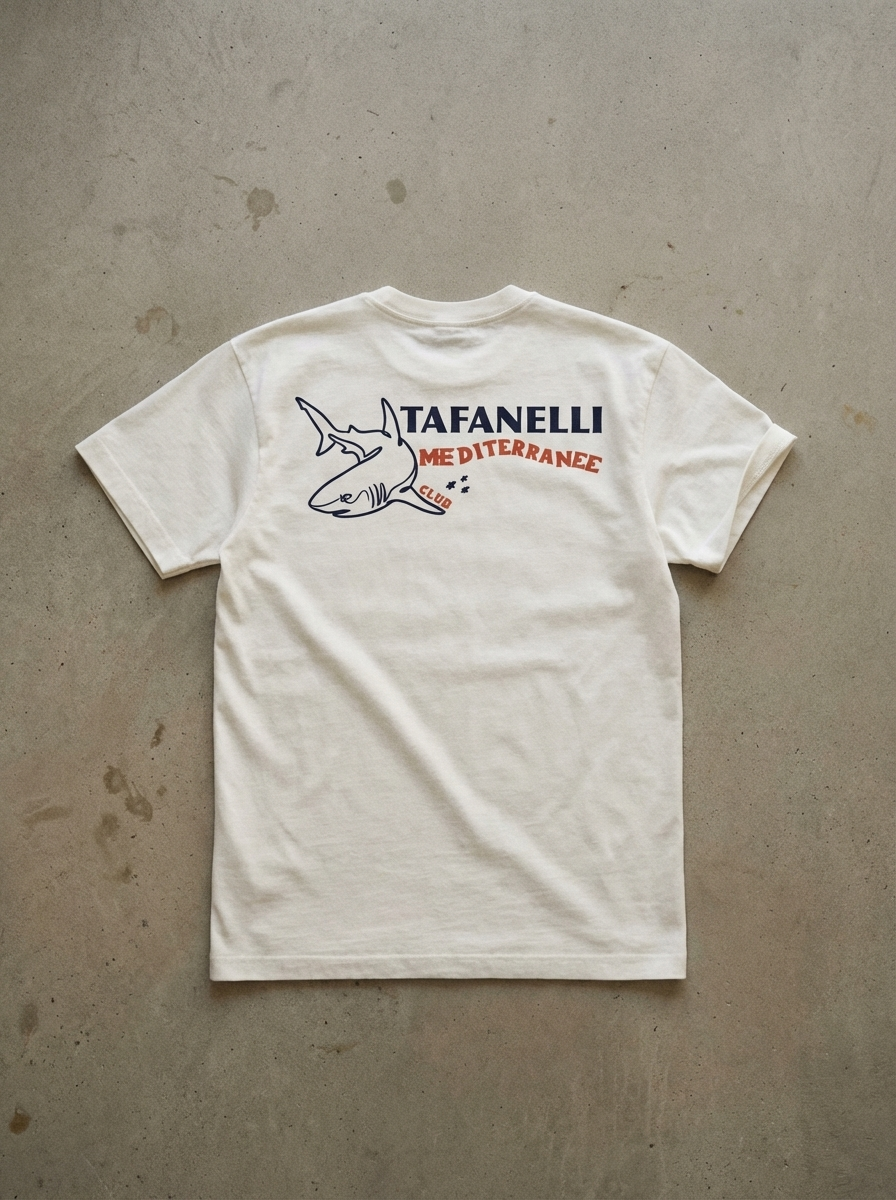
Why some t-shirts amplify sweat
Not all t-shirts react to heat in the same way. Some immediately give a feeling of stifling. The material sticks, your back gets hot, moisture stays trapped, and the garment becomes constantly noticeable. You’re no longer wearing the t-shirt; you’re enduring it.
This phenomenon often stems from a poor balance between breathability, density, and construction. When the fabric doesn’t allow enough air to circulate or retains moisture for too long, it accentuates what the body produces naturally. Sweat then becomes more visible, more uncomfortable, and sometimes even more odorous.
When you sweat a lot, the right t-shirt isn't the one you notice the most. It's the one you forget.
Blocked heat
The fabric heats up quickly and holds that heat instead of releasing it naturally.
Retained moisture
Sweat stays in the material and creates a film-like sensation on the skin.
Friction
The more the textile sticks to the body, the more present and uncomfortable it becomes.
Quick degradation
An average t-shirt wears out faster with intensive summer use.
Fabrics to avoid when you sweat a lot
There is no single perfect material for everyone, but there are definitely fabrics that make life harder. Dominant synthetic materials, poorly balanced blends, or low-quality thin cottons can quickly become poor companions in the summer.
The problem isn't just the composition listed on the label. It’s also the actual sensation on the body. Two t-shirts labeled as cotton can behave in totally different ways depending on the quality of the fiber, the tightness of the knit, the weight of the fabric, and the finishing.
| Fabric type | What often happens | Why it’s a problem |
|---|---|---|
| Dominant synthetic | The fabric heats up fast and retains odor | It can accentuate the feeling of moisture |
| Too-thin cotton | The fabric sticks and loses its shape | It doesn’t drape well on the body over a long day |
| Low-end blend | The t-shirt ages quickly | Actual breathability becomes low |
| Unstable knit | The garment loses its shape | Perceived comfort drops very quickly |
To understand why certain pieces quickly become uncomfortable, you should also connect this topic to why your t-shirt smells bad and how to avoid it. In many cases, excessive sweating and persistent odor have the same origin: a textile that manages heat and moisture poorly.
Fabrics that really work
When you sweat a lot, you need to look for a material that works with the body rather than against it. A good, well-spun cotton with real density often remains the most consistent option for daily use. It provides structure, a better feel when worn, and a more stable relationship between the skin and the garment.
It’s not a question of heaviness, but of balance. A more serious, better-constructed fabric maintains a consistent presence. It doesn’t immediately become limp, shiny, or sticky. It breathes better, ages better, and retains its actual comfort for longer.
What to look for
A breathable material, a clean knit, a crisp hand-feel, good drape on the body, and the ability to remain stable after several washes. This is often more important than a marketing promise of freshness.
Good density
The fabric remains present without becoming stifling or too fragile.
More serious fiber
The cotton maintains a better feeling of cleanliness and stability.
Regular knit
The garment drapes better and follows movement without sagging.
Long-lasting comfort
The t-shirt remains pleasant long after the first wear.
The key role of fabric weight
Fabric weight changes everything. A t-shirt that is too thin may seem pleasant in the store, but become unstable as soon as it’s worn in real conditions. It sticks faster, shows moisture more, and often loses its structure after a few washes. Conversely, a denser fabric maintains its shape better, drapes better on the body, and handles the day with more poise.
This doesn't mean you should choose the heaviest possible option. A fabric that is too thick can also become uncomfortable in the height of summer. The whole issue is one of balance. You need a t-shirt that breathes without being flimsy, holds up without suffocating, and stays neat without feeling like armor.
The right weight is not a theoretical question. It is what determines whether a t-shirt complements the heat or collapses as soon as it rises.
To expand on this point, you can also read which t-shirt to choose for longevity. It’s often the same subject viewed from another angle: a t-shirt that lasts well is often a t-shirt that behaves better from the start of summer.
Fit, volume, and air circulation
Material alone isn't enough. The fit matters enormously. A t-shirt that is too tight immediately increases areas of contact, heat, and friction. Conversely, a cut that is too loose isn't automatically the solution. It can unbalance your silhouette, hang poorly, and create a feeling of unnecessary bulk.
The right fit simply leaves air where it’s needed. It follows the body without clinging to it. It allows the fabric to live, to move, and to wick away moisture more effectively. This detail is often what turns a mundane t-shirt into a piece you can actually tolerate all day long.
What to observe
- The t-shirt should not stick to the torso from the start.
- The back should retain a little air.
- The collar should remain stable without being unnecessarily tight.
- The sleeves should follow the arm without compressing it.
Sensitive areas to watch
When you sweat a lot, certain areas immediately reveal the true quality of a t-shirt. The underarms, upper back, torso, and sometimes even the nape of the neck concentrate heat, movement, and friction. That is where comfort is decided.
Underarms
Critical zone for heat, odor, and fabric saturation.
Upper back
The fabric can quickly stick, especially when moving or with a bag.
Torso
A fit that is too close to the body quickly becomes uncomfortable.
Nape
The collar and the back of the t-shirt quickly show the limits of a weak material.
Watching how the piece reacts in these zones allows you to quickly understand if the problem is coming from the heat of the day or the t-shirt itself. It’s the same logic as in how to recognize a quality t-shirt in 5 seconds: certain details seem minimal at first, then become obvious once worn.
Mistakes almost everyone makes
When a t-shirt becomes uncomfortable in the summer, we often blame the weather, then try to fix it with washing, deodorant, or makeshift rotations. But the mistakes often come earlier: at the moment of purchase, the choice of material, or maintenance.
Choosing too light, thinking it will breathe more
An ultra-thin t-shirt seems cooler, but it can also stick much faster and lose all structure throughout the day.