What is the difference between a handmade garment and a mass-produced garment
Between handmade clothing and mass-produced clothing, the difference is not just a matter of place or technique. It lies in the rhythm, the intention, and the relationship between the hand and the material. One is born from a gesture, the other from an assembly line. At Tafanelli, we have chosen the slowness of the gesture.

Two worlds, two rhythms
Handmade clothing is born from time. Mass-produced clothing is born from flow. The former advances at the rhythm of the artisan’s breath; the latter follows the cadence of a machine. This difference in tempo creates everything else: the quality of the thread, the precision of the drape, the durability of the fabric. Where industrial production seeks regularity, handmade seeks truth.
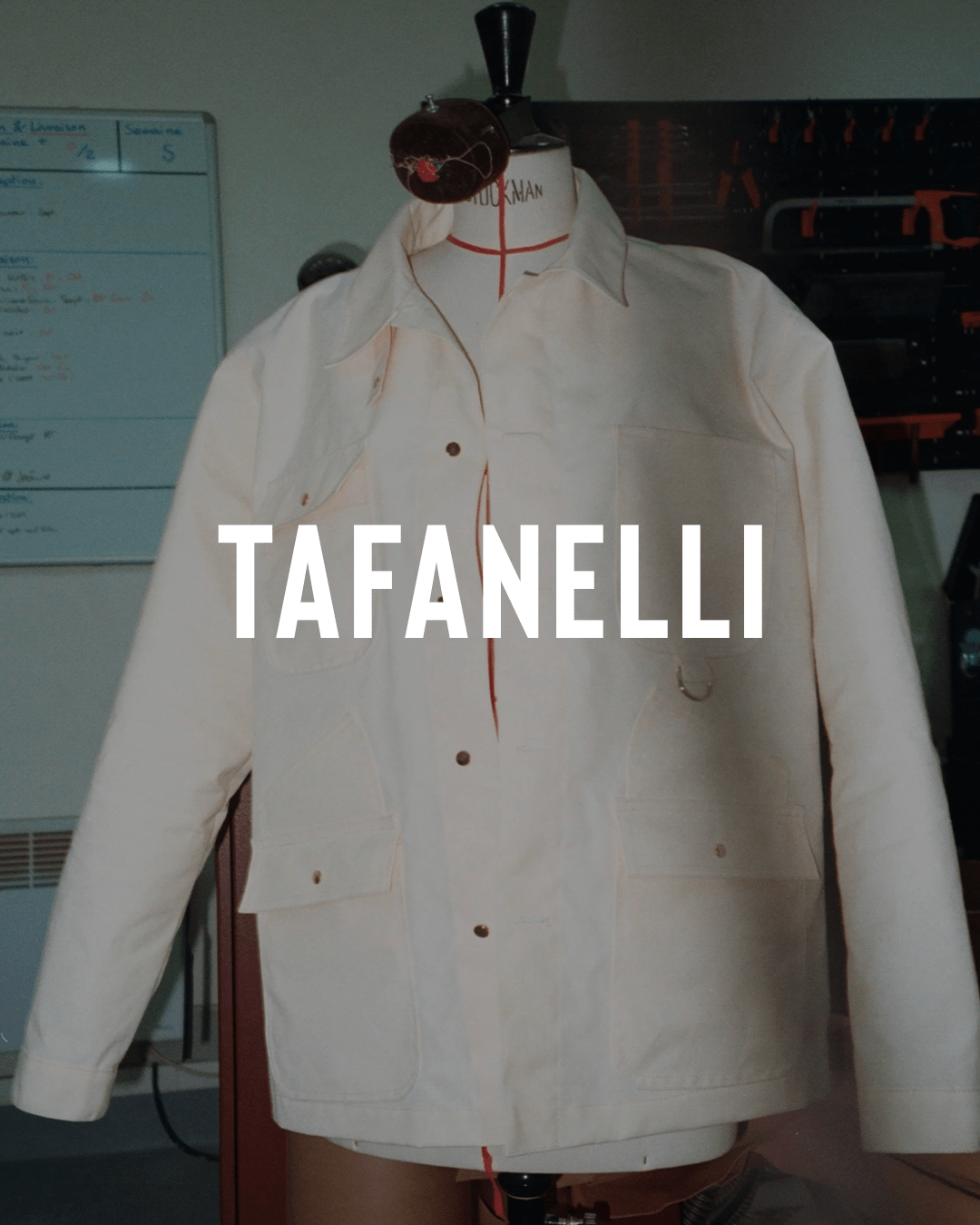
At Tafanelli, this slowness is a strength. Our pieces are designed on a small scale, in French and Corsican workshops, where each garment passes through several hands before being folded. Every gesture counts. Nothing is left to speed.
The gesture against repetition
In mass production, the machine replaces the hand. It reproduces identically, without pause, without nuance. Efficiency is total, but the relationship with the material disappears. The thread no longer speaks; it executes. In handmade work, on the contrary, the artisan listens. They adjust the thread tension, correct the cut, feel the fabric. They engage in a dialogue with the material. This is what makes the difference between a produced garment and a constructed one.
This human gesture, repeated without haste, gives the garment its uniqueness. A barely visible seam, a hem adjusted differently: details that only the hand knows how to create, and that the body senses without seeing.
The quality of time
A handmade garment requires several hours. A mass-produced garment, a few minutes. This long time is not a luxury; it is a necessity. It allows for checking every seam, hand-pressing, inspecting the shape, and adjusting one last time before shipment. Time here is not a cost, but a value. It is what gives the garment its stability, its balance, and its hold over the years.
Mass production, rapid by nature, prioritizes quantity. The garment comes out identical, but often fragile. Handmade accepts irregularity—the better to endure. What takes time always lasts longer.
The relationship with the material
An industrial garment is designed to be produced. An artisanal garment, to be worn. This nuance changes everything. The hand-selected cotton, the slowly woven twill, the cut adjusted to the fabric's density: all of this is part of a piece's construction. The artisan understands the behavior of the thread and works with it. The machine imposes it.
At Tafanelli, hand and material work together. This proximity gives the garment a soul that mass production cannot imitate.
The uniform and the unique
Industrial clothing is perfect—in the mathematical sense. Every piece is identical. Handmade clothing, however, bears the trace of the person who made it. A seam, a pressing, a fold—so many signs of life. This slight variation is not a flaw; it is a presence. What unites all Tafanelli pieces is this consistency in sincerity, not in symmetry. The attentive eye recognizes the hand, the breath, the patience.
The series reproduces. The hand transmits.
Durable clothing
A handmade garment lasts longer because it was designed to endure. Seams are reinforced, fabrics chosen for their resistance, finishes checked one by one. This individual care gives each piece its strength. The garment does not tear; it ages. It becomes softer, more authentic. Handmade builds a memory that the series cannot produce.
And that is, perhaps, the most beautiful difference: an artisanal garment travels through time without losing its meaning.
The hand as a signature
In every Tafanelli piece, there is a human trace. A knotted thread, an adjusted snap, a puff of steam from the iron. These gestures, discreet but real, make the garment an object of transmission, not consumption. Handmade is the refusal of noise and haste. It is the belief that true luxury is precision—not speed.
And when you look at a Tafanelli jacket, you understand: the hand is not always seen, but it is felt.