Corsican myrtle: a murta, the maquis plant that flavored meat before pepper
We know it by its liqueur, served at the end of a meal all over the island. But myrtle is much older than that. Before pepper arrived in the Mediterranean, it was used to season meats and sausages, so much so that it gave its name to mortadella. Here is the plant, its uses, its liqueur, and how to recognize it in the maquis.
A murta, a word that left its mark on the island
In Corsican, it is called a murta. This is not just a vocabulary detail: the word has left traces in the island's toponymy, as plants that have mattered always do.
It is the sign of a simple fact. Myrtle was not a botanical curiosity; it was a resource. People harvested it, burned it, ate it, and drank it. It was part of daily life just as much as chestnuts or olives.
It grows spontaneously in the maquis, without us having to do anything at all. Perhaps that is why we ended up forgetting about it a little: what is everywhere eventually becomes invisible.
A myrtle bush can live for three hundred years. The one you are passing by may have seen six generations born and die.
Recognizing myrtle in the maquis
Myrtus communis, of the Myrtaceae family. A Mediterranean shrub found all around the coast, reaching up to about 400 meters in altitude in Corsica.
Habit
Upright when young, it arches as it ages. Highly branched, it can reach 5 meters. And it is long-lived, reaching up to three centuries.
The leaves
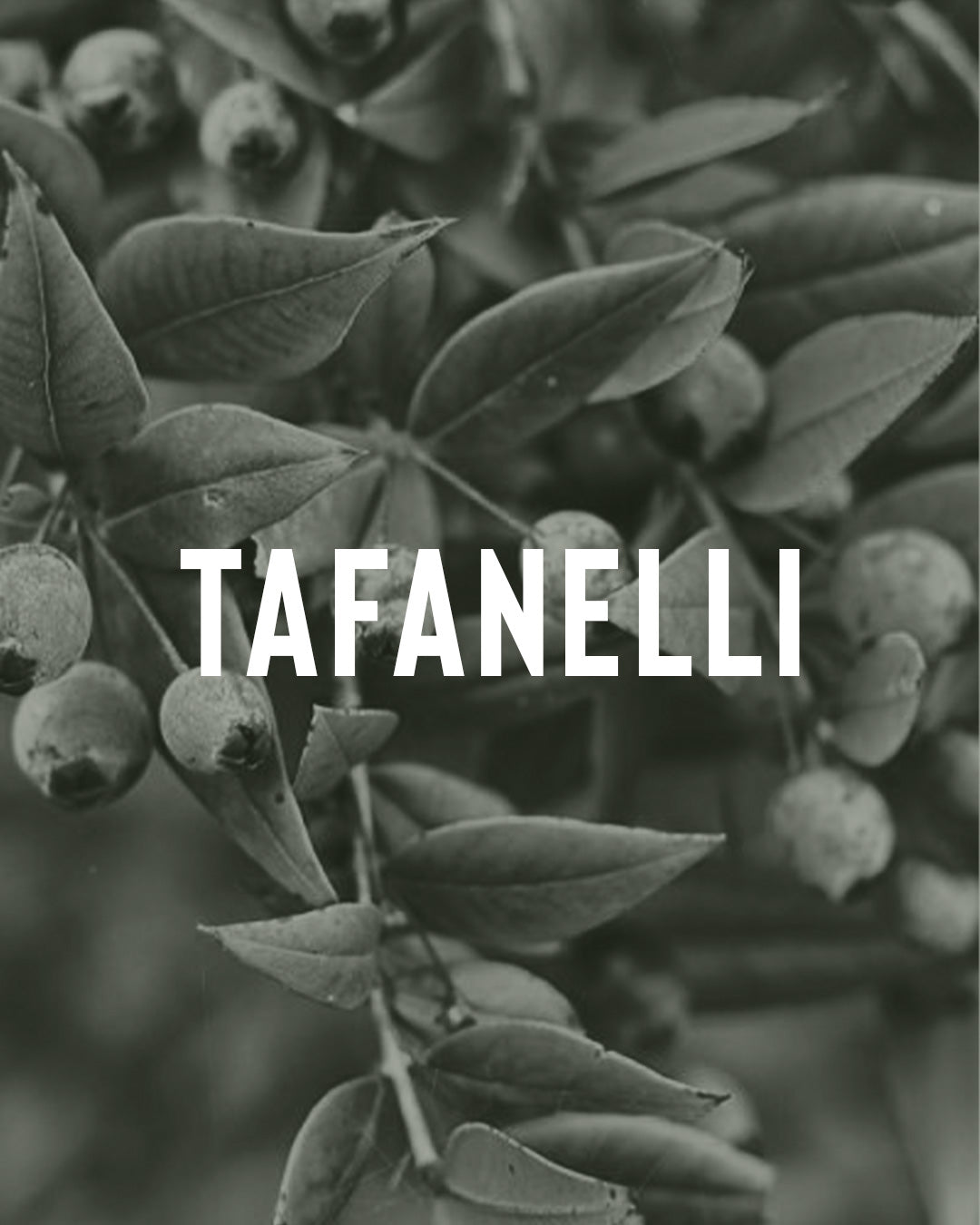
Evergreen, 2 to 5 centimeters long, opposite, oval, and a glossy dark green. This is the foolproof test: crush one between your fingers. It immediately releases a powerful scent, halfway between eucalyptus and pepper. No other plant in the maquis smells like it.
The flowers
White, solitary, with five petals and a tuft of stamens in the center. One to two centimeters in diameter, with an intoxicating fragrance you can smell before you see them. The blooming period stretches from June to October.
The berries
Oblong, 5 to 10 millimeters, deep purple, almost black. There are also white ones, which are rarer. They appear in autumn and slowly swell with juice.
Myrtle is not a blueberry
This is the most common confusion, and it deserves to be settled once and for all.
Myrtle is a Mediterranean evergreen shrub of the Myrtaceae family, like eucalyptus and cloves. Its berries are aromatic, resinous, and almost peppery. People do not eat them raw for pleasure.
Blueberries (myrtilles) are small mountain shrubs from the Ericaceae family, like heather. Their berries are sweet, juicy, and meant to be eaten by hand.
They have nothing in common—not the plant, the family, the taste, or the climate. A myrtle liqueur has never contained blueberries, and a cheese with myrtle is not a cheese with berries.
The proximity of the two words simply comes from Latin: myrtus for one, and vaccinium myrtillus for the other, which literally means "little myrtle." Botanists in the past thought they looked alike. They were mistaken, but the name stuck.
The spice from before pepper
Here is what almost no one knows, and it is the best part of the story.
Before pepper arrived in large quantities in the Mediterranean via trade routes, myrtle berries served as the spice. They are astringent, stimulating, and possess exactly the right amount of resinous heat to season meat.
They were used in particular to flavor sausages. And the most famous trace of this usage lies in a word everyone knows without suspecting its origin: mortadella. The Italian diminutive mortadella comes from there, from the myrtle that used to flavor it.
In Corsica, the tradition has never disappeared: some Corsican sausages are still flavored with myrtle today.
There is something fitting about that. An island that did not have access to exotic spices used what grew right at its doorstep, and did it so well that the word has crossed centuries and borders.
Myrtle liqueur: how it's made
Today, this is its most well-known use, both in Corsica and Sardinia. The principle is disarmingly simple, and that is precisely why every family has its own version.
The principle
An alcoholic maceration of myrtle berries, sometimes using a mixture of berries and leaves. Nothing else, besides sugar.
The alcohol
In Corsica, the preference traditionally goes to grape brandy, which is quite significant on an island that has been making wine since ancient times. It is a product that comes from nowhere else but the maquis and the vineyard.
The duration
Count on about forty days of maceration. Some do it faster, others much more slowly. This is where family recipes differ, and no one shares them.
Serving
Very cold, as a digestif, sometimes as a short aperitif. In restaurants on the island, it arrives at the end of the meal, often on the house. This is not a promotional gimmick; it is a gesture of hospitality.
Generally, there are two versions: a red one, dark and round, made from the berries, and a white one, lighter and more herbaceous, where the leaves and flowers take center stage. The red is the most common.
When and how to harvest the berries
The rule can be summed up in one sentence: you have to wait.
The berries appear in autumn, but they are not ready. They need to be fully ripe and even slightly shriveled, which concentrates the aromas and softens the astringency. The best window, therefore, is between December and January.
Tradition adds a condition that science won't settle: harvest during a waxing moon so that the flavors are in the fruit. Believe it or not, that is what those who know do.
Two common-sense tips if you decide to try it:
- Do not strip a shrub bare. Take a little from several plants. The maquis is not a supermarket.
- Verify that you are dealing with myrtle. Crush a leaf. If it does not release that characteristic scent, move on.
Myrtle in Corsican cuisine
Beyond the liqueur, myrtle has several uses that the island's cooks have never abandoned.
- In charcuterie, to flavor sausages and preparations, continuing its historical role as a spice.
- With cheese, some of which are aged while wrapped in its leaves.
- On the grill, by throwing a few branches onto the embers. The smoke flavors the meat, particularly wild boar and pork.
- As an infusion, using the leaves, for domestic and medicinal purposes.
In terms of properties, the berries are considered stomachic and astringent. The essential oil, rich in cineole and myrtenol, is antiseptic and expectorant, and is traditionally used for respiratory ailments. Myrtle even gave its name to an ancient eau de toilette, known as "angel water."
Myrtle, love, and crowns
In antiquity, myrtle was no ordinary plant. Its white flowers symbolized virginal grace, and in Rome, they were woven into crowns to adorn young girls and brides.
It was also appreciated in biblical times for its scent, to the point of sometimes being called the "Jewish myrtle."
This double life of the myrtle has something moving about it. It is both the plant of weddings and the plant of sausages. The symbol of purity and the pauper's spice. The bridal crown and the bush that scratches your legs while you walk.
That is quite Corsican, deep down: nothing is ever just decorative; everything has a purpose.
Frequently asked questions
What is the difference between myrtle and blueberries?
They have no botanical connection. Myrtle is an evergreen Mediterranean shrub with aromatic, resinous berries. Blueberries are small mountain shrubs with sweet berries. The Latin name for the blueberry means "little myrtle," hence the confusion, but they belong to two different families.
When should you harvest myrtle berries?
From December to January, when the berries are fully ripe and slightly shriveled. Harvested too early in autumn, they remain astringent and produce a harsh liqueur.
How is myrtle liqueur made?
By macerating the berries in strong alcohol—often grape brandy in Corsica—for about forty days, then adding sugar. Each family keeps its own proportions secret.
Is myrtle liqueur Corsican or Sardinian?
Both. It is a shared tradition between Corsica and Sardinia, two neighboring islands with the same maquis. The recipes and serving habits differ, but the plant is the same.
Can you eat raw myrtle berries?
Yes, they are not toxic, but they are astringent and resinous. They are used as a spice or in maceration, rarely eaten as is.
Is myrtle really the origin of the word mortadella?
That is the accepted etymology: the Italian diminutive mortadella refers to the myrtle used to flavor charcuterie before pepper arrived in the Mediterranean.
Why this subject matters to us
At TAFANELLI, we draw what makes up the memory of the island. Myrtle has a discreet place there, and that is exactly what we like about it.
It cannot be farmed. No one planted it. It grows wherever it wants, resisting drought, wind, and fire, and it waits. We come to it, never the other way around.
What moves us is what it tells us about an economy of necessity. An island cut off from the pepper routes did not give up on flavor: it looked into its own maquis for something to season its meat. And it did it so well that an Italian word still bears the trace of it a thousand years later.
There is a lesson here that we try to apply. You don't do better by looking further afield. You do better by looking seriously at what you have on hand.
Next time you walk through the maquis, stop in front of a bush with glossy foliage. Crush a leaf. What you are smelling, people were already smelling here two thousand years ago.
Also read: the Corsican maquis, Corsican charcuterie, Corsican cheeses and Corsican wines.
In passing through Corsica, the customer becomes a friend.
A DOPU, TAFA
Sources: Michel Chauvet, Encyclopedia of Food Plants, Belin, Myrtaceae chapter; botanical fact sheets for Myrtus communis; documentation on Corsican and Sardinian myrtle liqueur.