Nustrale: what this Corsican word means, and why it's worth more than a label
At a market stall, in a deli, at the counter of a village bar, one word keeps coming up in Corsica: nustrale. It doesn't really translate. It means "from our place," but it says much more than that. It is an appellation of origin that existed before official appellations of origin.
RESTOCK | SEPTEMBER 2026
The Nustrale is back this week, in a limited edition
Sold out in a few days upon release, the Le Nustrale t-shirt returns in a limited edition of 30 pieces, from SMALL to XX-LARGE. Hand-screen-printed, 280 g/m² organic cotton. Those signed up for alerts are notified first.
See The NustraleWhat nustrale means
Nustrale is a Corsican adjective. The shortest translation is: from our place.
You could also say from the land, from here, local, insular. None of these translations is entirely accurate, because none of them carries what the word actually carries when you hear it spoken.
It is not geographic information. It is a guarantee.
When a Corsican says of a ham, a cheese, or a wine that it is nustrale, they are not just saying where it comes from. They are saying that they know where it comes from, that they likely know the person who made it, and that they vouch for it.
It is not a word of provenance. It is a word of responsibility.
Where the word comes from
It comes from nostru, "our." Nustrale is literally that which is ours.
The relationship with Italian is direct: nostrale, nostrano, used throughout the peninsula to designate that which is local. It is a Mediterranean family of words, shared from Liguria to Sardinia, each time with the same idea behind it.
This linguistic detail says a lot about the island. The word that Corsica uses to designate that which belongs to it is a word it shares with its neighbors. It is very Corsican, this way of asserting one's singularity with a vocabulary common to the entire sea.
The word that changes the price
Go to a market in Bastia, Ajaccio, or Porto-Vecchio. In front of two crates of tomatoes, you will hear the same question asked a hundred times during the morning:
"Hè nustrale?"
And depending on the answer, the price is not the same, and the decision to purchase is not either.
The word applies to just about everything that is eaten and drunk:
- Fruits and vegetables from the market gardener
- Honey, olive oil, cheese
- Wine, beer, charcuterie
- And, as a special case, an entire breed of pig
It is a word of daily life, not a brochure word. No one invented it to sell things. It was used to know.
The nustrale pig, the breed that carries the name
This is the most official use of the word, and the most revealing.
The Corsican pig, present on the island for centuries, was officially recognized as a breed in 2006 under the name Nustrale pig. It belongs to the lineage of Mediterranean-stock pigs.
Its characteristics:
- A black or gray coat.
- A slow growth rate, the opposite of industrial breeds.
- A genetic capacity to produce fat, with a high marbling rate, which makes all the difference when tasting.
For the Corsican Charcuterie protected designation of origin, the rule is strict: the animals must be of the pure Nustrale pig breed, born and raised in Corsica, and the products must be prepared and processed within the designation zone.
There is an irony worth noting. The official name of the breed was chosen at the time of the application for the designation, to avoid confusion. In other words: when it came time to write into a law what "truly Corsican" meant, they reached for the word that people were already using at the market.
An appellation of origin before appellations of origin
This is the heart of the matter.
Official labels are recent. The Patrimonio AOC dates from 1968, the Corsican Clementine PGI from 2007, the Nustrale breed from 2006. Before that, for centuries, there had to be a way to distinguish what came from here from what came from elsewhere.
That way was the word. And it functioned on a mechanism that no label can replicate anymore: personal reputation.
Calling a product nustrale when it was not, in a village of three hundred inhabitants, was not an offense. It was worse: it was something people remembered.
No certification body has ever had that power.
What nustrale is not
It must be said, because the word is sometimes misunderstood from the outside.
It is not a political word
Nustrale says nothing about an opinion. It is an adjective of origin, as one might say farm-raised or artisanal. We use it for tomatoes.
It is not an exclusion
The opposite of nustrale is not "foreign," it is "from elsewhere." A product that is not nustrale is not bad, it simply comes from another place. The nuance matters.
It is not folklore
The word is alive, used every day, by everyone, including people who do not speak Corsican fluently. It is not a postcard word.
How to pronounce and use it
The pronunciation is close to Italian: noo-stra-lay, with the u pronounced "oo," and the final e slightly open.
Some useful forms:
- Hè nustrale?: is it from your place? The market question.
- U vinu hè nustrale.: the wine is from the region.
- Prudutti nustrali.: local products, in the plural.
A piece of advice, if you are not from the island: ask the question, do not assert it. Asking hè nustrale? is always well received; it is exactly what is expected of you. Declaring that something is nustrale when you have just arrived is much less so.
To go further on this language, see our article on the Corsican language.
Why we named a t-shirt Le Nustrale
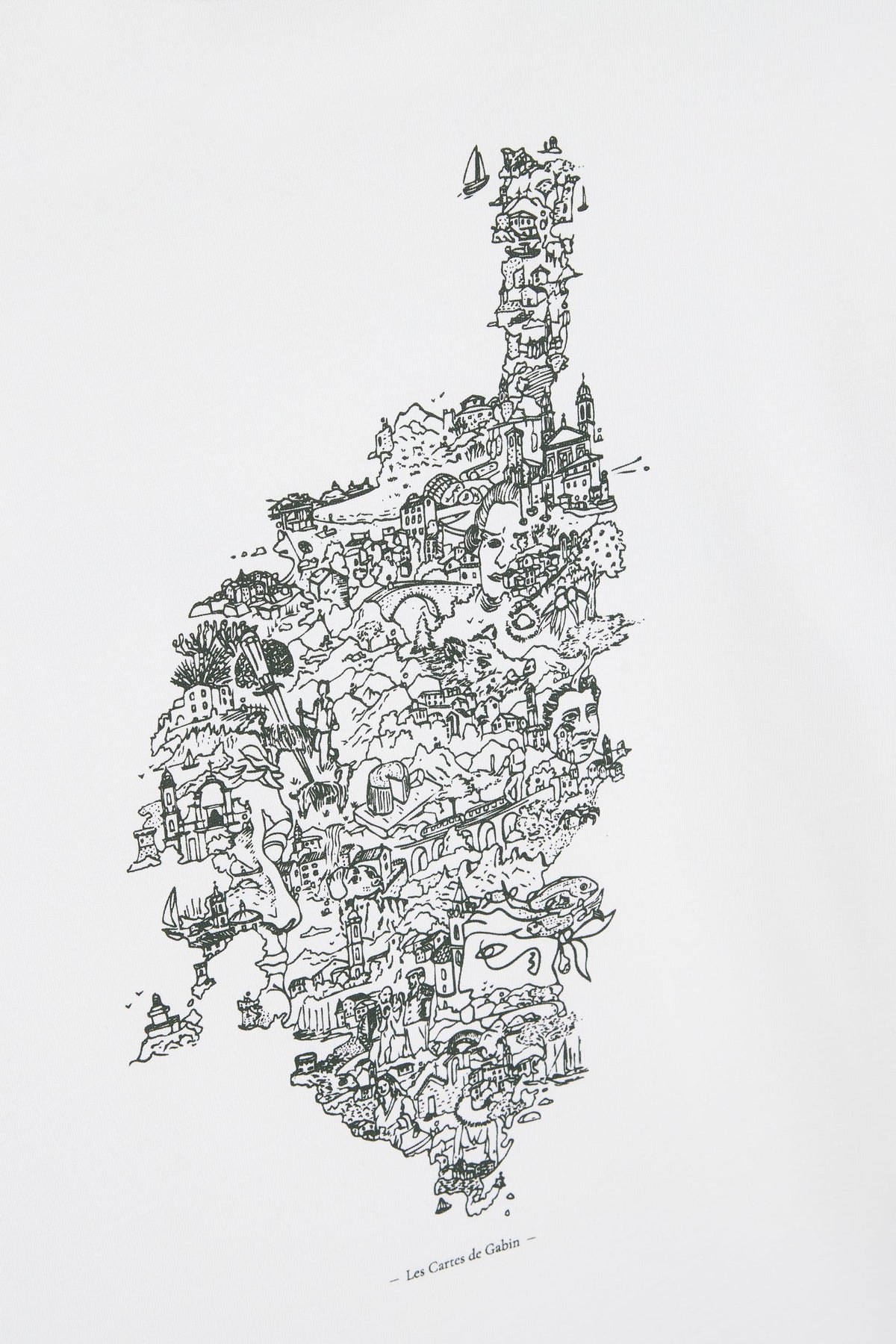
We had been looking for a long time to tell the story of the Island of Beauty through an old map. Not a map for orientation: a map where you recognize things.
We made it with Les Cartes de Gabin and Parcours la Corse. Gabin drew it by hand, village by village, tower by tower, bridge by bridge, until the entire island fit into the line. At the heart of the map, our face, the one that has signed all our pieces from the beginning.
All that remained was to find a name for it. And there was only one possible.
A map drawn by someone from here, worn by three accounts that talk about the island every day, hand-screen-printed in France on 280-gram organic cotton. If that isn't nustrale, then the word means nothing.
Discover LE NUSTRALE.
The September 2026 restock
The first series was gone in a few days. Since then, more than fifty people have signed up for the restock alert, and two have asked us for the map as a poster. We got the message.
The Nustrale is returning this week, in a limited edition of 30 pieces, from SMALL to XX-LARGE. Same blank white t-shirt, same hand screen printing at our screen printer, same drawing by Gabin. Nothing has changed, except the quantity.
Three things to know:
- Those signed up for the alert receive an email as soon as it goes online, before any announcement on Instagram.
- Thirty pieces, not one more. The LARGE was the first size to sell out the previous time. Do not count on it lasting.
- Once this series is gone, the next restock will depend on the availability of our screen printer. No date.
So that the piece lasts as long as the word, see our Care and Repair page.
Frequently asked questions
What does nustrale mean in Corsican?
From our place, from the land, local. The word comes from nostru, "our." It designates that which is produced on the island, as opposed to that which comes from elsewhere.
How do you pronounce nustrale?
Noo-stra-lay, with the u pronounced "oo," as in Italian.
What is the nustrale pig?
It is the Corsican porcine breed, officially recognized in 2006. Black or gray coat, slow growth, high marbling rate. The animals must be purebred, born and raised in Corsica, to enter into the AOP Charcuterie de Corse.
Are nustrale and nostrale the same thing?
It is the same family of words. Nostrale and nostrano are the Italian forms, used throughout the peninsula with the same meaning.
Can one use nustrale for something other than food?
Yes. The most common usage concerns food products, but the word applies to everything that comes from the island and whose origin is known.
Does the word have a political connotation?
No. It is an adjective of origin, in the same register as farm-raised or artisanal. It is used at the market for tomatoes.
Is the Le Nustrale t-shirt available again?
Yes, a limited edition of 30 pieces is being released in September 2026, from SMALL to XX-LARGE. Those signed up for the restock alert are notified first.
Why this word matters to us
At TAFANELLI, we draw what makes up the memory of the island. And nustrale is perhaps the word that best summarizes what we are trying to do.
Because it is a word that commits the person who says it. It does not describe a product; it puts someone behind it. You cannot say nustrale without someone being able to come and ask you for accountability.
This is exactly what we are looking for when we write hand-screen-printed. These are not arguments, these are verifiable things, and someone can come and verify them.
There is also this lesson that is rarely found elsewhere. When the Republic wanted to write in a law what "truly Corsican" meant, for a pig breed, it did not invent an administrative term. It went to find the word that people were already using.
That is rare enough to be noticed: for once, the law listened to the market rather than the other way around.
Read also: Corsican charcuterie, the Corsican language, Corsican cheeses, and what "Corsican brand" means.
Passing through Corsica, the customer becomes a friend.
A DOPU,
TAFA
Sources: Charcuterie de Corse AOP, Nustrale breed file; INAO; documentation on the Corsican pig breed recognized in 2006; common usage of contemporary Corsican. Updated September 9, 2026.