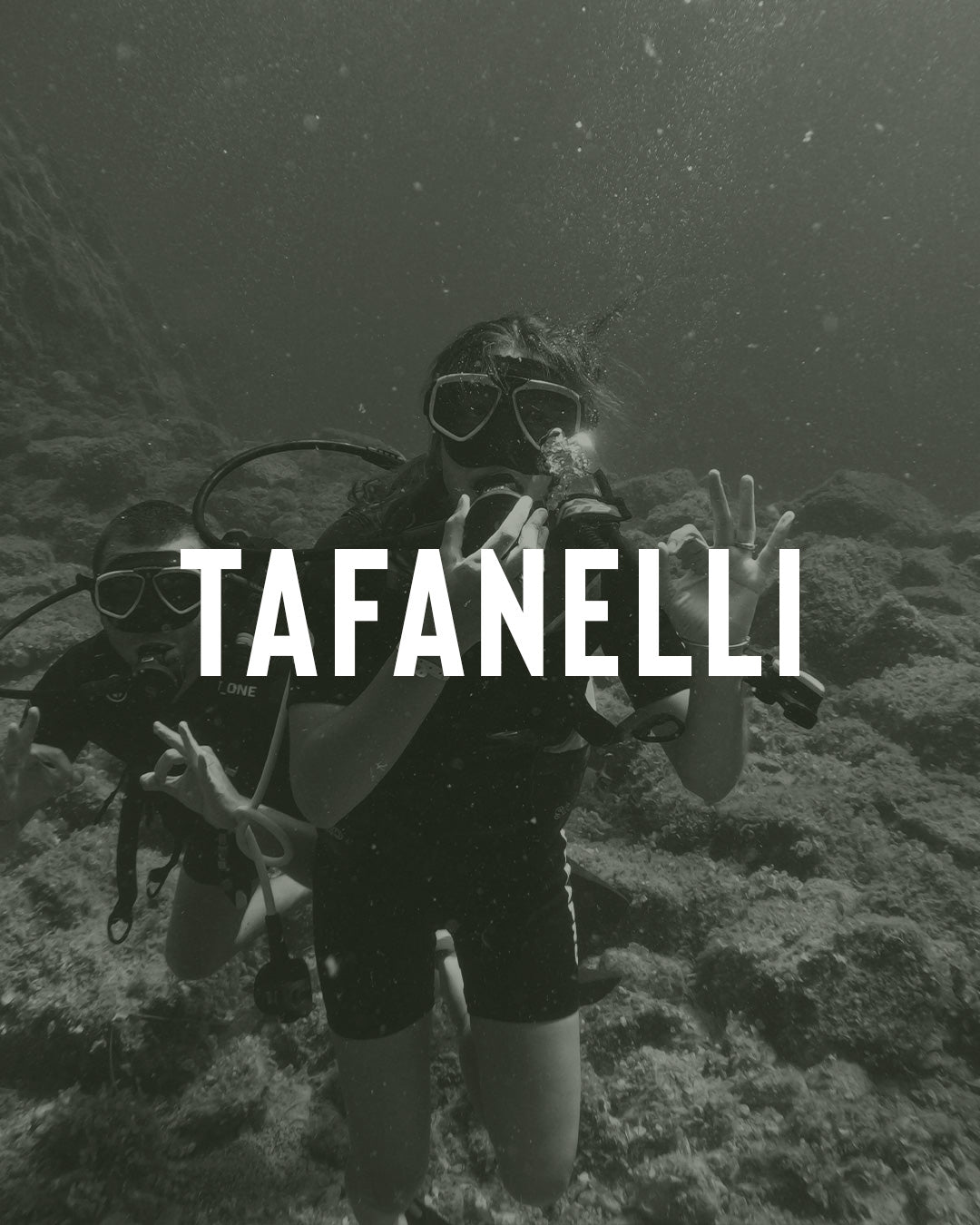
Diving in Corsica: why the island is the Mediterranean's greatest underwater paradise
We know Corsica for its beaches, mountains, and villages. But its greatest treasure is invisible from land: it begins where the water turns a deep blue. With its 1,000 kilometers of coastline, protected marine reserves, and some of the purest water in the Mediterranean, Corsica is a world-class diving destination. Here is why you absolutely must dip your head underwater — and the TAFANELLI designs born from this imagination.
Why dive in Corsica?
Because few places in the world combine so many assets over so few kilometers. Corsica offers crystal-clear water with exceptional visibility, seabeds preserved by sustainable tourism and several marine reserves, rare biodiversity that has disappeared elsewhere in the Mediterranean, and a unique variety of sites: dizzying drop-offs, caves, wrecks, rocky pinnacles, and seagrass meadows.
Here, you dive into underwater landscapes that evoke the wild beauty of the Corsican land: the red granite of Scandola continues underwater, the cliffs of Bonifacio plunge straight into the blue, and archipelagos like the satellite islands shelter sanctuaries of marine life.
In Corsica, the sea is not just scenery: it is a second land. You find the same feeling as on the paths of the maquis — the sense of an intact, untamed world that only reveals itself to those who approach it with respect.
Some of the purest water in the Mediterranean
The quality of Corsican water is a phenomenon. Far from major industrial and urban pollution, the island benefits from exceptional transparency, with visibility that often exceeds 30 to 40 meters in good conditions.
Posidonia seagrass meadows
The secret to this purity has a name: Posidonia. These underwater meadows, the true lungs of the Mediterranean, filter the water, produce oxygen, shelter hundreds of species, and stabilize the seabed. Corsica possesses some of the best-preserved seagrass meadows in the Mediterranean basin. Swimming above these undulating meadows, in green and golden light, is a unique experience.
Reserves that make the difference
The Scandola Nature Reserve, the Bouches de Bonifacio, and the Lavezzi and Cerbicale islands: all are protected areas where fishing is regulated or prohibited. The result is abundant and unafraid wildlife, as if frozen in a state before overfishing. This protection is what makes Corsica a living museum of the Mediterranean.
The most beautiful dive spots in Corsica
From north to south, the island unfolds a map of sites among the most renowned in the Mediterranean. Here are a few jewels.
La Mérouville (Lavezzi Islands)
Off the coast of Bonifacio, in the Lavezzi archipelago, La Mérouville is a legendary site: a concentration of enormous and curious dusky groupers, accustomed to the presence of divers, who even come up to interact. It is one of the most beautiful gatherings of groupers in the Mediterranean, an absolute must-see.
La Revellata and the B-17 (Calvi)
The Revellata peninsula, near Calvi, offers splendid drop-offs. And in the bay lies one of the island's most famous wrecks: a World War II B-17 "Flying Fortress" bomber, resting on the sand at a shallow depth, accessible and spectacular.
Scandola and the Gulf of Porto
Beneath the Scandola reserve, the red porphyry continues in drop-offs, caves, and arches populated by groupers, brown meagres, and spiny lobsters. An underwater backdrop that lives up to the beauty of the surface.
Capo Rosso, Cerbicale, and the southern pinnacles
- Capo Rosso (Gulf of Porto): dizzying red drop-offs and gorgonians.
- Cerbicale Islands (Porto-Vecchio): rocky pinnacles, barracudas, and dentex in a protected reserve.
- Bouches de Bonifacio: faults, caves, and limestone cliffs plunging into the blue.
- Cap Corse: wild drop-offs and sites still known only to a few, for divers in search of solitude.
Underwater fauna: groupers, red coral, barracudas
This is the great reward of diving in Corsica: encountering wildlife that has disappeared almost everywhere else in the Mediterranean.
- The dusky grouper: the emblem. Protected, it has repopulated the reserves and allows itself to be approached, imposing and peaceful.
- Red coral: the gold of the Corsican depths, clinging to overhangs and in caves, once highly coveted, now protected.
- Barracudas and dentex: silvery schools swirling over the offshore pinnacles.
- Gorgonians: purple fans that color the drop-offs.
- Spiny lobsters, brown meagres, moray eels, sea breams, damselfish: life teems in every meter.
- The sea urchin: found even in the rocky depths, a star of island gastronomy — we dedicated an entire article to it.
Meeting an old grouper in Corsican waters is like catching the gaze of a village elder: it sizes you up without fear, sure of its territory. These animals do not flee, because here, for decades, we have chosen to protect them.
Snorkeling and freediving: diving for everyone
You don't need to be a certified diver to enjoy the Corsican depths. The beauty begins one meter below the surface.
A simple mask and snorkel are enough to discover incredible underwater life in the coves and at the foot of the rocks: schools of fish, seagrass meadows, and plays of light. The island's beaches and calanques — from our wild beaches to the transparent waters of the satellite islands — are all playgrounds accessible to everyone, children included.
For those who want to go further without a tank, freediving is truly booming in Corsica, driven by the water's clarity and the beauty of the drop-offs. Descending along an underwater cliff, in silence, on a single breath: the purest experience of the sea.
Diving responsibly in a sanctuary
If Corsica is a paradise, it is because rules protect it. Every diver is its guardian.
- Touch nothing, take nothing: no coral, no shells, no animals. We look, we do not take.
- Respect the reserves: Scandola, Lavezzi, Cerbicale, and the Bouches de Bonifacio have strict rules. Follow them.
- Master your buoyancy: never rest your fins or hands on seagrass meadows or fragile bottoms.
- Choose labeled, eco-friendly dive centers.
- Keep your distance from wildlife: the curiosity of groupers should not turn into harassment.
The rule is simple, the same as in the mountains or the maquis: leave nothing behind, take nothing away but memories.
Practical advice
When to dive
- June to October: the best time, warm water (up to 24-26°C in summer) and calm sea.
- September: the ideal month, water still warm, top visibility, crowds gone.
- Spring: cooler water but very active wildlife and deserted sites.
Where to find a club
All major ports and seaside resorts have their own dive centers: Calvi, Île-Rousse, Saint-Florent, Ajaccio, Porto, Bonifacio, Porto-Vecchio. Discoveries for beginners, training, and trips for the experienced: there is something for every level, from your first breath underwater to the seasoned diver.
What level
Many iconic sites (La Mérouville, the B-17 wreck) are accessible from the very first levels. Deep drop-offs and offshore pinnacles require more experience. A well-supervised first-time dive allows anyone to experience their first encounter with a Corsican grouper.
Diving in Calvi with our friends at Plongée Castille
If we had to recommend only one address to discover the Corsican depths, it would be that of our friends: Plongée Castille, the dive center located directly on the port of Calvi, aboard the boat Le Thalassa.
It is one of the most beautiful centers in Calvi, ideally located to explore the jewels of the bay: the famous B-17 wreck, the spectacular drop-offs of the Revellata peninsula, and the sites bordering the reserve where groupers, dentex, brown meagres, and barracudas thrive in water of rare clarity.
Diving for all levels
- First-time dives and initiations: to discover the seabed in total safety, with no prior experience.
- Explorations: the most beautiful sites in the bay, including the B-17, for certified divers.
- Snorkeling: fins, mask, and snorkel, accessible to the whole family.
- French and international training: FFESSM, ANMP, and PADI, from the first level to Divemaster.
- Children's courses from age 8 and personalized private trips.
On-site: three fast rigid-inflatable boats, high-end Scubapro equipment, all gear prepared in advance, changing rooms and hot showers, and even a rooftop with a view of the port to extend the pleasure after the dive. A center affiliated with FFESSM, CMAS, PADI, and ANMP, a guarantee of professionalism and safety.
Booking at plongeecastille.com or by phone at +33 (0)6 07 89 77 63. Tell them you were sent by TAFANELLI.
Corsican friendships are formed as much on the water as on land. Plongée Castille represents the spirit we love: enthusiasts who share their sea with generosity, and who introduce everyone, from an 8-year-old kid to an experienced diver, to the hidden beauty of the Bay of Calvi.
Diving, the TAFANELLI DNA
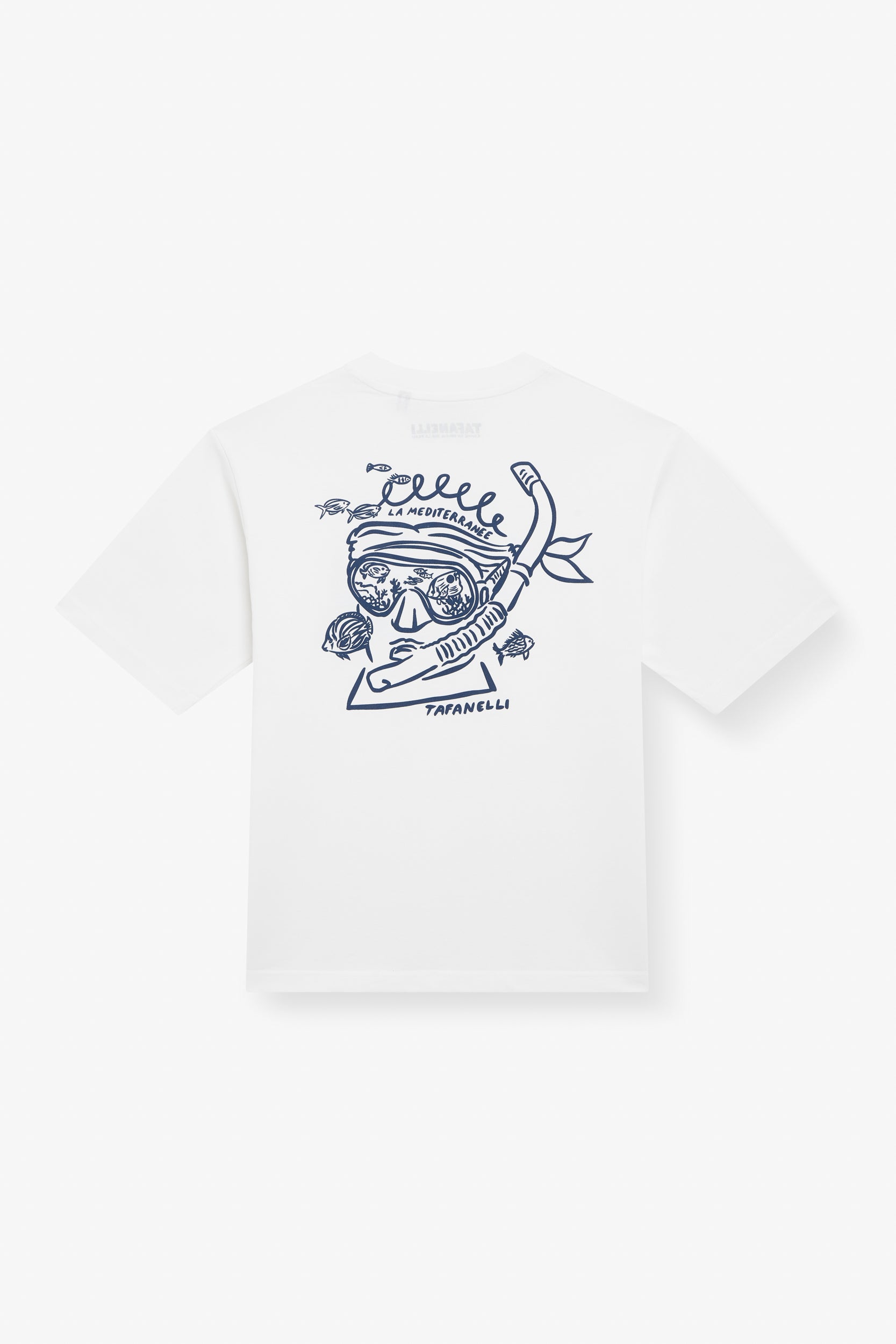
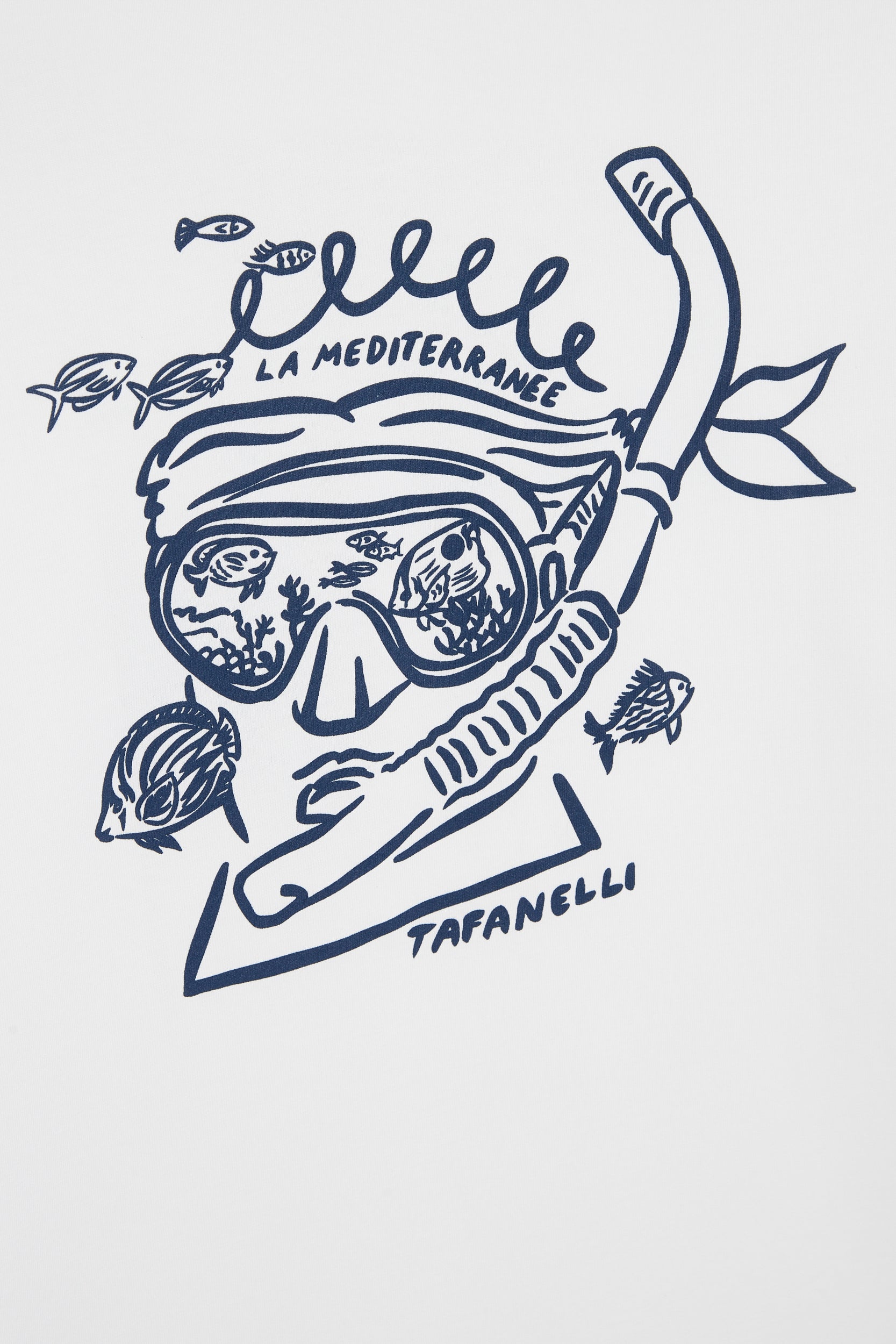
If we had to summarize TAFANELLI in one image, it might be this: a man falling backward from a boat, back to the sea, disappearing into the Corsican blue. Diving is not just another theme in our collection: it is a foundational imagination. That of a Corsica turned towards the sea, that of sea urchin fishermen, dive clubs, and children jumping off rocks.
An entire line was born from this love of the depths:
- The Le Plongeur Méditerranéen t-shirt: our icon, the man between two waters at the foot of the red cliffs. Discover its history.
- The Le Plongeur de Calvi t-shirt: a tribute to the depths of the Bay of Calvi and La Revellata.
- The La Pêche aux Oursins t-shirt: the quintessential Corsican underwater tradition.
- The Club Sirène t-shirt: the island's seaside and aquatic spirit.
- The Requin Corsica cap: the companion for trips out to sea, made for sun and salt.
To continue exploring Corsica by sea:
- Gulf of Porto, Girolata, and Scandola: the UNESCO trio
- The 10 most beautiful satellite islands of Corsica
- Sea urchins in Corsica: culture, tradition, gastronomy
- The 20 most beautiful wild beaches of Corsica
- Bonifacio, complete guide
When passing through Corsica, the customer becomes a friend.
A DOPU,
TAFA