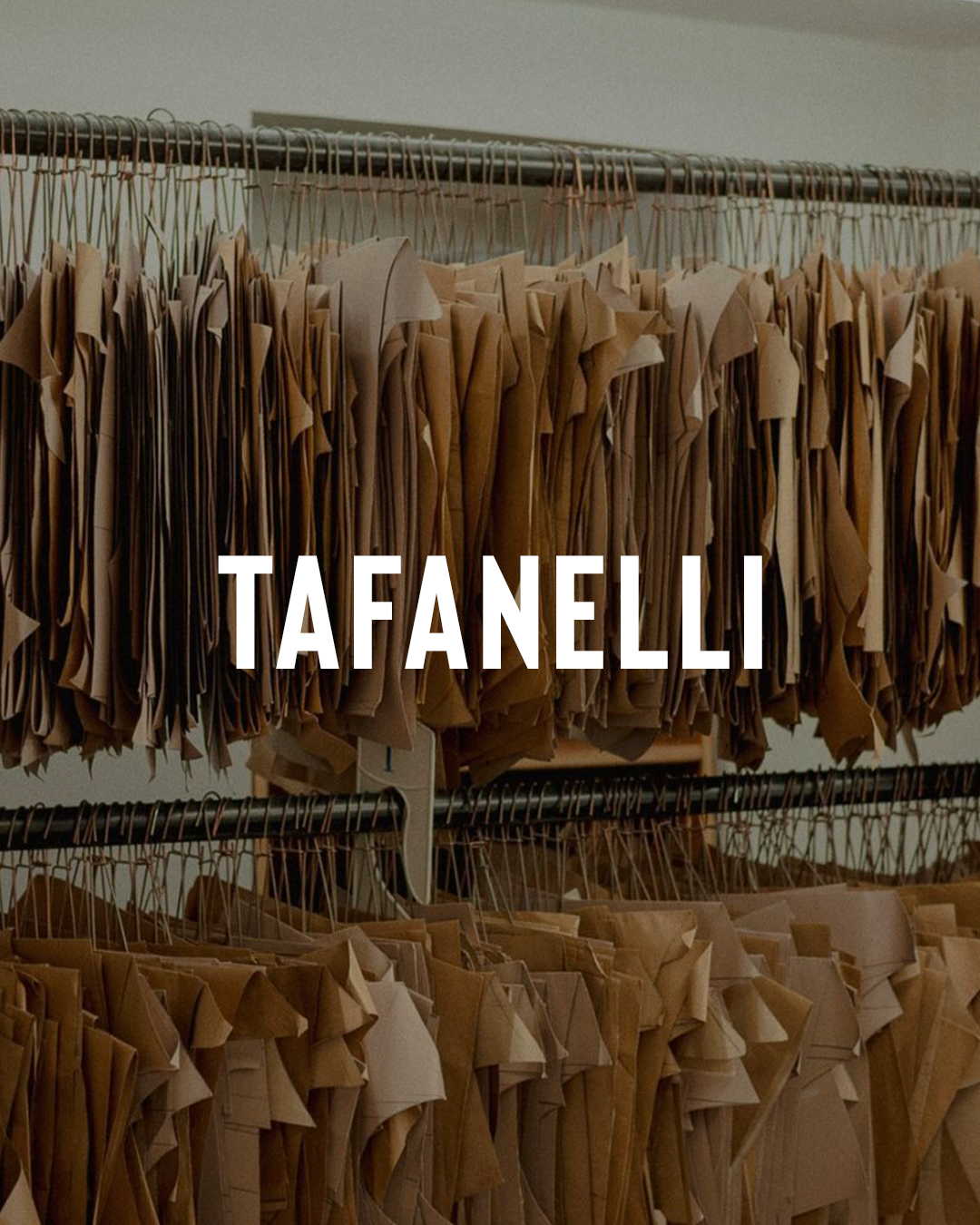
Why a garment can tell a story
Some garments do more than just clothe: they tell a story. They carry within them a gesture, a memory, an era. At Tafanelli, every piece is conceived as a fragment of history—of the region, of craftsmanship, and of the person who wears it.

A piece is not a product: it is a worn memory.
Clothing as a trace
A garment keeps everything. The hand that stitched it, the place where it was made, the light in which it was worn. It is a silent memory that does not fade. Every seam, every sign of wear tells a story: a movement, a season, a life. A garment is never truly new—it begins already with a history, that of its creation.
At Tafanelli, this trace is intentional. Our clothes are designed to age, to absorb time, and to develop a patina without losing their strength. It is not an object: it is a continuity.
The gesture at the origin
Every garment begins with a gesture. A knotted thread, a stretched fabric, a closed hem. These gestures, repeated hundreds of times, are marks of dedication. The artisan does not sign their work, but leaves their presence in it. When a garment is handmade, it becomes a witness to a craft. This gesture, passed down from generation to generation, is already a story in itself.
In our studios, the time taken for the gesture can be felt even in the touch of the fabric. In every seam, there is the patience of a trade, the rigor of a tradition, and the freedom of a contemporary perspective.
Material as memory
A fabric lives. It keeps the warmth of the body, the shape of the shoulder, the trace of the wind. The material tells everything it has been through. A twill canvas, a dense cotton, or a worn-in gabardine eventually reflect the history of those who wear them. This is why we choose natural materials capable of transforming without breaking. The garment changes, but never betrays its origin.
The material is not decorative: it is narrative.
Time as an author
What gives a garment value is not its price, but its journey. Every wash, every crease, every repair becomes a sentence in its history. Industrial clothing seeks to remain frozen; artisanal clothing accepts change. That is where it becomes alive, unique, human. At Tafanelli, we believe that the most beautiful garment is the one that ages well—because it has learned to endure.
The wearer's story
A garment also tells the story of the person who wears it. The way they fold it, wear it in, pass it on. A t-shirt that has seen the summer through, a jacket worn by the seaside, a hoodie borrowed from a friend: every piece eventually becomes an intimate narrative. This bond between the garment and the person is what interests us most. A Tafanelli garment does not seek to show off—it seeks to accompany.
One day, you might no longer remember which collection it came from, but you will remember the moment you wore it. That is its story.
Clothing as collective memory
In every studio, in every thread, there is a piece of the territory. Tafanelli garments carry the sea, the wind, and the light of the south. They tell a larger story: that of an island, a culture, a transmitted craft. Wearing a garment made here means participating in this collective narrative—that of a world that prefers loyalty to speed.
A garment can tell a story because it is made by people who still have something to say.