

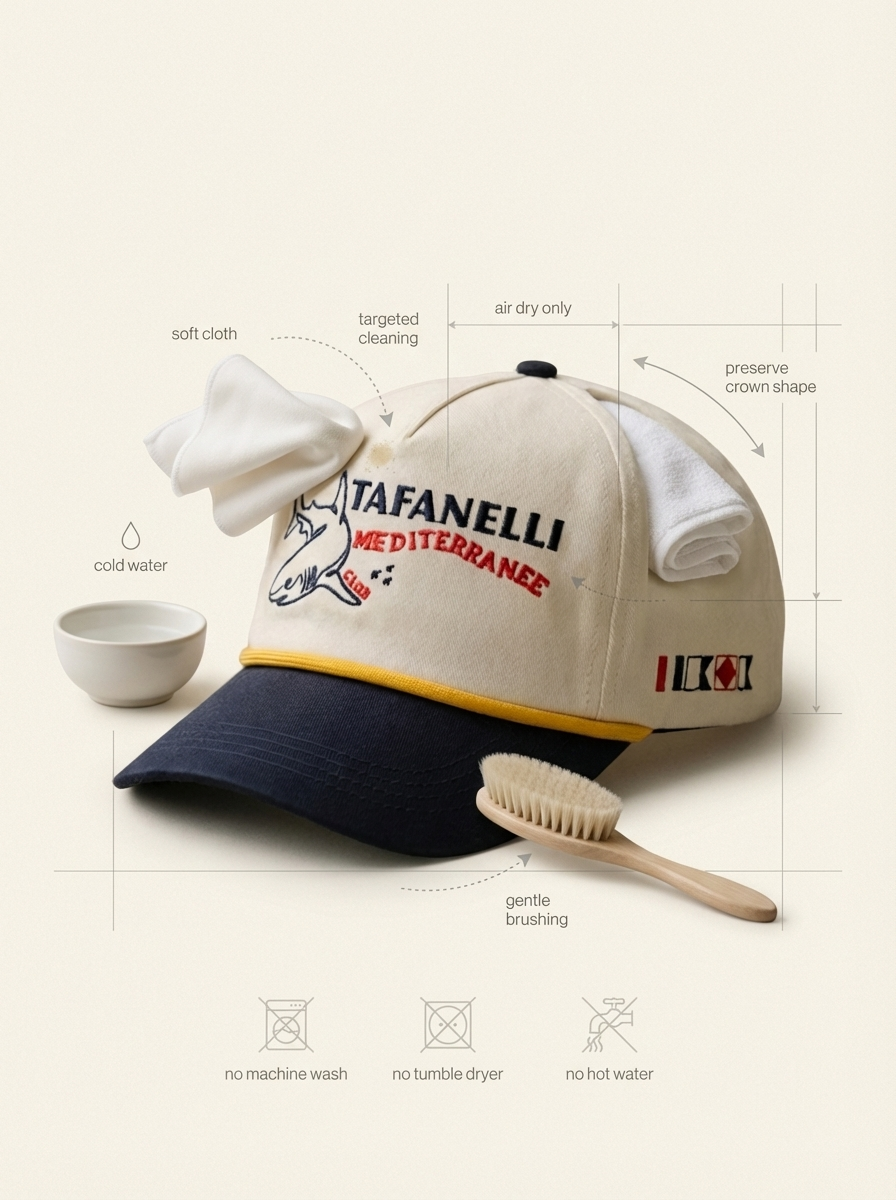
How to wash a cap without ruining it: the complete guide
A cap is not a t-shirt. It has a shape, a structure, and a reinforced visor that cannot withstand heat, twisting, or the tumble of a washing machine. A single bad wash is enough to turn a beautiful piece into a misshapen rag, and this deformation is almost always permanent. Here is the complete method, the mistakes you must never make, and what to do depending on the type of cap.
The six things you should never do
Before any method, here is the list of actions that destroy a cap. Avoiding these is enough to solve most of the problem.
- The tumble dryer. This is the most serious mistake. The circulating heat warps the crown and the visor in just minutes. No cap should ever go in there.
- Hot water. Above 30°C (86°F), cotton shrinks, colors bleed, and the visor reinforcements are compromised.
- Spin cycle. The cap is pressed against the drum and comes out oval-shaped.
- The dishwasher. You still see this advice on the internet. The heat of the cycle and the drying phase ruin the visor. Do not do it.
- The iron. It can soften the internal reinforcements and crack a screen print.
- Hanging the cap by the visor to dry. The weight of the water pulls on the structure and warps it.
The vast majority of ruined caps are not damaged by use. They are damaged by a single poorly executed wash.
Why a cap shouldn't be washed like regular clothing
A t-shirt is a piece of soft fabric. It can be twisted, wrung out, folded: it goes back to its shape. A cap does not.
It has an internal structure: a reinforcement under the visor (cardboard in older models, plastic in recent ones), a lining, a sweatband, and sometimes a forehead reinforcement. These elements, not the fabric, are what give the cap its shape. And these are the ones that suffer.
Cotton, on the other hand, is very water-resistant. The problem is therefore never the water itself, but three things: heat, mechanical twisting, and prolonged immersion. The entire method that follows consists of limiting these three factors.
The hand-washing method, step-by-step
This is the only method that completely preserves the structure. Allow twenty minutes, most of which is passive soaking.
What you need
- A basin or a sink
- Cold or lukewarm water, 30°C (86°F) maximum
- A mild detergent, or Marseille soap
- A soft-bristled brush; a clean toothbrush works fine
- A cotton towel
1. Dry brush
Remove surface dust with the dry brush. Also, remove the visor sticker if you want to keep it; it will peel off in the water.
2. Prepare the bath
Fill with lukewarm water. Add the equivalent of a teaspoon of mild detergent. Mix without creating too much foam.
3. Let it soak for 15 to 20 minutes
This is the most important step, and it is the one everyone always skips. Soaking dissolves dirt for you. Without it, you would have to scrub, and it is scrubbing that causes damage.
4. Brush the dirty areas
Take the cap out. Gently brush the inner headband and marked areas with light, circular motions. Never scrub directly on embroidery or screen printing.
5. Rinse multiple times
Empty the basin, refill with clean water, press gently, and repeat two or three times until the water remains clear. Incomplete rinsing leaves soap in the fibers, and this soap becomes a yellow stain when drying. This is the most frequent cause of stains that appear after a supposedly well-done wash.
6. Blot without twisting
Press the cap between your hands, never twisting it. Place it on a towel and pat to absorb excess water.
Then move directly to drying, as described below. Do not leave a wet cap lying flat for hours.
Machine washing, as a last resort
It is not recommended, but not forbidden for a standard cotton cap without fragile embroidery or a special visor. If you must, here is how to limit the damage.
- Cap in a wash bag, without exception
- A clean towel in the drum to cushion impacts
- Delicate cycle, 30°C maximum
- Spin cycle at 400 RPM maximum, ideally zero
- Mild liquid detergent; no powder, as it leaves residue
- No fabric softener
- Remove the cap as soon as the cycle ends; do not leave it in the drum
The mold trick. Before putting the cap in the wash bag, slip a round, rigid object inside: an upside-down mug, a plastic cylinder. It will maintain the shape during the tumbling.
Caps that should never go in the machine
- Fine or dense embroidery
- Genuine leather visor
- Caps over ten years old, whose visor reinforcement is often cardboard
- Flat cap made of wool or soft fabric
- Any piece that you value
Cleaning a stain without washing the whole thing
Nine times out of ten, the cap is not dirty: it has a stain. In this case, a full wash is unnecessary and counterproductive. Spot cleaning is sufficient and does not affect the structure.
- Perspiration on the inner band. Lukewarm water and a little white vinegar, or a baking soda paste left on for twenty minutes. Soft brush, then damp cloth.
- Grease stain. Sprinkle with talc or flour, let it absorb for an hour, then brush off. If the stain persists, dab with a cotton pad and a little diluted dish soap, working from the edge toward the center to avoid spreading it.
- Dirt and dust. Always dry brush first. Water on dry dirt creates a ring stain.
- Yellow ring. Equal parts baking soda and lemon juice paste, let sit for thirty minutes, rinse with cold water. Several applications may be necessary.
For odors rather than stains, the logic is the same as for a t-shirt: see how to remove odors without re-washing.
Drying, just as important as washing
A perfect wash can be ruined by poor drying. A wet cap sags under its own weight, and the visor loses its curve.
The right method: drying on a form
Place the still-damp cap on a round object that fits its inner shape: an upside-down mug, a salad bowl, a cylinder, a box of the right size. This is the only way to ensure the crown keeps its shape.
Leave it in the open air, in a ventilated area, in the shade. Direct sunlight fades cotton, and it does so quickly.
If you don't have a suitable object
Roll up a cotton dish towel tightly and slide it inside, adjusting the amount so the cap regains its shape.
How long?
Twelve to twenty-four hours depending on the weight of the cotton and ambient humidity. Do not wear a still-damp cap: it will take the shape of your head in the wrong places, and the odor with it.
What you must not do
- Tumble dryer
- Hairdryer, which creates heat points and therefore distortion points
- Radiator
- Direct sunlight
- Hanging by the visor
Keeping its shape, and restoring it if lost
The shape of the crown is what makes a cap look good. Impeccable fabric on a sagging crown still gives the impression of a worn-out piece.
Storage
Place the cap upright, never under a pile. A wall-mounted cap rack costs a few euros and preserves shapes for the long term.
Traveling
Stuff the crown with a t-shirt rolled into a ball before putting it in the suitcase. It won't get flattened.
Restoring a misshapen cap
Lightly dampen with a spray bottle, place on a round mold, and let dry for a full twenty-four hours in that position. The cotton will readjust to the shape. The visor can be reshaped by hand while it dries.
This works well for recent deformation. For old or severe deformation, the result will be partial.
What to do depending on the type of cap
- Solid cotton, 6-panel baseball. Hand wash, 30°C max. Low risk.
- Embroidered cap. Hand only, lukewarm water, no scrubbing on the embroidery. Risk: threads becoming distorted or dull.
- Screen-printed cap. Hand wash preferred. High-density screen printing holds up well, but never scrub it directly.
- 5-panel and trucker. Hand wash. Watch out for the back mesh of truckers, which deforms easily.
- Genuine leather visor. Never submerge. Spot clean the cotton, use a dedicated leather product.
- Vintage cap. Spot cleaning without immersion. The visor reinforcement is often cardboard and it is unforgiving.
- Soft flat cap. Hand wash, dry flat, no mold.
For pieces you truly value, dry cleaning at a professional cleaner remains an option. Expect to pay ten to twenty euros, which is modest compared to the price of a good cap.
How often to wash your cap
As little as possible. That is the honest answer, and the one no one gives.
Each wash puts stress on the structure. A cap worn daily should be washed every four to six weeks, or as soon as a ring appears on the band. In between, a dry brushing and airing out are more than enough.
After a sports session, however, do not let the perspiration dry in the fabric for several days: it ends up staining permanently.
For a cap worn occasionally, two to three washes per year are sufficient. For a collector's item, do not wash by immersion; only use spot cleaning.
It is better to clean often and lightly than to wash rarely and harshly.
What we recommend for our caps
Our caps are made of dense cotton, with embroidery and screen prints applied with care. This construction requires the same level of care during maintenance.
Our recommendation is simple and clear: hand wash only, cold or lukewarm water, mild detergent, air dry on a form. This is the method described above, and there is no other.
With these precautions, a well-constructed cap will easily last five to ten years and gain a patina that new items don't have. This is exactly what we are looking for: pieces that age instead of wearing out.
All our caps can be seen in the caps collection.
Frequently asked questions
How to wash a cap without ruining it?
By hand, in cold or lukewarm water at 30°C maximum, with mild detergent. Soak for fifteen to twenty minutes, gently brush dirty areas, rinse until water is clear, press without wringing, then air dry on a round object that maintains the shape. Never use a tumble dryer.
Can you machine wash a cap?
It is possible on a simple cotton cap, but risky. You need a wash bag, a delicate cycle at 30°C, minimal spin speed, and ideally a round object inside the crown. Embroidered, vintage, or leather-visor caps should never be machine washed.
Can you wash a cap in the dishwasher?
No. This advice circulates on the internet, but it is bad advice: the temperature of the cycle and especially the drying phase warp the visor and can melt internal reinforcements. The time saved is not worth the risk.
What temperature should you wash a cap at?
Cold or lukewarm, 30°C maximum. Beyond that, cotton shrinks, colors bleed, and the visor reinforcements work themselves loose. This is the most important rule.
How can I keep my cap from shrinking?
Shrinking comes from heat, almost exclusively. Wash in cold or lukewarm water and never put the cap in the tumble dryer: at 30°C with air drying, the cotton keeps its dimensions.
How can I restore the shape of a misshapen cap?
Lightly dampen it with a spray bottle, place it on a round object of the right size, and let it dry for twenty-four hours in that position. Reshape the visor curve by hand while it dries. This works well if the deformation is recent.
How can I remove yellow ring stains from a cap?
Apply a paste of baking soda and lemon juice in equal parts, let sit for thirty minutes, rinse with cold water, and air dry. Several applications may be necessary. Warning: these stains often come from incomplete rinsing during a previous wash, not from perspiration.
How to wash an embroidered cap?
Exclusively by hand, lukewarm water, mild detergent, and above all, no direct scrubbing on the embroidery: dab rather than brush. While drying, do not press the embroidered area against a surface. Neither machine nor tumble dryer.
How to clean a cap without getting it wet?
Dry brushing with a soft brush for dust, talcum powder or flour to absorb grease stains, or a barely damp cloth with a little Marseille soap for localized marks. For valuable pieces, professional dry cleaning remains the best option.
How long does it take for a cap to dry?
Twelve to twenty-four hours in the open air, depending on the weight of the cotton and the humidity. Do not wear it until it is perfectly dry.
How often should a cap be washed?
As little as possible. Every four to six weeks for daily wear, or as soon as a sweat ring appears. Two to three times a year for occasional use. In between, dry brushing and airing it out are sufficient. Over-washing is the number one cause of worn-out caps.
How long does a well-maintained cap last?
A quality cotton cap, washed correctly, easily lasts five to ten years with regular use. The difference depends on three things: the density of the cotton, the strength of the seams, and the consistency of the maintenance.
To go further
Caring for a cap is part of a broader attention paid to the clothes we keep. Our other guides on the subject:
- How to choose a cap
- Which cap to choose based on face shape
- Avoiding pinholes in a cotton T-shirt
- Reviving the colors of cotton clothing
- Why a T-shirt smells bad after washing
- Corsican brand: what it means
To discover our caps and all our pieces, browse the cap collection.
A well-maintained cap lasts ten years. A poorly washed cap, one season. The whole difference lies in a basin of cold water and twenty-four hours of patience.
A DOPU,
TAFA
When passing through Corsica, the customer becomes a friend.