The "Bleu de Chine": origin, manufacturing, how to recognize a genuine one and how to wear it
It is not a Chinese jacket. Nor is it denim. The "bleu de Chine" (Chinese blue) owes its name to a dye imported from Asia in the 19th century, and its cut to a century and a half of French manual labor. Here is everything you need to know: where it comes from, how to distinguish a real one from a copy, what size to choose, and how to wear it today.
What is a "bleu de Chine"
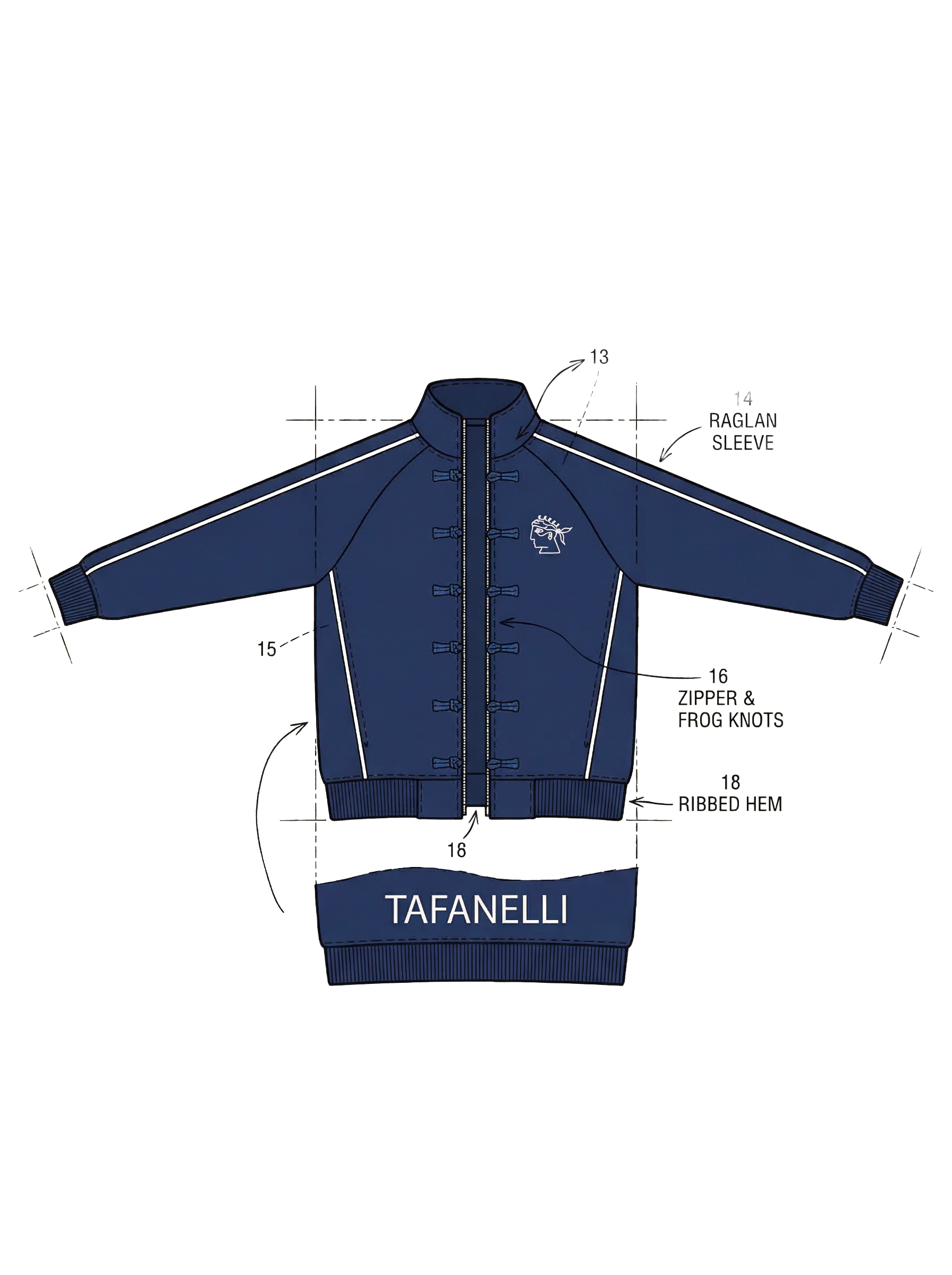
The "bleu de Chine" is an indigo-dyed cotton work jacket with a straight cut, stand-up collar, central buttoning, and patch pockets.
Three misunderstandings must be cleared up right away.
- It is not a Chinese garment. It is a French work garment, where only the name refers to Asia.
- It is not denim. The fabric construction is different, which we address below.
- It is not a Mao suit. The stand-up collar can be confusing, but its lineage comes from the workshop and the construction site, not political uniforms.
It is a professional garment, designed to be worn every day for years, washed without precaution, and passed down once it was no longer presentable enough for Sunday wear.
Origin of the name: a dye, not a country
It all starts with indigo.
In the 19th century, European shipping companies imported an indigo dye from Asia, mainly from China and India, of a superior quality to that produced in Europe. It was deeper, more stable, and more resistant to washing.
The "bleu de Chine" does not come from China. It is its color that did.
The name remained attached to the shade, then to the garment it colored, long after synthetic indigos replaced natural ones in the early 20th century.
This is the exact same mechanism as the Corsican mezzaru, a head veil that became an island emblem despite descending from Indian painted fabrics imported by Genoa. A material from elsewhere, adopted to the point that its origin is forgotten. See our article on traditional Corsican costume.
The quintessential French workwear garment
In the second half of the 19th century, the "bleu de Chine" became the work uniform of all working France. The reasons were practical.
- Robust. A tight cotton canvas that resists daily wear.
- Does not show dirt easily. Indigo masks stains better than any other shade.
- Washable without special precautions.
- Accessible. Much cheaper than wool cloth clothing.
It is found everywhere, and this geography is telling: textile workers in the North, Mediterranean sailors, Breton peasants, Angevin slate miners, Burgundian winemakers.
The same garment, from one end of the country to the other, for a century. Few pieces can say as much.
Its shape was inspired by the Chinese peasant jacket, adapted by French manufacturers to the needs of the workshop. Hence a cut that is slightly more structured than the original Asian model.
Anatomy of a "bleu de Chine"
The construction is of absolute simplicity, and that is its true strength.
- The collar. Stand-up, without lapels, set low. It is sometimes called an officer or Mao collar. It does not get in the way while working and is worn open.
- The buttoning. Central, visible buttons, often four or five. Nothing concealed.
- The pockets. Three or four patch pockets, generally including one inside. Patch, meaning sewn on top, which is stronger than welt pockets.
- The cut. Straight, ample at the armholes to allow for movement, without tapering.
- The length. It stops at the hip, never lower.
- No lining. A single layer of canvas, which allows the piece to develop a patina and remain wearable for three out of four seasons.
Nothing is decorative. Each element serves a purpose. This explains why the shape has practically not changed in 150 years.
Bleu de Chine, denim, Shanghai blue: the differences
Bleu de Chine vs. denim
Both are made of cotton, both are blue, both come from workwear. However, they are not constructed the same way.
Denim is a twill, woven diagonally, where only the warp threads are indigo-dyed while the weft remains undyed. This is what gives the lighter underside of jeans and that characteristic wear on the edges. A jacket denim is around 12 to 14 oz, making it a heavy and stiff fabric initially.
The bleu de Chine is a cotton canvas, lighter, dyed homogeneously. It is supple from day one, develops a patina without marking sharp edges, and ages by fading uniformly rather than in zones.
In short: denim breaks in, "bleu de Chine" fades.
Bleu de Chine vs. Shanghai blue
In common usage, both terms refer to the same family of indigo cotton work jackets with a stand-up collar. Shanghai blue is essentially a more recent commercial term, popularized by certain brands.
If one wants to be precise, we note that the historical French vocabulary is indeed bleu de Chine, and Shanghai blue is a synonym used in current parlance.
Bleu de Chine vs. French work jacket
The French work jacket, often in moleskin or drill, is a broader family of which the "bleu de Chine" is a variant. The difference mainly lies in the collar: folded down on most French workshop jackets, stand-up on the "bleu de Chine".
How to recognize a genuine "bleu de Chine"
Six criteria, in the order one checks them in the store.
- Composition. 100% cotton. Any presence of polyester disqualifies the piece: it will never develop a patina and will shine at the first ironing.
- Fabric weight. A serious "bleu de Chine" is between 200 and 300 g/m². Below that, it's a shirt disguised as a jacket.
- Pockets. Patch and top-stitched, never welted. This is the sign of a faithful pattern.
- Seams. Felled and double-stitched on well-made pieces, like on real workwear. A simple overlock stitch betrays mass production.
- No lining. A lined "bleu de Chine" is not a real one.
- Dye. A deep, slightly irregular indigo. A perfectly uniform and vibrant blue indicates a surface dye that will wash out by the third wash.
A final reflex: turn the piece inside out. On a well-constructed garment, the inside is almost as clean as the outside.
The four-point checklist
Keep this in mind when browsing a rack or a product page online.
| Element | Good jacket | Weak jacket |
|---|---|---|
| Material | Cotton, 200-300 g/m², dense canvas | Thin canvas, polyester blend, no structure |
| Collar | Stand-up, well-mounted, holds its shape | Floppy, irregular, collapses |
| Blue | Deep, slightly irregular indigo | Uniform, too bright, surface dye |
| Cut | Straight, ease at the armholes | Tapered or overly exaggerated "oversize" |
How to choose: size, cut, shade
Size
The "bleu de Chine" is worn ample. It was a jacket slipped over everyday clothes, not a second skin.
- Classic fit: your usual size, shoulder in place, possibility of wearing a thin sweater underneath.
- Work fit, more ample: one size up, slightly dropped shoulder.
- Never go below your actual size. A tapered "bleu de Chine" loses all its meaning.
Check the sleeve length: it should stop at the wrist, never on the hand.
Men and Women
The piece is inherently unisex and always has been. What changes is not the cut, but the balance of the silhouette. Many women wear it a size up, as an open jacket over a t-shirt or dress.
Shade
Deep indigo remains the standard. Black and off-white exist and work, but will not develop a patina the same way: it is the indigo that produces the slow wear that gives the piece its value over time.
How to wear it: three silhouettes
Today it is one of the most versatile pieces in the wardrobe, precisely because it was never designed as a fashion item.
1. The most direct
Bleu de Chine, white t-shirt, raw denim, sober shoes. The most obvious version, and often the best.
2. The Mediterranean
Bleu de Chine, off-white t-shirt or linen shirt with an open collar, sand-colored pants, canvas shoes. Brighter, more open, it gives the blue a very natural depth.
3. The densest
Bleu de Chine, fine light gray or navy knit, dark straight-leg trousers. More urban, more structured. It works provided the jacket's canvas has enough substance.
A "bleu de Chine" pairs better with a calm silhouette than a showy one. The cleaner the base, the stronger the jacket becomes.
Colors and materials to pair with
Indigo already has real intensity. It does not need to be paired with colors that compete with it.
The palette that works
White, off-white, beige, sand, khaki, raw denim, light gray. Black in limited touches. These shades let the jacket breathe and reinforce the clarity of the blue.
Materials that hold their own
- Dense cotton. A heavy t-shirt, white or off-white, with real structure. The most reliable base.
- Raw denim. Very natural, provided you avoid denim-on-denim if the shades are too close.
- Linen and off-white canvas. Probably the most balanced pairing in summer.
- Fine knit. To densify the silhouette without weighing it down.
Wearing it all year round
It acts as a bridge between seasons.
- Spring. It replaces a light jacket. White t-shirt, off-white pants or raw denim.
- Summer. It becomes the evening layer, over a light base, when the wind picks up.
- Autumn. Fine knit or heavy t-shirt underneath, canvas pants.
- Mild winter. Layered under an ample coat.
Mistakes to avoid
- Wearing it buttoned to the top. It is meant to be worn open, or buttoned halfway.
- Pairing it with overly formal trousers. It is not a blazer; it does not replace a suit jacket.
- Choosing a tailored size to "modernize" it. It is the best way to denature it.
- Accumulating too much workwear in one outfit. One reference is enough, otherwise it becomes a costume.
- Surrounding the jacket with materials that are too thin. It loses its presence by contrast.
Care and patina
This determines the lifespan of the piece.
- Wash sparingly. A "bleu de Chine" does not need to be machine-washed after every wear. Airing it out is sufficient in most cases.
- 30°C maximum, inside out. Beyond that, the indigo fades faster and the cotton shrinks.
- The first few washes separately. Indigo bleeds, especially on deeply dyed pieces.
- No tumble drying. Air dry in the shade on a wide hanger.
- No fabric softener. It clogs the fibers and prevents the patina from forming correctly.
Patina is something you seek, not something you suffer through. A garment worn for two years is more beautiful than when it was new: creases mark at the elbows, the collar lightens, the edges soften. It is the only garment at this price point that actually benefits from being worn.
Frequently Asked Questions
Why is this jacket called a "bleu de Chine"?
Because of the dye. In the 19th century, indigo imported from China and India by European shipping companies was of higher quality than the indigo produced on the continent. The name became associated with the color, and eventually the garment.
What is the difference between a "bleu de Chine" and jeans?
Denim is a twill where only the warp is dyed, resulting in a light interior and wear along the edges. The *bleu de Chine* is a uniformly dyed canvas that is more supple and fades evenly.
Are "bleu de Chine" and "bleu de Shanghai" the same thing?
In common usage, yes. Both refer to the same indigo cotton work jacket with a mandarin collar. *Bleu de Chine* is the traditional French term, while *bleu de Shanghai* is a more recent commercial name.
How do you recognize an authentic "bleu de Chine"?
One hundred percent cotton, canvas between 200 and 300 g/m², topstitched patch pockets, felled seams, no lining, and a deep, slightly irregular indigo dye.
What size should I choose?
Your usual size for a classic fit, one size up for a looser fit. Never go smaller: if it’s too tight, the piece loses its character.
Is a "bleu de Chine" a men's or women's garment?
Both. The piece has been unisex since its origin. What changes from one silhouette to another is not the cut of the jacket, but the balance of the rest of the outfit.
How should you wash a "bleu de Chine"?
As rarely as possible, at 30°C inside out, separately for the first few washes, without fabric softener and without using a tumble dryer.
Can it be worn all year round?
Yes. A light jacket in spring, an evening layer in summer, a top layer over a fine knit in autumn, and layered under a coat in winter. It is the perfect bridge between seasons.
Is the "bleu de Chine" still worn today?
More than ever. It is one of the rare pieces that stands the test of time because it was never designed as a fashion piece.
The TAFANELLI Bleu de Chine
We wanted our own version for a simple reason: most *bleus de Chine* on the market today are lightweight interpretations of a garment that was never meant to be light.
Fabrics that are too thin, piped pockets, slim cuts, added linings. The result looks like a *bleu de Chine* but lacks all of its qualities, starting with the most important one: durability.
Ours returns to the original construction. Cotton, heavy canvas, mandarin collar, topstitched patch pockets, no lining, and a dye designed to develop a patina.
It follows the same logic as the rest of our pieces: few styles, a material chosen for how it performs, and a garment that should look better in three years than the day you bought it. We explain this in detail in our guide on how to recognize an authentic Corsican brand.
Find the full collection on the Bleu de Chine page. Free shipping in France, free exchanges in mainland France and the European Union.
To learn more:
- Corsican brand: how to recognize the real thing
- Traditional Corsican costume
- Made in France T-shirt, the guide
- What fabric weight to choose for a quality garment
- Men's Corsican clothing, style guide
- Women's Corsican clothing, style guide
- See all our jackets
A DOPU,
TAFA
When passing through Corsica, the customer becomes a friend.