Why it took us four years to finalize our t-shirt
The t-shirt is the most demanding garment in a wardrobe. Nothing covers it, nothing saves it. Everything is visible: the fabric, the collar, the design. That is why it took us four years to finalize ours. Four years spent looking for the right weight, the right fit, the right collar. Four years working with rare French knitters, testing screen-printing inks, and trying and discarding prototypes. This article is the editorial manifesto of the TAFANELLI t-shirt. The precision of its manufacturing, the rarity of its production, and the reason why it costs €95.
A t-shirt is never a basic piece
It is often wrongly believed that the t-shirt is the simplest piece in the wardrobe. It is the opposite. A t-shirt is probably the most demanding piece to get right. Because it is uncompromising. Because it hides nothing. Because it can only rely on itself.
A jacket, trousers, or a shirt can tolerate approximations. The fit compensates for the fabric, the fabric for the color, the color for the assembly. A t-shirt does not. A t-shirt is worn alone. Nothing covers it, nothing saves it. Everything is visible at first glance: the knit, the drape, the collar, the design, the cut, the stitching.
It is for this reason that most t-shirts sold worldwide are poor quality. Not because they are cheap. But because they are approximate. They are designed to be worn for one season, thrown away at the end of summer, and replaced in the autumn. They are intended for volume, not for longevity. For the average, not for the exception.
Too much is the enemy of good. A great t-shirt does not seek to do more. It seeks to do less, but perfectly. Each detail is calculated to disappear in favor of presence. It is this obsession with precision that makes the difference between a piece you forget and one you keep for twenty years.
At TAFANELLI, we chose the opposite path. We wanted to make a t-shirt you keep. A t-shirt that ages well. A t-shirt that, after five years, is even more beautiful than on the first day. This requires rare material, a studied fit, a collar that holds, a design that doesn't flake, and controlled manufacturing from yarn to screen printing. It requires four years of research to find the balance. Here is how.
The fabric: 280g/m² cotton knitted in France
The first battle, when you want to make an exceptional t-shirt, is the fabric. Most t-shirts on the market are knitted from 150-gram-per-square-meter cotton. This is the standard weight for fast-fashion chains. It is light, thin, translucent in the sun, and above all, it is inexpensive.
We chose a jersey of 280 grams per square meter. Nearly double. This is the weight of 90s archive t-shirts, the kind still found in sports wardrobes or in the chests of enthusiasts. It is also the weight of t-shirts from major Japanese and American brands that have been the benchmark in the textile industry for twenty years.
What the 280g/m² changes
A 280-gram jersey does not behave like a 150-gram jersey. Here is exactly what changes:
- It falls straight without clinging. The weight of the material creates a natural drape that structures the silhouette without ever clinging to the body. A 150-gram t-shirt molds or wrinkles. A 280-gram t-shirt holds its shape and frames the body.
- It is opaque without being rigid. No transparency under spotlights, no underwear visible underneath. Yet the fabric remains soft, pleasant to the touch, and breathable.
- It gains a patina with washing instead of wearing out. A light jersey thins with every wash, loses its shape, and develops holes. A heavy jersey thickens over time, gains character, and develops a patina like raw denim.
- It can be felt in the hand. The very first second you take a TAFANELLI t-shirt in your hands, you understand. It's not just an impression: it's a material, a texture, a density. It fools no one.
Knitting on rare machines
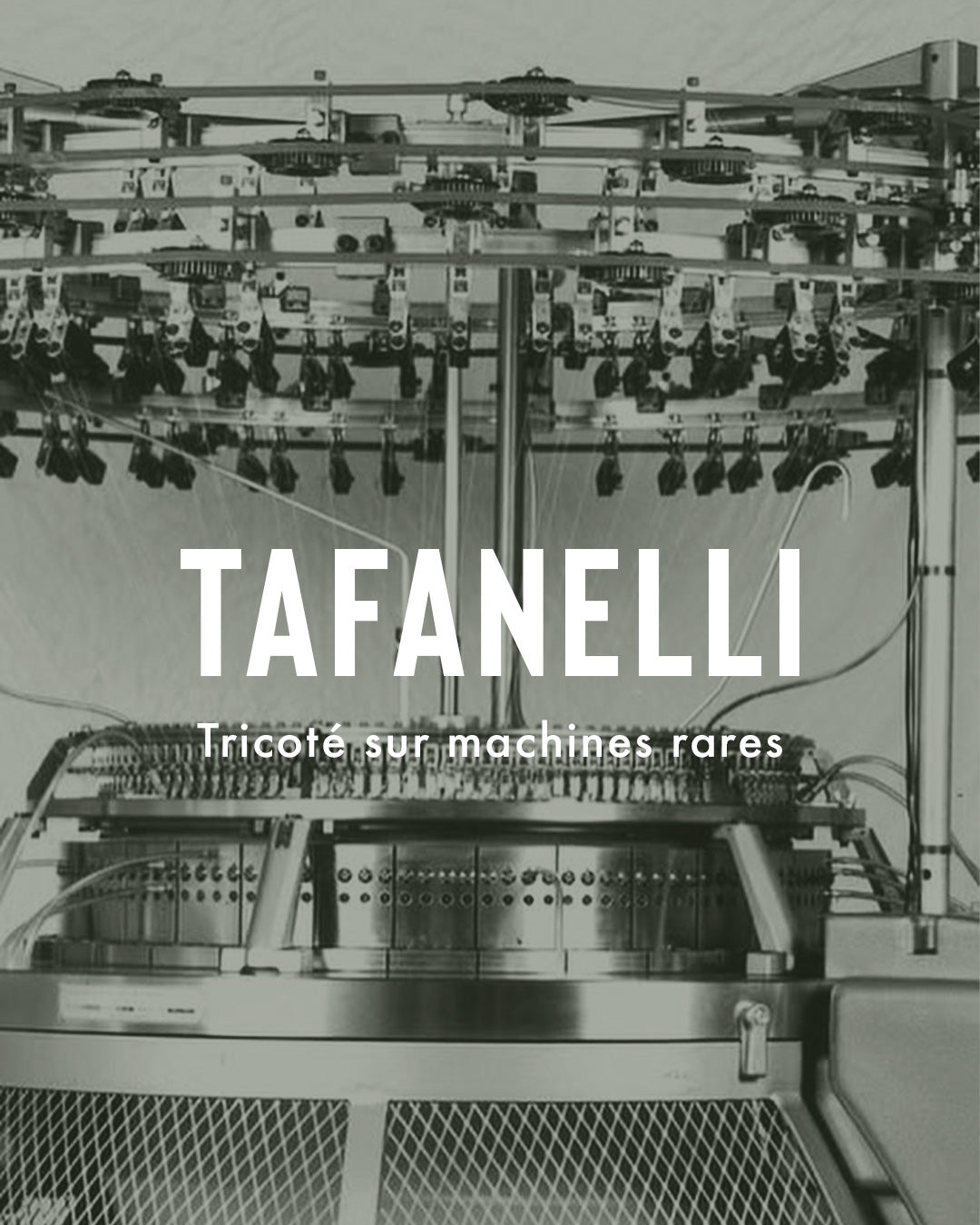
280g/m² cotton cannot be knitted on standard industrial machines. It requires low-tension machines capable of handling heavy yarns without breaking them and maintaining the elasticity of the jersey. These machines are rare in Europe. Most were dismantled in the 2000s when textile production moved to Asia.
We work with a French workshop that has preserved these machines. Each meter of jersey is knitted in-house, locally, with certified cotton yarns of known origin. It is a long-term partnership that allows us to guarantee the stability of the material season after season.
The collar: the silent death of t-shirts
Look at your old t-shirts. The ones you bought three or four years ago. Look at their collar. Nine times out of ten, they are stretched out. The fabric is limp, it hangs, it forms little waves around the neck. You don't wear them anymore. They have lost their appeal.
A t-shirt always dies by the collar. It is the most stressed part of the garment: it endures every time it is put on, every spin cycle, every stretch. It is also the part that frames the face. A stretched collar means a t-shirt that can no longer be worn in public. No matter the quality of the fabric or the design, the collar determines the lifespan of the piece.
The TAFANELLI collar
We worked for months on the collar of our t-shirts. Here is what distinguishes it:
- A specific reinforced jersey. The collar is not knitted from the same jersey as the body of the t-shirt. It is knitted from a denser ribbed jersey, calibrated to resist traction without deforming.
- An assembly sewn on a flat-seam machine. The seam connecting the collar to the body is made with a specific stitch that absorbs mechanical tension. It does not break or stretch over washes.
- A calculated width. Neither too narrow (which pinches the face), nor too wide (which gives an unintentional laid-back effect). The width of the TAFANELLI collar is the result of dozens of prototypes tested on different body types.
- Preserved original tension. Our collar keeps its shape through the first, twentieth, and hundredth wash. That is our commitment.
A t-shirt without a collar that holds up is like a shirt without buttons. You can try to wear it, but it no longer serves any purpose. The collar is the pillar of the structure. It is the first place where one must refuse all compromise.
The inside: luxury is what cannot be seen
Turn a designer t-shirt inside out. Look at the inside. Nine times out of ten, you will see a label sewn into the collar or the side seam. This label indicates the size, composition, washing instructions, and country of manufacture. It itches. Sometimes it sticks out. Some people cut it off with scissors as soon as they buy it.
At TAFANELLI, we made a radical decision: no internal labels. The size and origin are screen-printed directly onto the knit with flexible ink. Nothing itches, nothing sticks out, nothing is visible from the outside. Everything is integrated into the piece.
Why this is important
The absence of a label is not just a comfort detail. It is a philosophy. Here is why:
- Raw comfort. No synthetic fabric scratching your neck. You wear the cotton, nothing else.
- Discretion. Nothing about the brand appears in the collar. It is a piece worn for oneself, not for the eyes of others.
- The purity of the artisan's touch. The internal screen printing is a quality detail that marks a piece thought out to the very end.
- Consistency with our positioning. True luxury does not need to show itself. It is felt, it is worn, it is passed on.
Luxury is what cannot be seen. This is a phrase found among great fashion designers, Italian tailors, and Japanese artisans. It defines exactly what we strive to do at TAFANELLI: a quality that reveals itself to the person wearing it, not to the person looking at it.
The design: the artist's hand
A TAFANELLI t-shirt is never a plain white t-shirt. It always features a design. Each design is the result of a collaboration with an artist or internal graphic research. Each design tells a story: a Corsican location, a Mediterranean figure, a memory, a symbol.
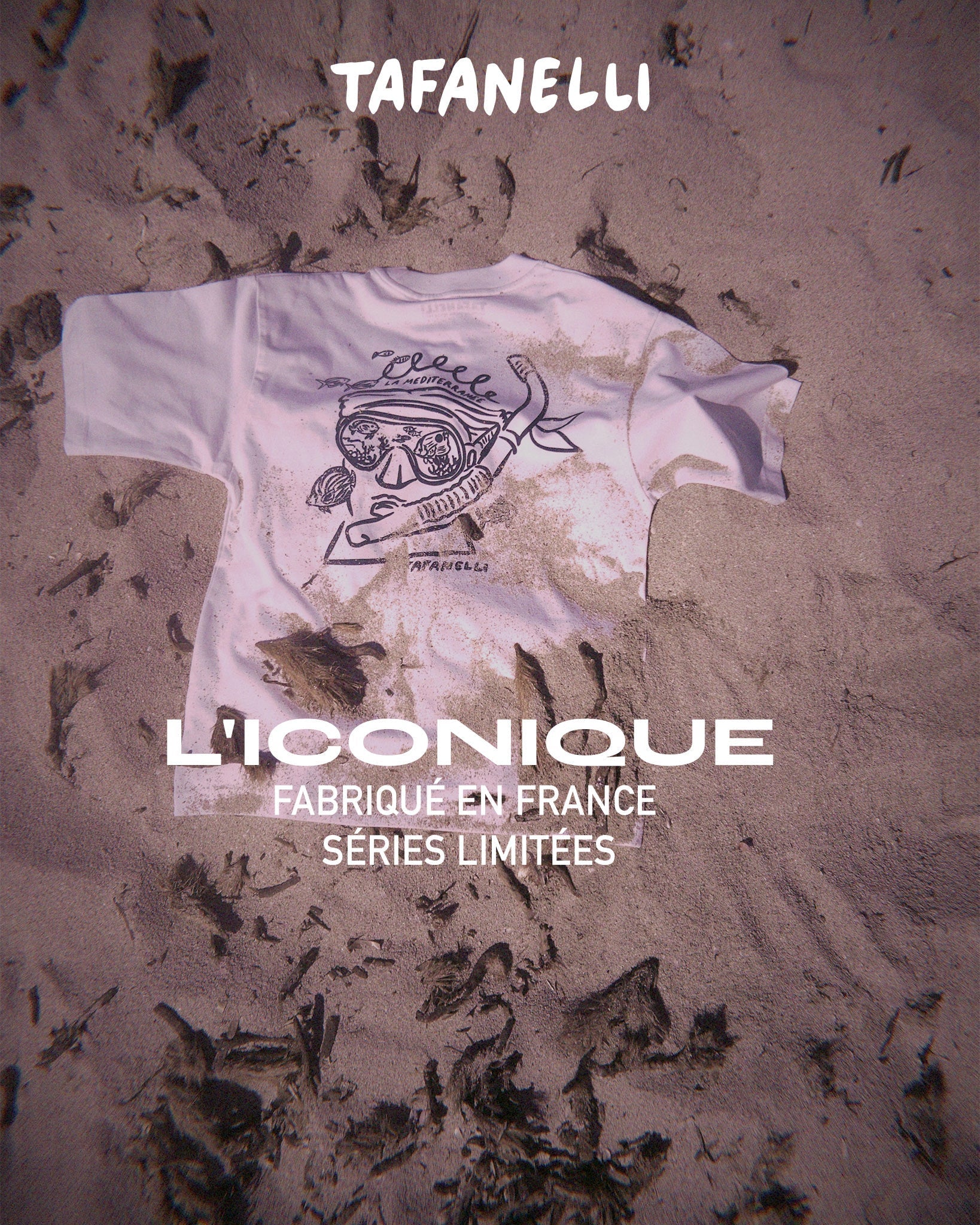
Roccapina is the granite lion of the wild south. The Mediterranean Diver is the man suspended between sky and sea. La Trinità is Corsica in three profiles. Sea Urchin Fishing is an ancestral gesture. Each design is a small work of art, worn on the knit like a tattoo on the skin.
Hand screen printing
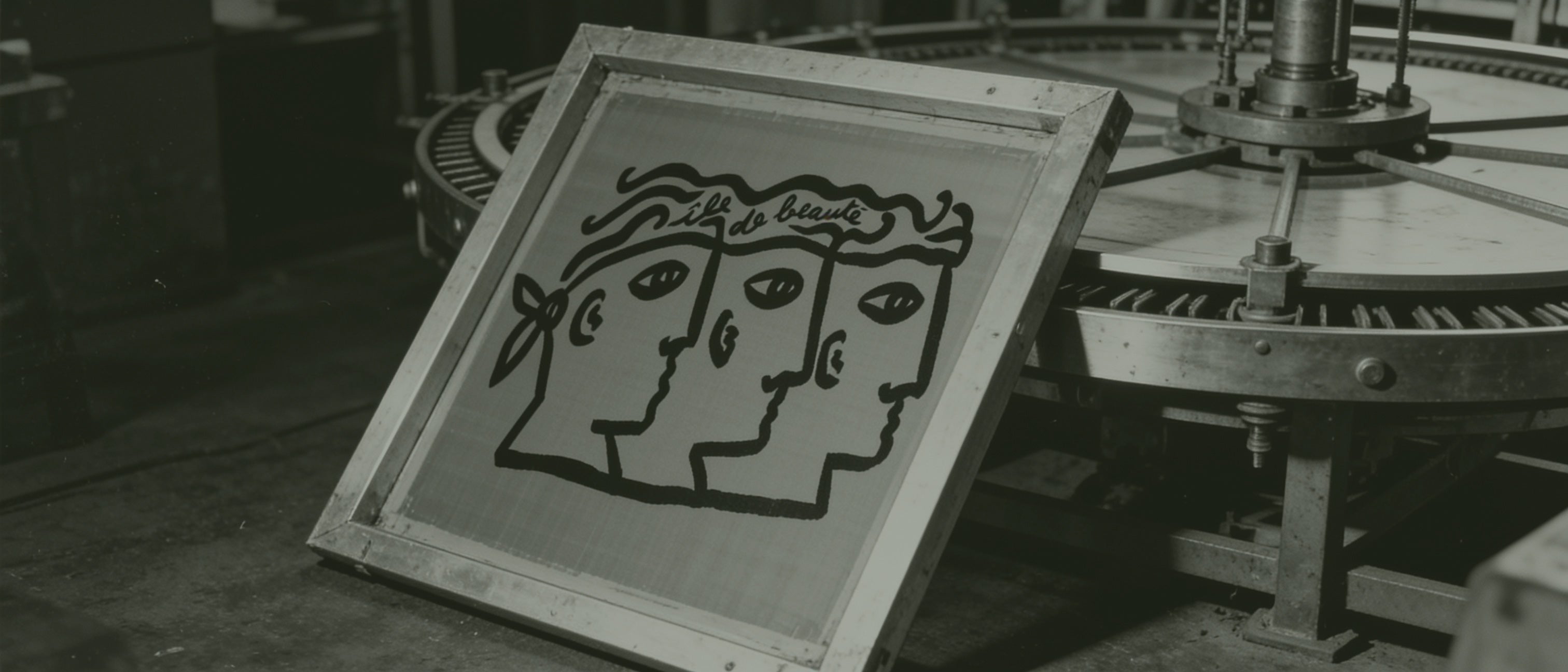
Each design is hand screen-printed, layer by layer, in our workshop in France. It is neither digital printing, nor thermal transfer, nor embroidery. It is the original technique, the most demanding, the most beautiful.
Concretely, each color in the design requires a dedicated screen-printing frame. The ink is applied with a squeegee, by hand, on each t-shirt, one by one. There is no automatic production. There is an artisan, a frame, a squeegee, and a t-shirt. The production time for a complex design can take several hours for a small run.
This technique has several direct consequences on the finished product:
- Unique color depth. Hand screen printing deposits more ink than digital printing. The design has a density, a texture, and a presence that cannot be found elsewhere.
- Durability over time. A hand screen-printed design lasts much longer through washing than a thermal transfer, which cracks in a few months.
- An accepted share of imperfection. Each piece is slightly different. Two pieces from the same run are never strictly identical. This is what makes them unique.
- A direct connection to the craft. You are wearing the result of human movement, not a machine. This changes the relationship with the garment.
Manufacturing: French from yarn to screen printing
A TAFANELLI t-shirt is entirely made in France, from yarn to finished product. This phrase is read everywhere in contemporary fashion. It is often hollow. For us, it has a precise meaning.
Knitting
The 280g/m² cotton jersey is knitted in a French textile workshop, on machines preserved since the 90s. The cotton used is certified, with known origin and traceability. No components come from Asia.
Construction
The cut, the sewing, the collar assembly, and the topstitching are done in a French workshop. Each piece is inspected by eye and touch before being sent to our screen-printing partner.
Screen printing
The design is screen-printed by hand in a partner workshop located in Corsica. Each screen is prepared for each design. Each color is deposited separately, using a squeegee, on each piece. Drying is done in the open air to preserve the softness of the knit.
Quality control
Each piece is individually checked before being packaged. We reject pieces that have significant irregularities: a skipped stitch, a design off-center by more than three millimeters, or a stain on the collar. These rejections are part of the cost price. They are what guarantee the final quality of what reaches your hands.
Manufacturing in France means refusing to outsource. It also means refusing to outsource responsibility. Every step is visible, every workshop is known, every person who touches a TAFANELLI t-shirt is identifiable. This is not marketing traceability, it is ethical responsibility.
To learn more about this subject, consult our article Why a French t-shirt costs 80 euros and not 15 euros.
The fit: neither slim nor oversize, just right
Fashion has long swung between two extremes. The 2010s were about slim fits. Tight t-shirts, glued shoulders, almost non-existent drape. The 2020s are the opposite: oversize. XXL t-shirts, dropped shoulders down to the elbows, length past the hands. Two caricatures, two trends that age quickly.
At TAFANELLI, we have chosen the just right middle ground. Neither slim nor oversize. A classic straight cut, with precise adjustments so that it is both wearable and elegant:
- A slightly dropped shoulder. Not enough to be oversize, just enough to be comfortable and give ease to the arm.
- A straight width. The t-shirt does not tighten at the waist, nor does it flare out. It falls straight.
- A studied length. The t-shirt ends just at the hips. Long enough to be worn alone over jeans, short enough to be tucked into elegant trousers without bunching.
- A mid-short sleeve. The sleeve stops at the middle of the bicep. Neither too short (which infantilizes), nor too long (which overwhelms the arm).
A "just right" fit is timeless. Slim and oversize will look dated in ten years. Our classic straight cut will still be wearable in twenty years. That is true modernity: not being trendy, being out of time.
The short run: 100 pieces that will not return
Every design, every color, and every size of TAFANELLI t-shirt is produced in a short run of a maximum of 100 pieces. This is a deliberately low figure. It is a defining decision of the brand.
Why 100 pieces?
Three main reasons explain our choice of the short run:
- Scarcity creates value. A piece that 5,000 people wear loses its meaning. A piece that 100 people wear becomes a signature. Our customers do not want to cross paths wearing the same thing.
- Local production is incompatible with large volumes. Our French workshops are not mass-production factories. They have limited capacity. We respect this pace.
- Small runs allow for precision. In a batch of 100 pieces, every single item is inspected. In a batch of 10,000, individual inspection is abandoned. The former enables quality; the latter rarely demands it.
Never repeating a design
Once a run of 100 pieces is sold out, it is never reissued identically. We might revisit a design in a different color, a different material, or for a different season. But we never reprint the same series. Each edition is dated, anchored in a season, and worn by the customers who were there at the right moment.
This transforms the relationship with the garment. A TAFANELLI t-shirt is not a permanent product that can be purchased indefinitely. It is a dated object, a piece of a season, a souvenir of the year it was bought. This is what makes it a garment to be kept, not replaced.
The small run is not a marketing gimmick to create false scarcity. It is a deliberate constraint: we make very little, we make it well, and we prefer to miss out on certain orders rather than betray our quality standards.
Price: Why €95 and not €15
The price of a TAFANELLI t-shirt is 95 euros. This is not an arbitrary price. Nor is it a marketing price. It is the result of a precise industrial calculation applied to small-run French production.
Breaking down the price
For a 95-euro t-shirt, here is how the price is distributed:
- Certified cotton: about 8 euros per piece (vs 1 to 2 euros for standard imported Asian cotton).
- Knitting on French machines: about 12 euros per piece.
- Assembly in French workshops: about 15 euros per piece (vs 2 to 3 euros for Asian assembly).
- Hand screen printing: about 8 euros per piece (higher for multi-color designs).
- Quality control and packaging: about 3 euros per piece.
- Overhead and product development costs: about 15 euros per piece (research, prototypes, salaries, rent).
- Logistics and distribution: about 8 euros per piece.
- Margin and cash flow: about 26 euros per piece.
Total: about 95 euros. This is the fair price for a product made entirely in France in short runs, using heavy-weight material, manual screen printing, and individual quality control.
Market comparison
A fast-fashion t-shirt costs between 8 and 20 euros. It is manufactured in Asia in workshops with unknown working conditions, using cotton of uncertain origin, with low grammage and a lifespan of 6 to 18 months at most.
A t-shirt from a major French or Italian luxury brand costs between 200 and 500 euros. It is sometimes made in France or Italy, often in subcontracting workshops not owned by the brand. It carries the burden of multi-level distribution margins (flagship stores, marketing, global networks).
A 95-euro TAFANELLI t-shirt sits between these two worlds. The quality and territorial grounding of luxury, without the distribution overhead. The value for money of direct French craftsmanship.
To learn more, read our dedicated article: Why a French t-shirt costs 80 euros and not 15 euros.
Patina: What distinguishes a great t-shirt from a banal one
There is a concept found in the worlds of denim, leather, or mechanical watchmaking. It is the concept of patina. An object with patina is an object that has lived, that has been used, and that carries the traces of that life with elegance.
Patina cannot be decreed; it must be earned. It is the result of time passing over a well-made object. Raw denim jeans patina differently on every person who wears them. The Vachetta leather of a Louis Vuitton bag develops a different patina for every user. A mechanical watch develops a unique character after years on the wrist.
The patinated t-shirt
A quality t-shirt, like ours, develops a patina over time. Here is how:
- The cotton softens without thinning. After about thirty washes, the 280g/m² cotton gains softness without losing its weight. The t-shirt becomes more comfortable and conforms better to the body, while remaining opaque and structured.
- The colors live. A deep black becomes a slightly vintage anthracite. A bright white becomes a warm off-white. Navy takes on bluish highlights. No garish fading, just new depth.
- The screen print integrates. After a few months, the screen printing ink is permanently set into the weave. The design becomes an integral part of the fabric, rather than just a printed motif.
- The fit personalizes. A well-made t-shirt takes the measure of the person wearing it. It doesn't lose its shape, but it molds slightly to the wearer’s habits and movements.
A great t-shirt is a t-shirt you keep for twenty years. It evolves with you. It becomes a piece of your personal history. That is why you pay the price once, and never twice. A 15-euro t-shirt that you replace every six months costs you 600 euros over ten years. A 95-euro t-shirt that you keep for ten years costs you less than 10 euros a year.
The TAFANELLI wardrobe today
Our current wardrobe of t-shirts is built around several models, each with its own design, its own story, and its own short run. Here are the main ones.
The Roccapina
The granite lion of the wild Corsican south, watching over turquoise waters for eight million years. One of the brand's founding designs. Discover it in our dedicated article.
The Mediterranean Diver
The man suspended between sky and sea, a tribute to the freediving culture of Cap Corse. Our marine piece par excellence. Details in our article.
La Trinità
New 2026 capsule. Three profiles, one horizon. The Corsican landscape trinity: Mare (Sea), Muntagna (Mountain), Machja (Maquis). Our most recent identity piece.
Corsica 1755
A tribute to Pasquale Paoli and the Corsican Constitution of 1755. Our piece with a strong historical anchor.
Sea Urchin Harvesting
An ancestral gesture, a Corsican maritime tradition, a moment on the sea. Our most talked-about piece on Instagram.
The Sportmer
The result of the TAFANELLI x Sportmer collaboration in Saint-Tropez. The meeting between Corsica and the Var, in a piece charged with Mediterranean spirit.
Each piece adheres to the same specifications: 280g/m² cotton Made in France, reinforced collar, no labels, hand screen printing, small runs of 100 pieces, tailored straight fit. This is our signature, our commitment, our standard.
The essentials, chosen by those who know
A TAFANELLI t-shirt is not for everyone. It is not for those looking for novelty every season. It is not for those who replace their wardrobe every year. It is not for those looking for low prices, nor for those who want to wear a logo visible from a distance.
A TAFANELLI t-shirt is made for those who know. Those who know that heavy-weight material is worth more than light-weight material in the long run. Those who prefer a discreet, meaningful design to an aggressive logo. Those who love wearing pieces produced in France, in respectful workshops, with a direct link between the artisan and the wearer. Those who prefer timelessness to fashion.
It’s not a t-shirt for everyone. It’s a t-shirt for someone. Perhaps you.
The essentials, chosen by those who know. This sentence closes every TAFANELLI product description. It summarizes our philosophy: we are not looking for mass, we are looking for correctness. We are not looking for recognition, we are looking for the recognition of the few.
Continue the discovery
To further reflect on TAFANELLI’s manufacturing, materials, and philosophy:
- Why a French t-shirt costs 80 euros and not 15 euros
- Anatomy of a Corsican t-shirt: codes of the TAFANELLI wardrobe
- The symbolism of TAFANELLI designs
- TAFANELLI white or navy t-shirt: which to choose
- How to wash and care for a TAFANELLI piece
- The 5 codes of authentic Corsican fashion
Or discover our current wardrobe directly:
Passing through Corsica, the customer becomes a friend.
A DOPU,
TAFA