Corsican clothing: the complete 2026 guide to the brands, codes, and pieces that define island elegance
For most French people, the term "Corsican clothing" remains associated with two clichés: the souvenir t-shirt sold at the beach and the polo shirt embroidered with a Moor's Head bought at the airport. Yet, these two items say nothing about what, in fifteen years, real contemporary Corsican clothing has become. A distinct sartorial grammar has been established on the island, rooted in its heritage, shaped by its climatic codes, and driven by a new generation of demanding Corsican clothing brands. Here is the complete guide to understanding what Corsican clothing is today, how to recognize an authentic Corsican brand, which pieces make up this wardrobe, and how to integrate it into your own without falling into touristy caricature.
What is Corsican clothing today
A Corsican garment is not a garment made in Corsica. This first clarification is essential, as it has long muddied the conversation. Corsica, like most Mediterranean regions, has never possessed a heavy textile industry. Its sheep, goats, and flax once produced fabrics for local use, but commercial-scale manufacturing has never been a pillar of the island's economy.
A Corsican garment, in the contemporary sense of the term, is a garment inspired by Corsica, carrying its codes, references, colors, and figures, and designed by a brand whose identity claims this anchoring. Manufacturing may take place in mainland France, Italy, or sometimes in Asia for more accessible pieces, but the soul and the story are from the island.
This semantic shift is important. It frees Corsican clothing from folkloric nostalgia and allows it to exist as a modern sartorial proposition, capable of engaging with the contemporary codes of premium Mediterranean ready-to-wear, just as Jacquemus speaks for Provence, Slowear for Northern Italy, and Aimé Leon Dore for New York.
Today, saying "Corsican clothing" means designating a structured, legible, and recognizable sartorial universe that fits into the broader grammar of Mediterranean fashion while defending its uniqueness.
Corsican brand or costume: the three questions to filter them
In any boutique on the island, from Bastia to Bonifacio, three questions are enough to distinguish a true Corsican clothing brand from a label slapped on an imported product. Three questions that nobody ever asks, and which change everything.
Who designs it?
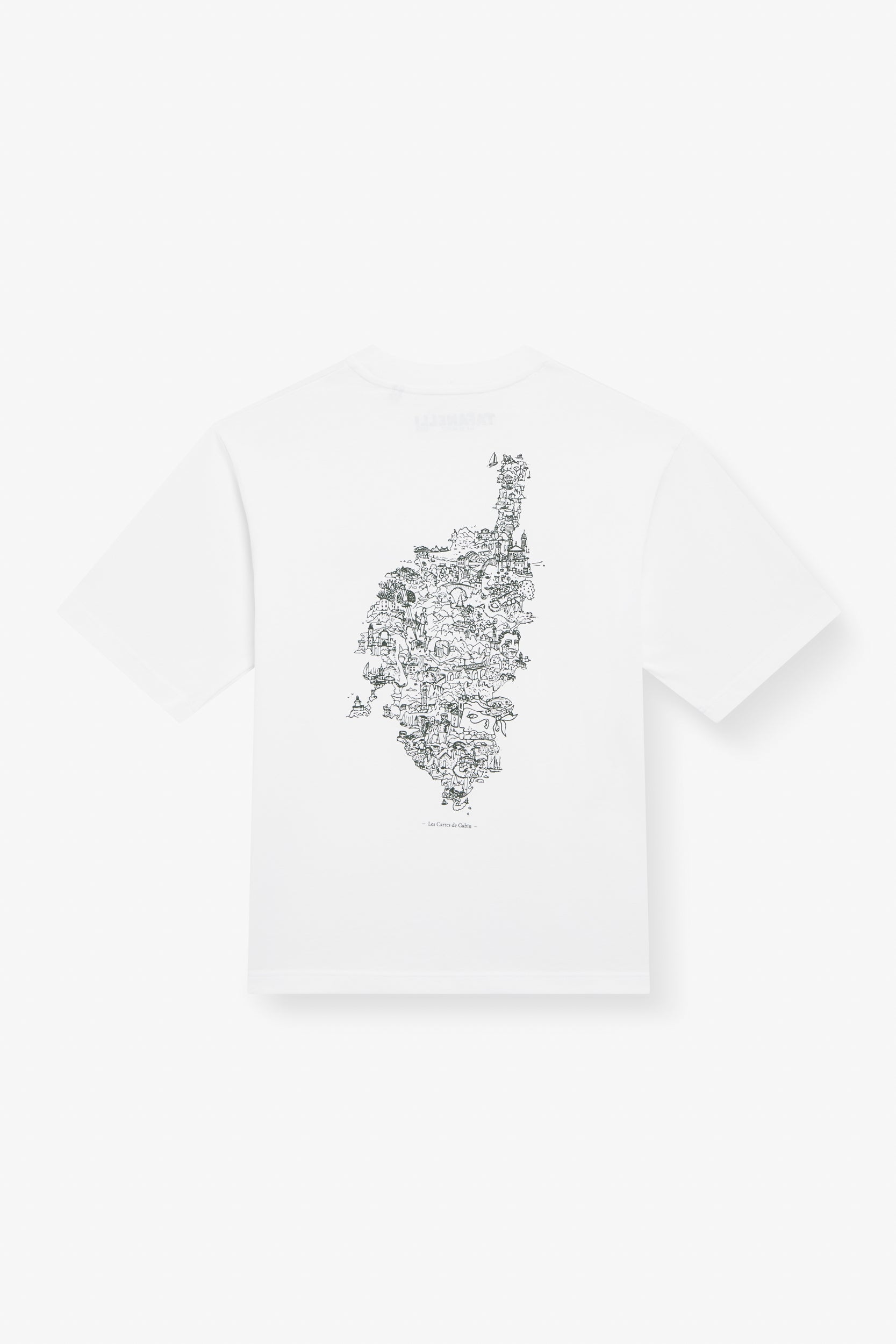
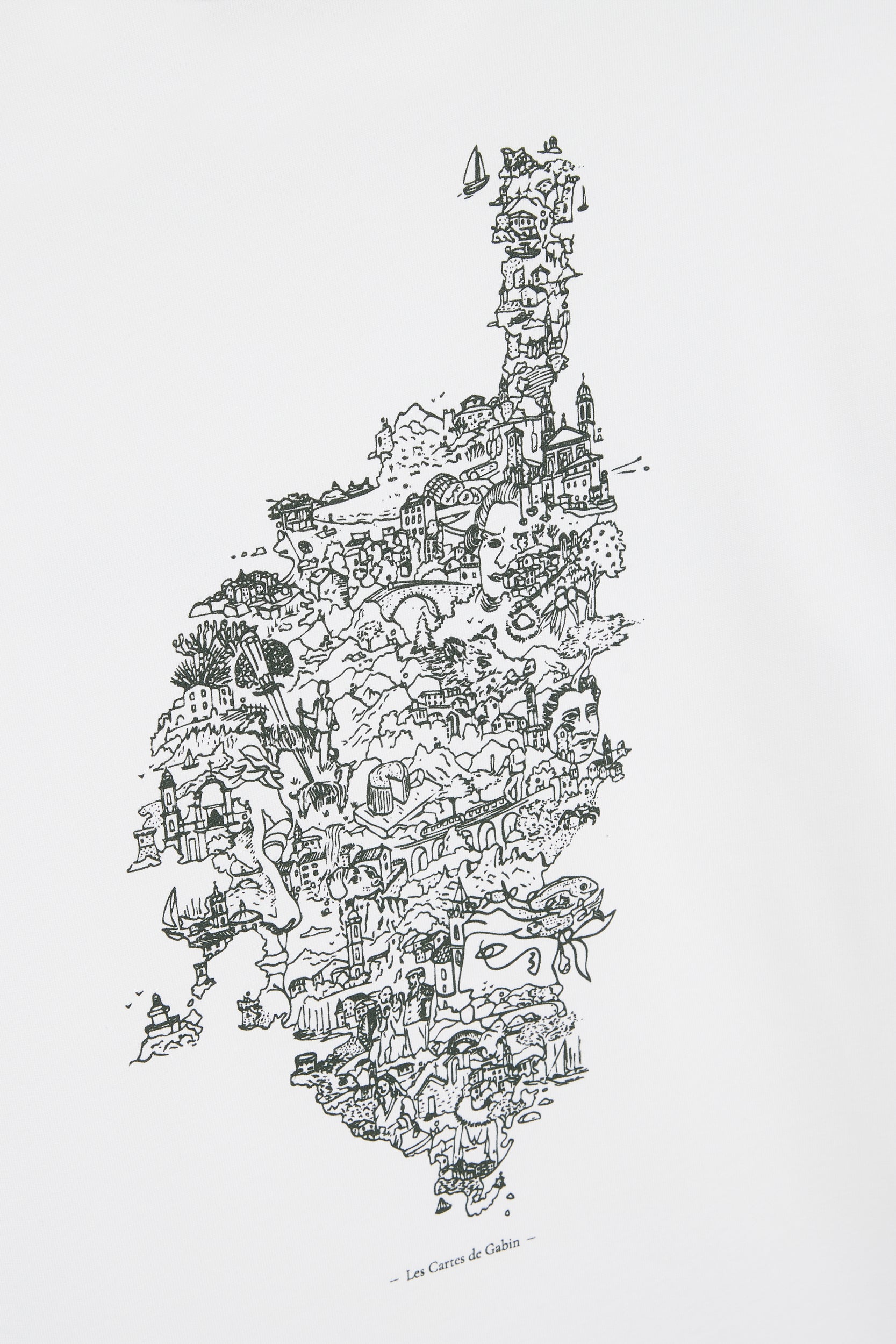
A Corsican brand worthy of the name creates its own visuals. An original drawing, signed and traced by an identifiable hand, tells a story of a place or the island: a port, a beach, a face, a mountain. A generic motif bought from a stock image bank commits no one, and you will find the exact same one on the racks of ten different shops. Turn the t-shirt over; look for the signature. If there is no author, there is no work.
Where is it made?
Look at the label, or the lack thereof. French or European manufacturing comes at a price, and you feel it immediately: the weight of the cotton, the structure of the collar, the quality of the print. A twenty-euro t-shirt on the port was not knitted in France; that is a mathematical certainty. Serious brands display their place of manufacture with pride. Others write it in small print, or not at all.
In what quantity?
Sincere brands produce in small series. This is the opposite of the mass-souvenir logic: fewer pieces, more care, and the certainty of not bumping into your t-shirt on every street corner in Porto-Vecchio in August. Limited edition is not a marketing gimmick; it is a direct consequence of artisanal manufacturing: when every visual is hand-screenprinted, you don't produce ten thousand pieces.
Who designs it, where is it made, in what quantity. Three questions, thirty seconds, and you will know if you are holding a Corsican garment or a costume of one. The island deserves for you to ask them.
A brief history of clothing in Corsica
To understand contemporary Corsican clothing, one must know the three major eras that have shaped the island's sartorial imagination.
The traditional era (until the end of the 19th century)
Island clothing then served strictly utilitarian functions. The shepherd wore the pelone, that loose coat made of raw wool that protected against the cold of the mountains. Village women wore the fazzulettu, a black scarf tied on their heads, and dark dresses made of locally woven wool or linen. Coastal fishermen used oiled jackets to resist the spray and bandanas to absorb sweat from their work at sea.
The palette was dominated by black, brown, ecru, and a deep indigo blue obtained through natural dyeing, which was already called "China blue" in reference to imported pigments. The cuts were loose, robust, and designed to last several seasons without wear.
The tourist era (1960-2000)
With the rise of summer tourism starting in the 1960s, Corsican clothing shifted into a disconnected commercial logic. This was the appearance of the souvenir t-shirt, the Moor's Head polo, the printed cap, and the beach bandana. These products, sold by the seaside and in airport shops, had no real connection to the island's sartorial identity. They satisfied a demand for souvenirs, not a fashion grammar.
It is this era that contributed to degrading the image of "Corsican clothing" in the French collective mind. For forty years, the term evoked average quality, garish prints, and pseudo-folklore. A massive symbolic depreciation, from which recovery required time.
The contemporary era (since 2010)
Starting in the 2010s, a new generation of Corsican designers, often trained in Paris, Milan, or Antwerp, returned to the island with the ambition of reinventing Corsican clothing by restoring its nobility. They draw inspiration from traditional codes (natural materials, earthy palette, loose cuts) but rephrase them in the language of contemporary ready-to-wear. They integrate heritage references (historical figures, places, symbols) without falling into folklore.
This new wave, which consolidated between 2015 and 2025, has completely transformed the perception of Corsican clothing. Today, talking about Corsican fashion no longer brings to mind the airport souvenir. It evokes a qualitative, grounded sartorial proposition capable of holding its own against the best Mediterranean brands.
The seven aesthetic codes of contemporary Corsican clothing
Modern Corsican clothing is defined by seven precise aesthetic codes which, together, compose its unique grammar. Any garment claiming to be Corsican should respect the majority of them.
1. Natural materials
Heavy cotton, raw linen, virgin wool, patinated leather, oiled canvas. Corsican clothing refuses synthetic materials. This requirement is not an aesthetic whim: it corresponds to the island's climatic reality, where summer heat necessitates breathable fibers, and where the ruggedness of the maquis demands resistant fabrics.
2. Earthy palette
Ecru, off-white, deep navy blue, faded khaki, ochre, terracotta, matte black, stone gray. This palette intentionally contrasts with the bright and saturated colors of classic sportswear or streetwear. It draws from the hues of the island landscape: the lime of the walls, the red earth of the Cap, the deep sea of the coves, and the dry maquis in mid-summer.
3. Loose cuts
Boxy fit for t-shirts. Straight, slightly loose shirts. Fluid trousers. Off-shoulder dresses. The Corsican cut rejects the tight, skin-clinging, and slim fit. It prefers flexibility, air between the skin and the fabric, and the fluidity that allows for movement, walking, or a nap under the pine trees.
4. Discrete heritage references
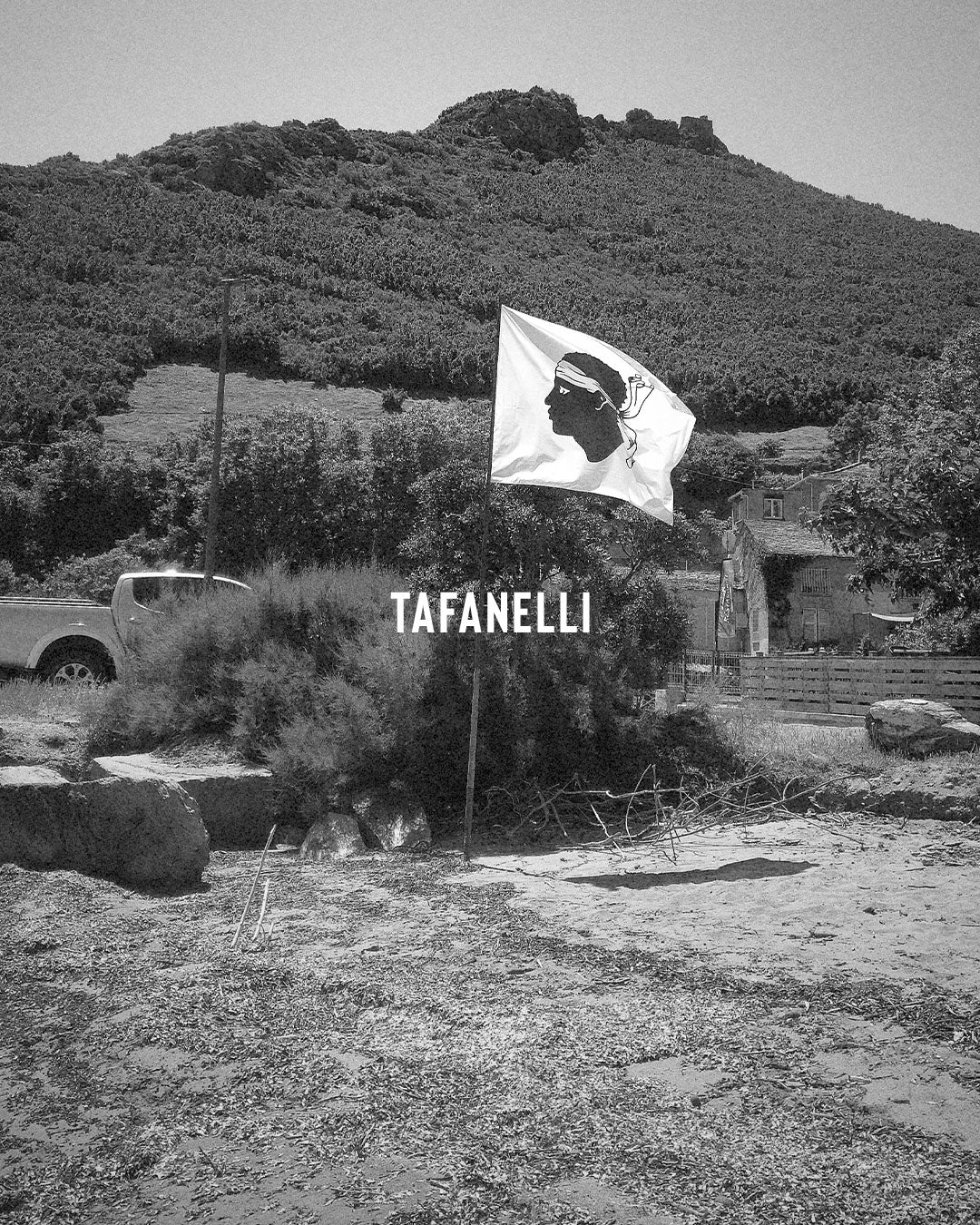
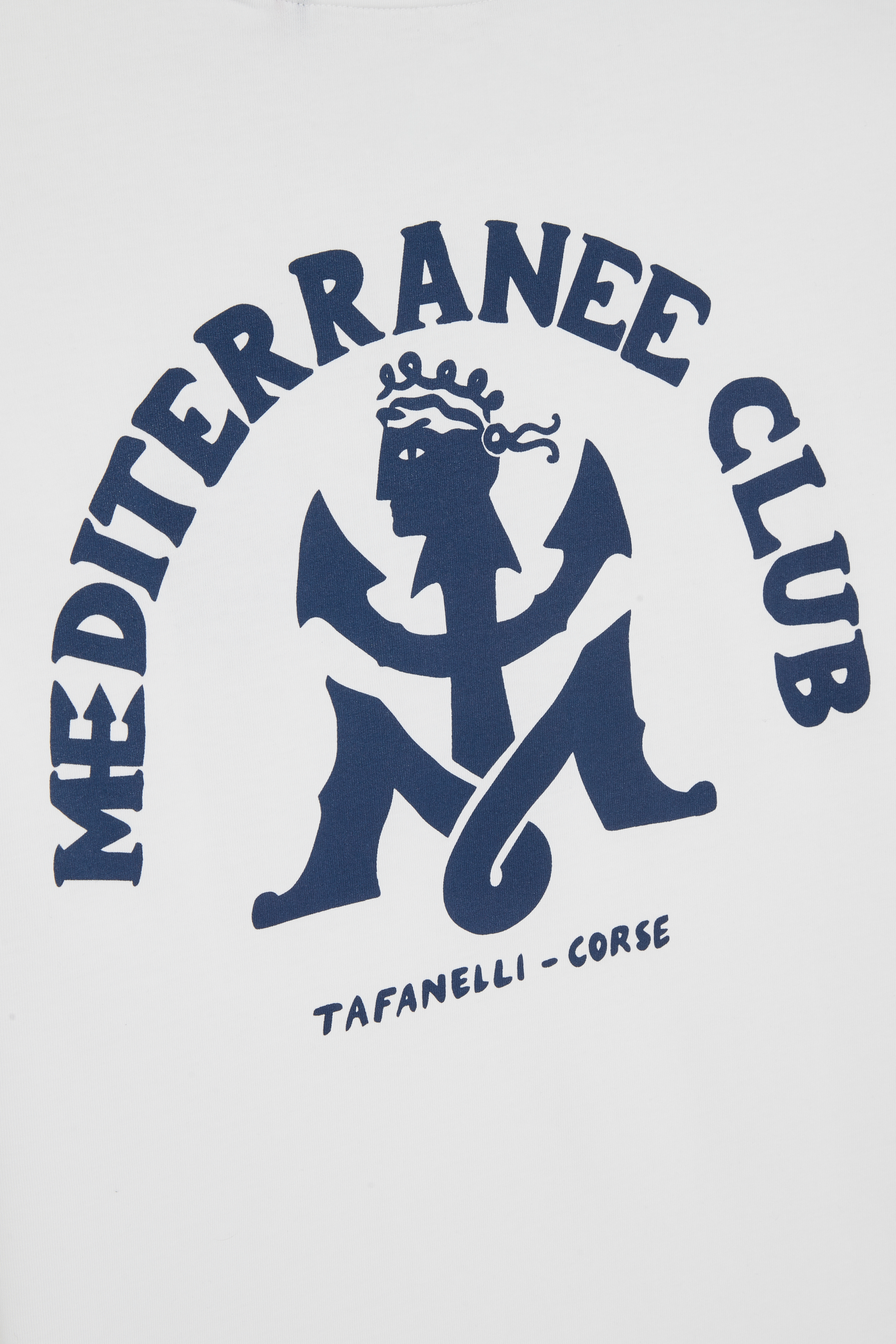
Moor's Head with a raised headband, eight-pointed stars from medieval coats of arms, traditional gozzi sailboats, lions of Roccapina, vintage maritime motifs. These references are integrated without aggression—never in a giant, garish logo, always as a subtle signature on the chest, on the back, or inside a label.
5. Traditional techniques
Hand-applied high-density screen printing, embroidery, visible topstitching, flat-stitched hems. Contemporary Corsican clothing favors artisanal techniques that develop a patina over time rather than industrial prints that flake off after the third wash.
6. French or European manufacturing
Serious Corsican brands have almost exclusively chosen French, Italian, or Portuguese manufacturing. This requirement guarantees recognized expertise, possible quality control, and consistency with their claimed heritage commitment. Buying a Corsican garment made in Asia without transparency regarding the supply chain remains a fundamental contradiction.
7. Limited series
To preserve rarity and the attention paid to each piece, almost all contemporary Corsican brands manufacture in intentionally restricted series. This logic prevents trivialization and maintains maximum quality. A successful Corsican piece is never produced in tens of thousands of copies.
The eight essential pieces of a Corsican wardrobe
Here are the eight pieces that form the heart of a contemporary Corsican wardrobe, for men and women alike. They can be combined with one another across all seasons and form the foundation of a confident island wardrobe.
1. The heavy cotton t-shirt
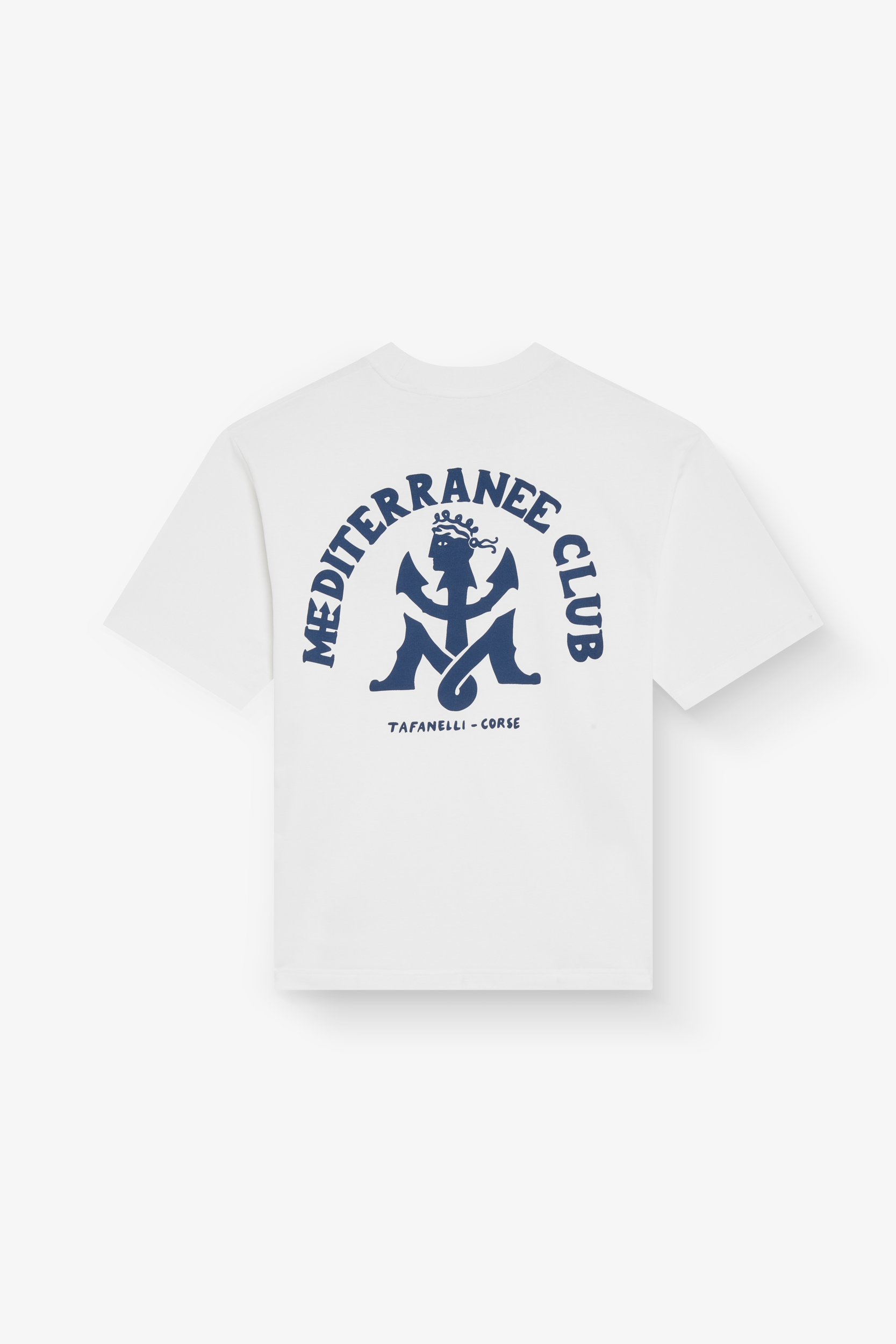
A foundational piece of any Corsican wardrobe. 240 to 280 gram-per-square-meter cotton, boxy fit, restricted palette (white, navy, faded khaki, ecru), discrete screen print on the heart or back evoking a figure or place on the island. It is the universal base, for summer and mid-season alike.
2. The linen shirt
White, ecru, or sky blue, straight cut, long sleeves to be rolled up in summer. Essential for lunches, evenings, and walks in the village. The linen shirt is universal Corsican elegance—both sober and warm.
3. The China blue jacket
One of the most iconic pieces of the contemporary Corsican wardrobe. A workwear jacket inspired by the work coats of farmers and sailors, dyed a deep indigo blue, with a utilitarian cut and heavy cotton. It is worn in mid-season over a t-shirt, or later in the year over a sweatshirt.
4. Linen or sand-colored chino trousers
Loose fit, mid-rise, in earthy shades. Corsican trousers reject both the formality of a suit and the laziness of jogging pants. They occupy an intermediate space—elegant without being rigid, comfortable without being sloppy.
5. The Corsican bandana
A cotton square, often printed with maritime or heraldic motifs, to be worn around the neck, in a jean pocket, or tied to the wrist. It is the signature accessory that immediately adds a touch of island identity to any outfit.
6. The flat cap or canvas bucket hat
For sun and style. The navy fisherman's flat cap or the light cotton bucket hat have always been part of the Corsican sartorial vocabulary. A discreetly embroidered Moor's Head cap remains an unbeatable classic.
7. Espadrilles or leather sandals
For footwear, the Corsican refuses both technical sneakers and city shoes. They prefer natural canvas espadrilles for the light of summer or simple leather sandals for long days of walking. The patinated leather loafer is also very present in the high-end Corsican silhouette.
8. The heritage signature piece
Finally, a unique piece that tells the story of a place, a figure, or a memory of the island. A vintage t-shirt paying homage to an imaginary yacht club, a cap embroidered with an eight-pointed star, a jacket screen-printed with a traditional sailboat. It is this piece that shifts a silhouette from generic Mediterranean to affirmed islander.
The brands that define Corsican clothing in 2026
The ecosystem of Corsican clothing brands is still relatively restricted, but it has become significantly more professional over the last ten years. Here are the main trends that structure the market today. To judge each brand, apply the three filtering questions: who designs it, where is it made, and in what quantity.
Premium narrative brands
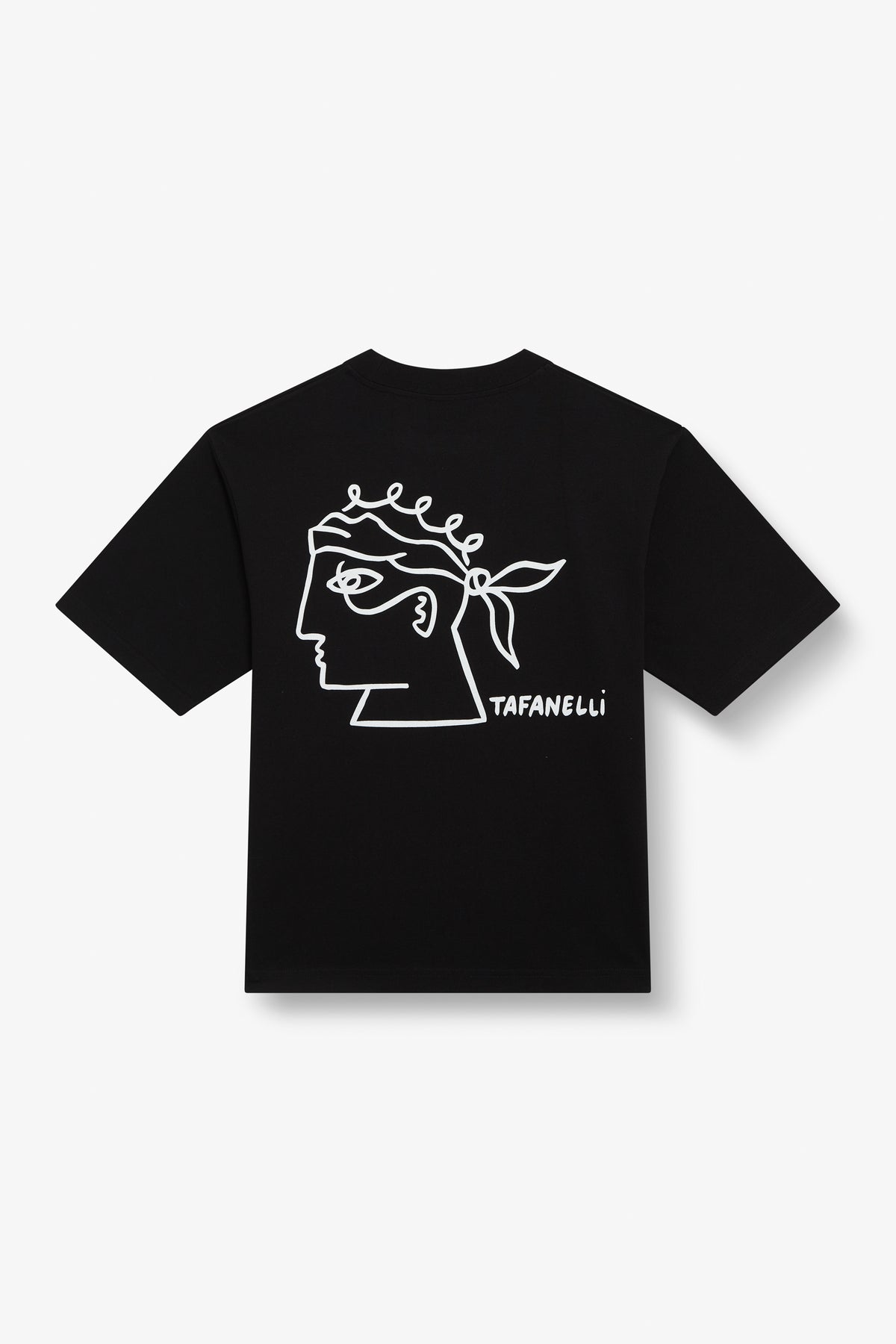
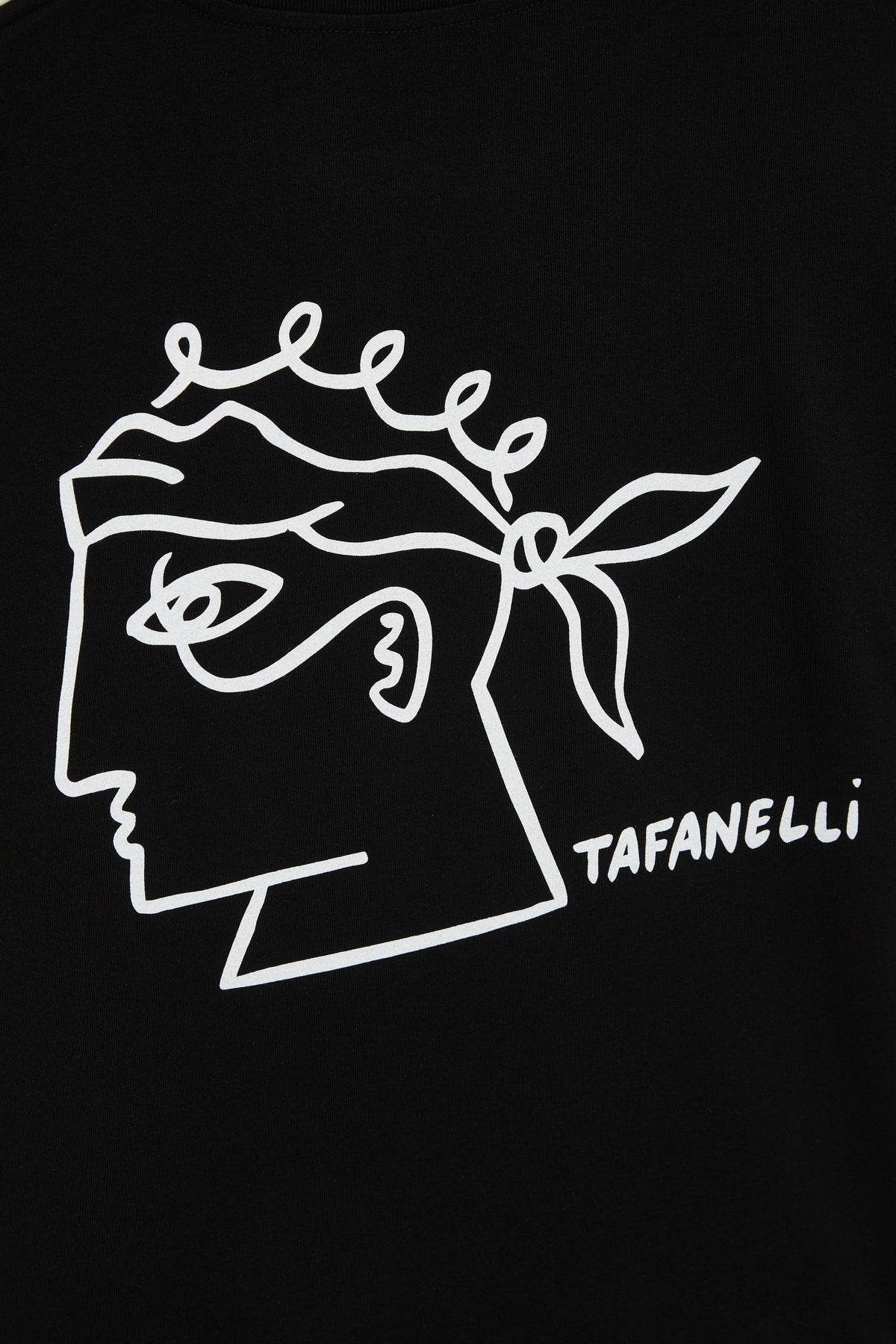
Several brands have chosen an editorial approach based on heritage storytelling. Each piece tells the story of a place, a figure, or a memory of the island, and the entire catalog composes a true, sensitive map of Corsica. Manufacturing is French, artisanal, in limited series, with premium prices (between 65 and 200 euros per piece). It is in this category that TAFANELLI fits, a brand founded in homage to the creator Matthieu Tafanelli's mother, a native of Montemaggiore in Balagne, and a 2024 Ministry of Culture laureate. Its collection of Corsican clothing concretely illustrates this movement.
Identity-focused streetwear brands
A second school, more oriented toward urban codes and streetwear, offers sportswear pieces that claim Corsican identity through contemporary, sometimes activist, graphics. The cuts are more oversized, the prints more assertive, and the target audience is rather young. This category exists in parallel with the previous one and reaches a different audience.
Tourist brands
This historical category remains the majority in terms of volume on the island. It focuses on accessible products sold in tourist shops, in markets, or by the beach. Variable quality, often Asian-made, and generally classic graphic codes. This segment is not part of what we call "Corsican fashion" in the contemporary sense, but it still represents the bulk of the offer available to hurried summer visitors. The test is simple: if you see the same visual in three shops that do not know each other, none of the three created it.
Traditional workshops and independent couturiers
Finally, several sewing workshops and independent designers offer unique pieces or very small series, based on traditional techniques: embroidery, weaving, natural dyeing. These workshops, often located in inland villages, perpetuate precious heritage expertise, sometimes in collaboration with better-known brands.
Accessory and jewelry designers
Corsican clothing naturally goes hand-in-hand with an ecosystem of accessory designers (bandanas, scarves, leather belts, raffia bags) and jewelers (jewelers in Ajaccio, Bastia, and Calvi offering jewelry inspired by Corsican symbols: Moor's Head, stars, religious crosses, carnation motifs).
The TAFANELLI proposal
Among the premium narrative brands mentioned above, TAFANELLI occupies a unique position. The brand was founded in tribute to Dominique Tafanelli, the creator's mother, who was originally from Montemaggiore in Balagne and left us too soon. This family anchor gives the project an emotional dimension that can be felt in every piece.
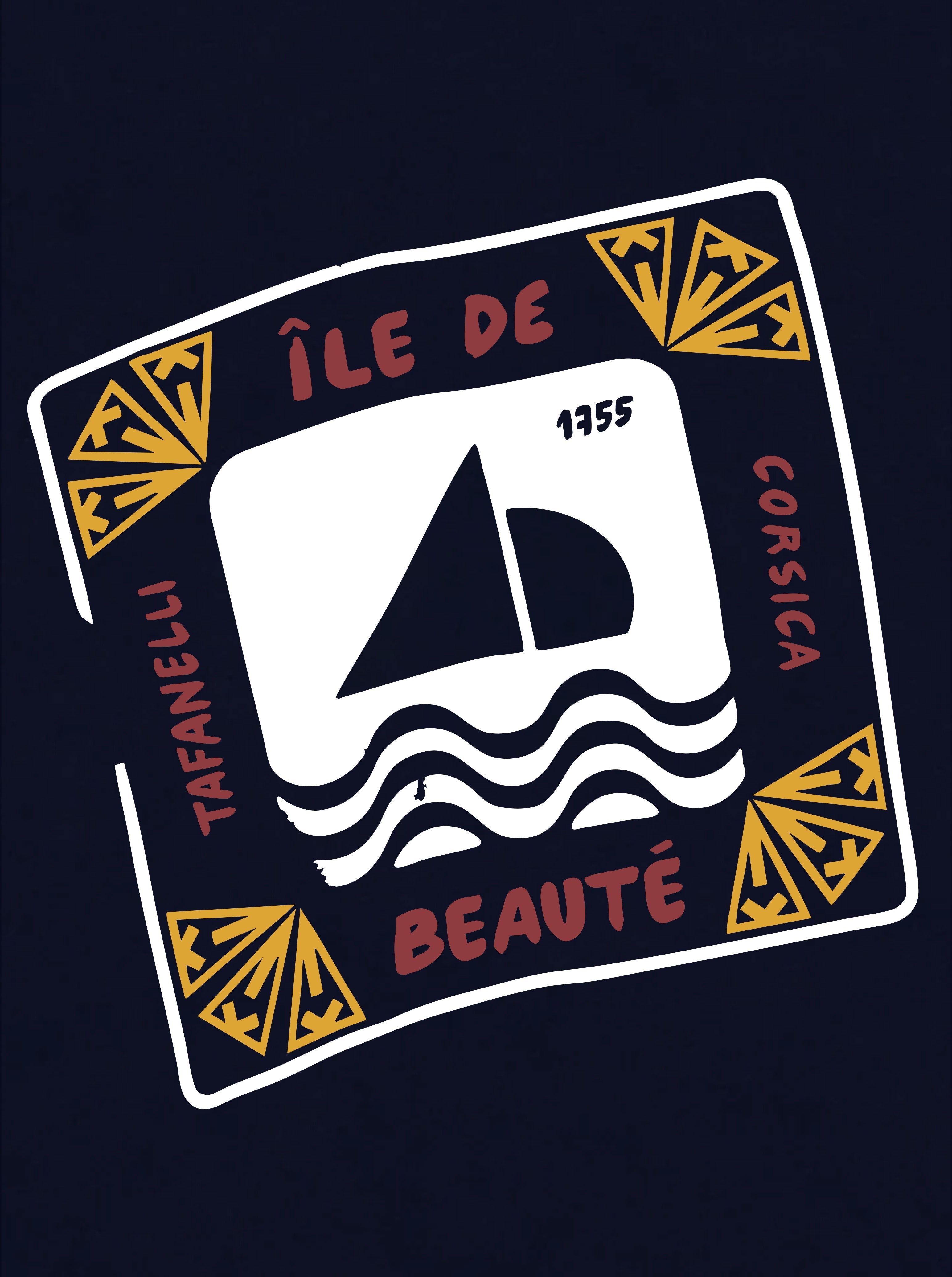
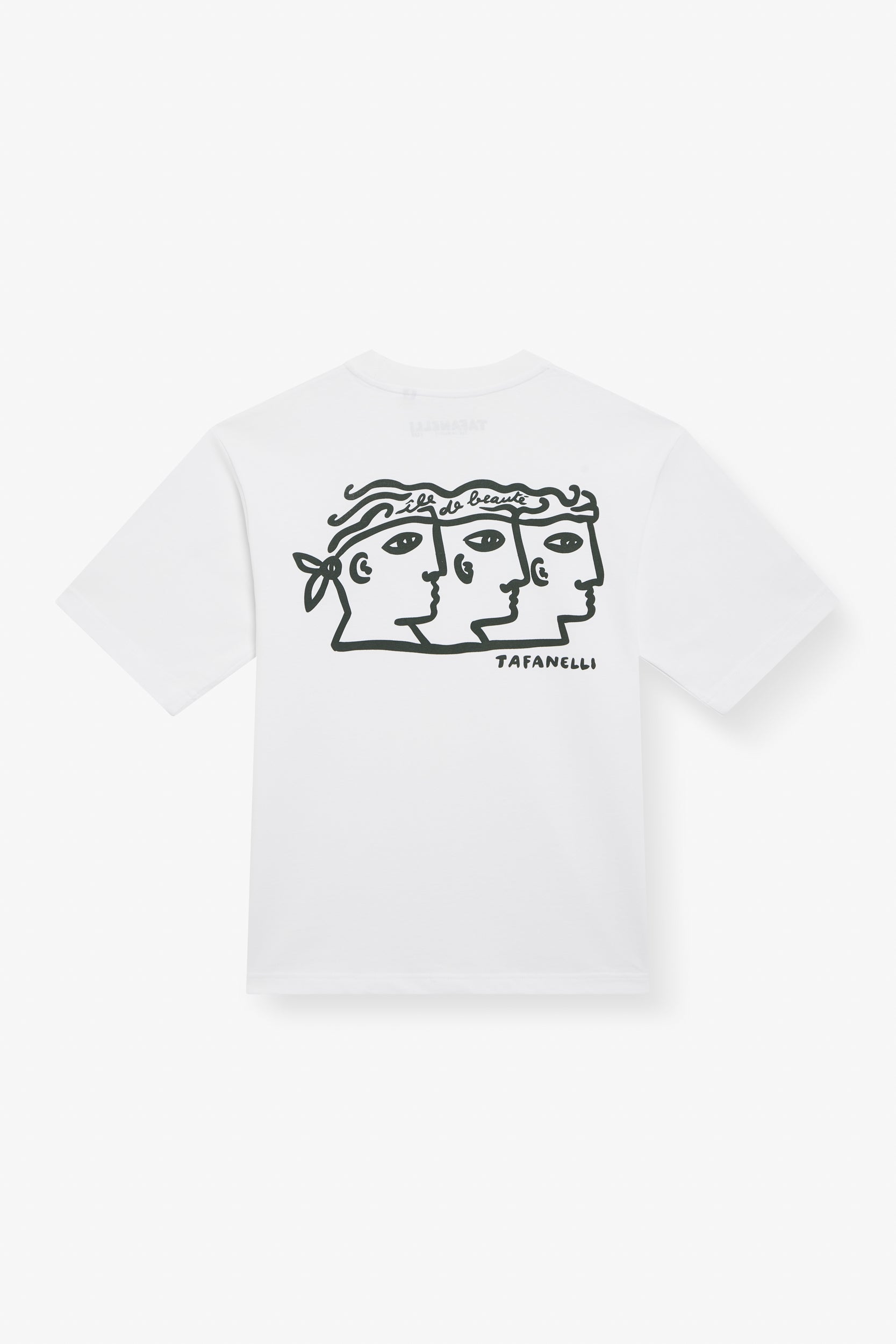
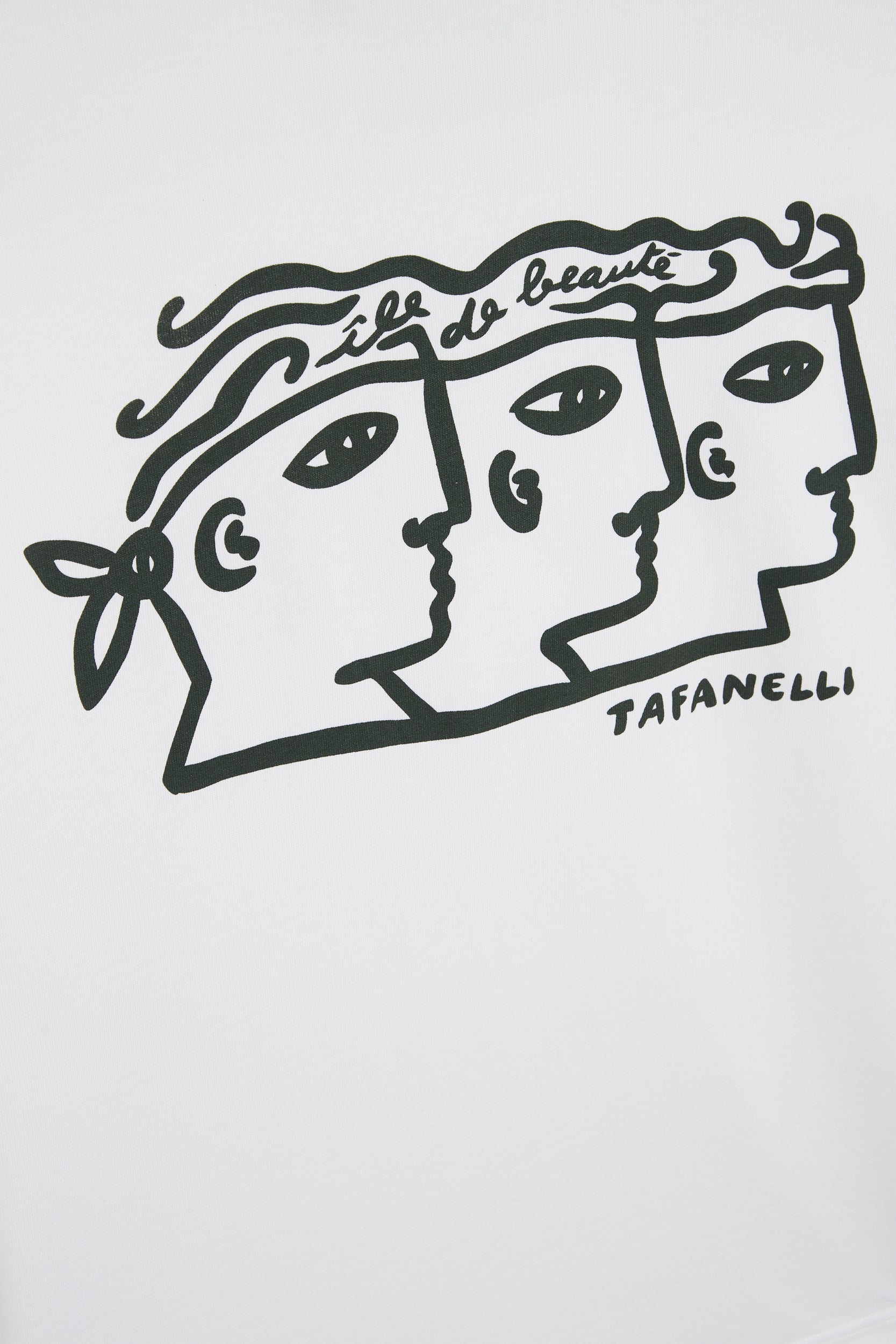
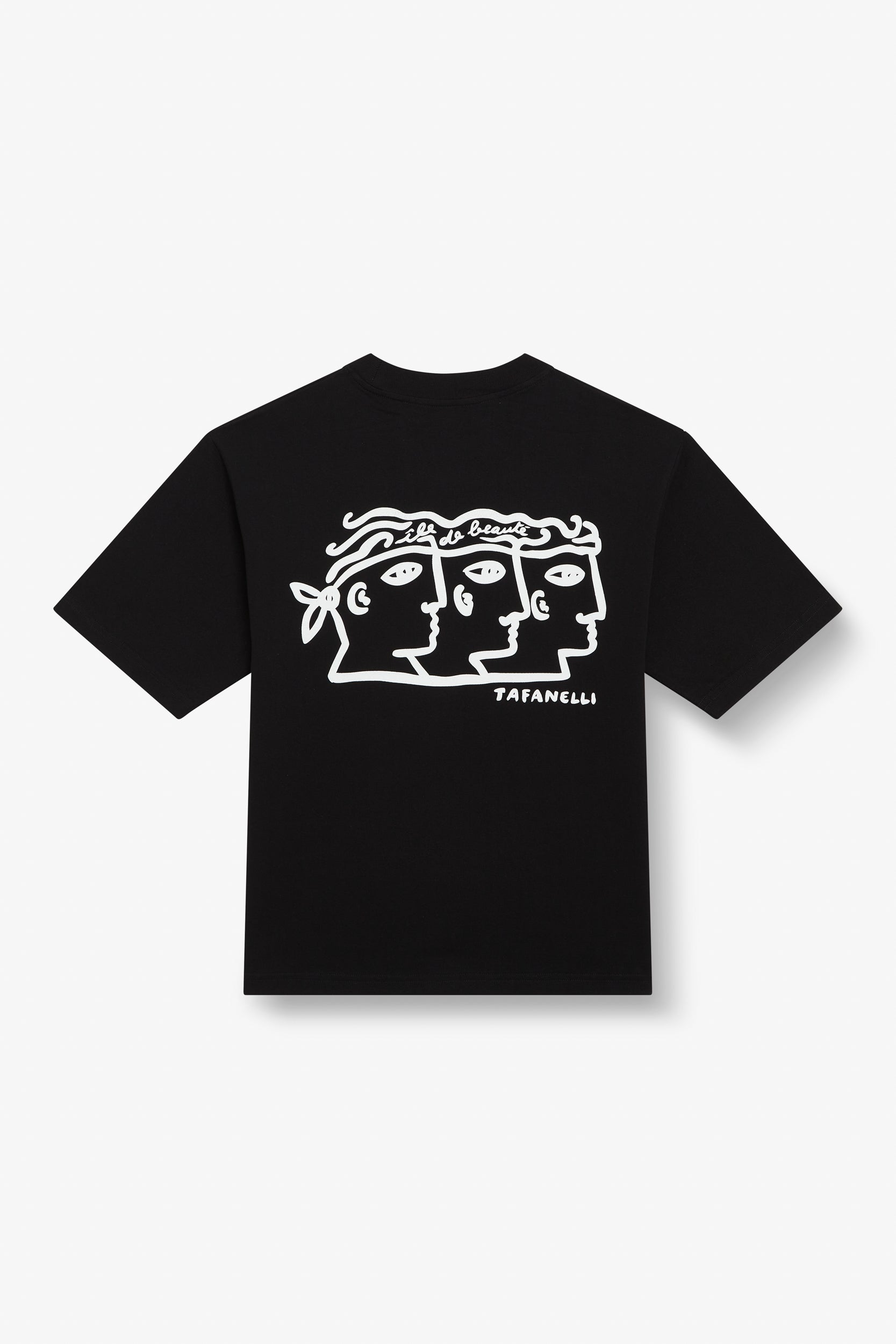
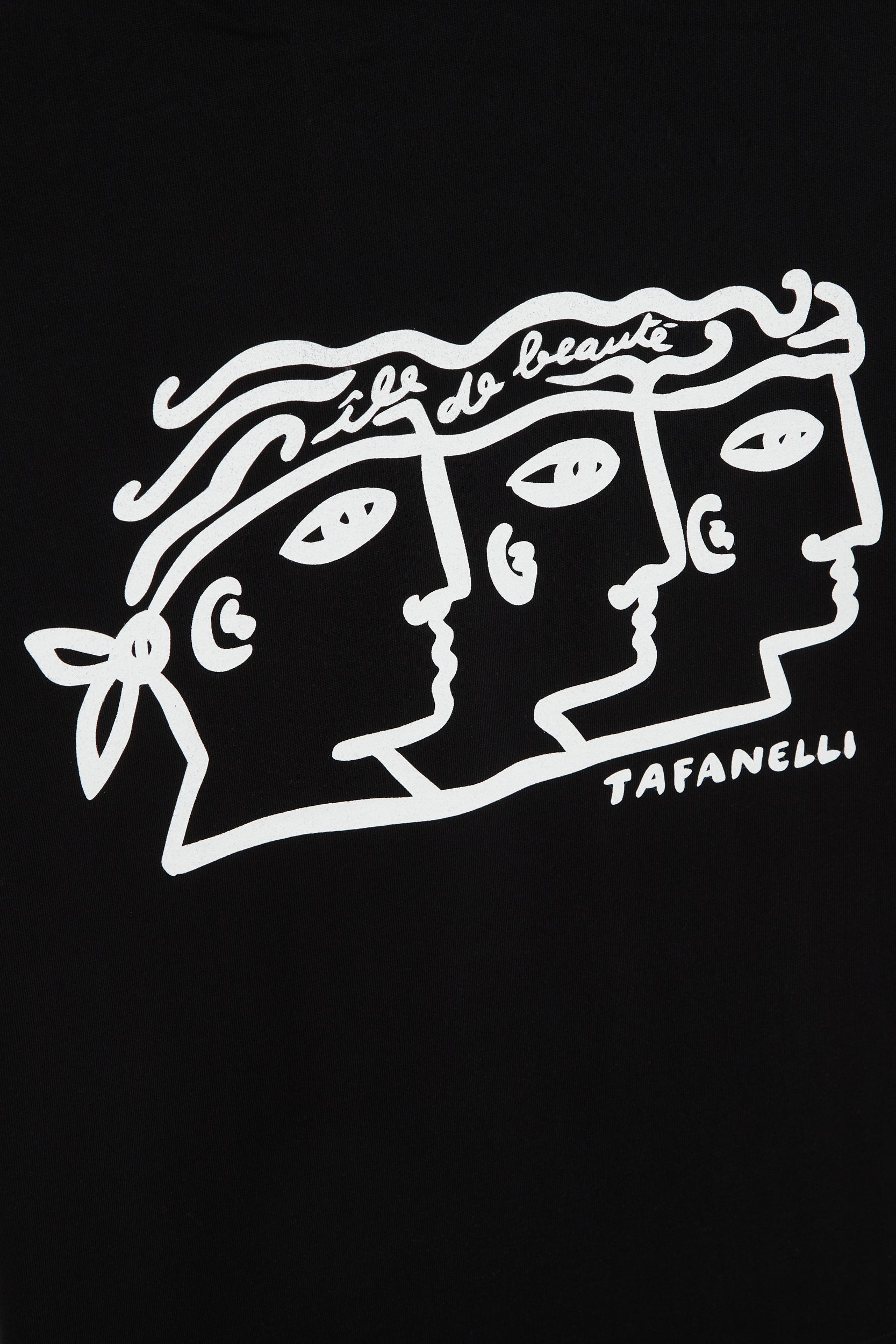
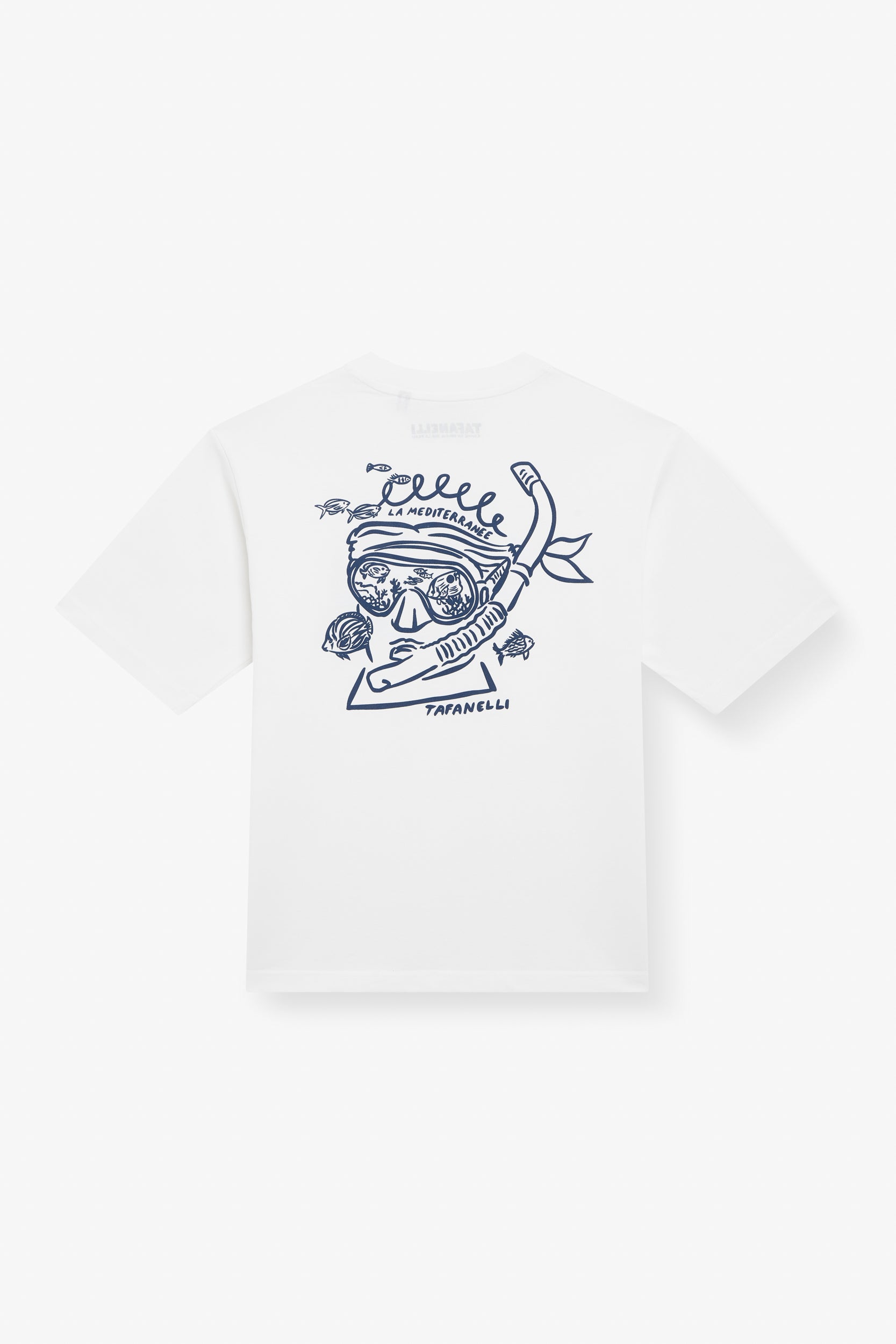
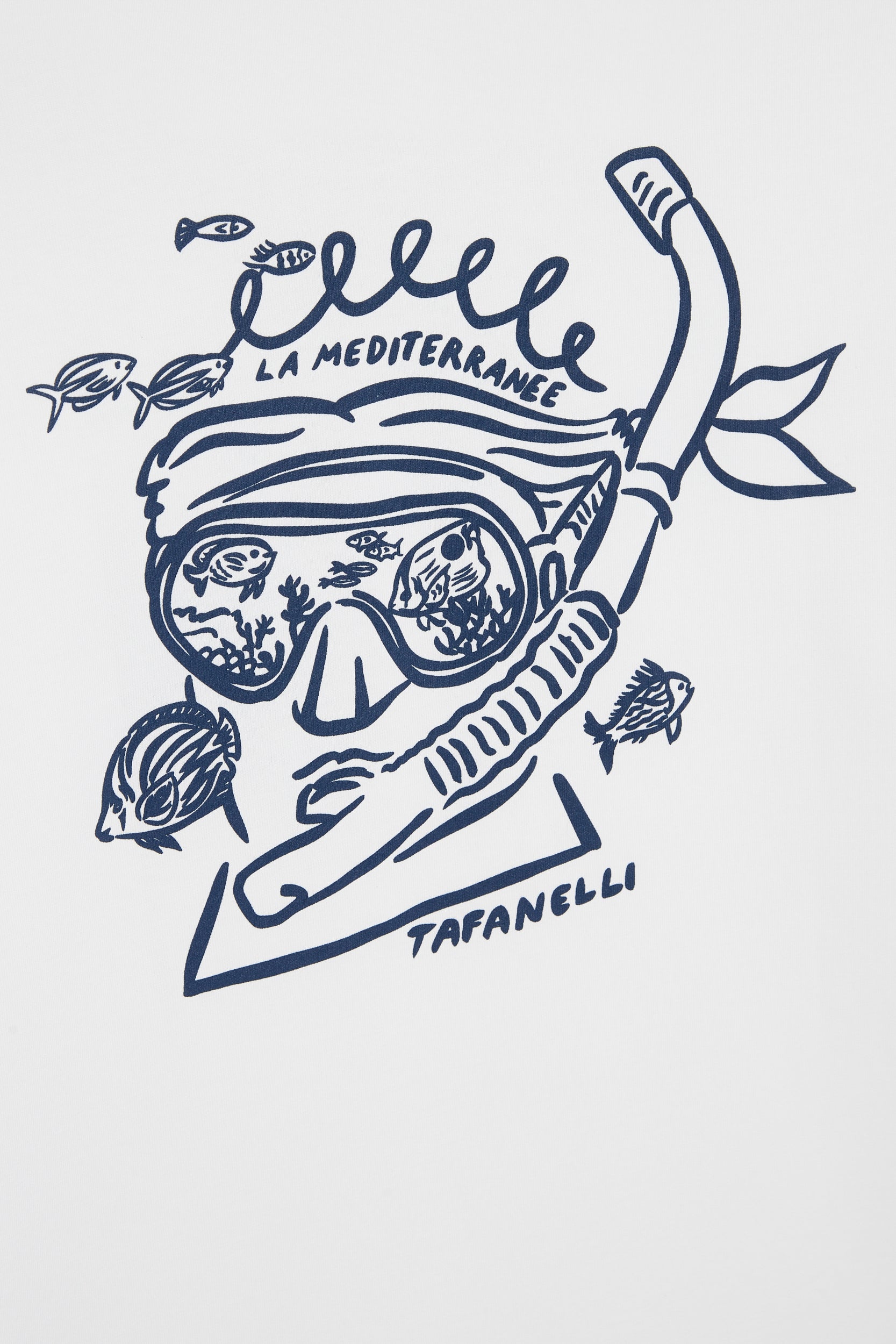
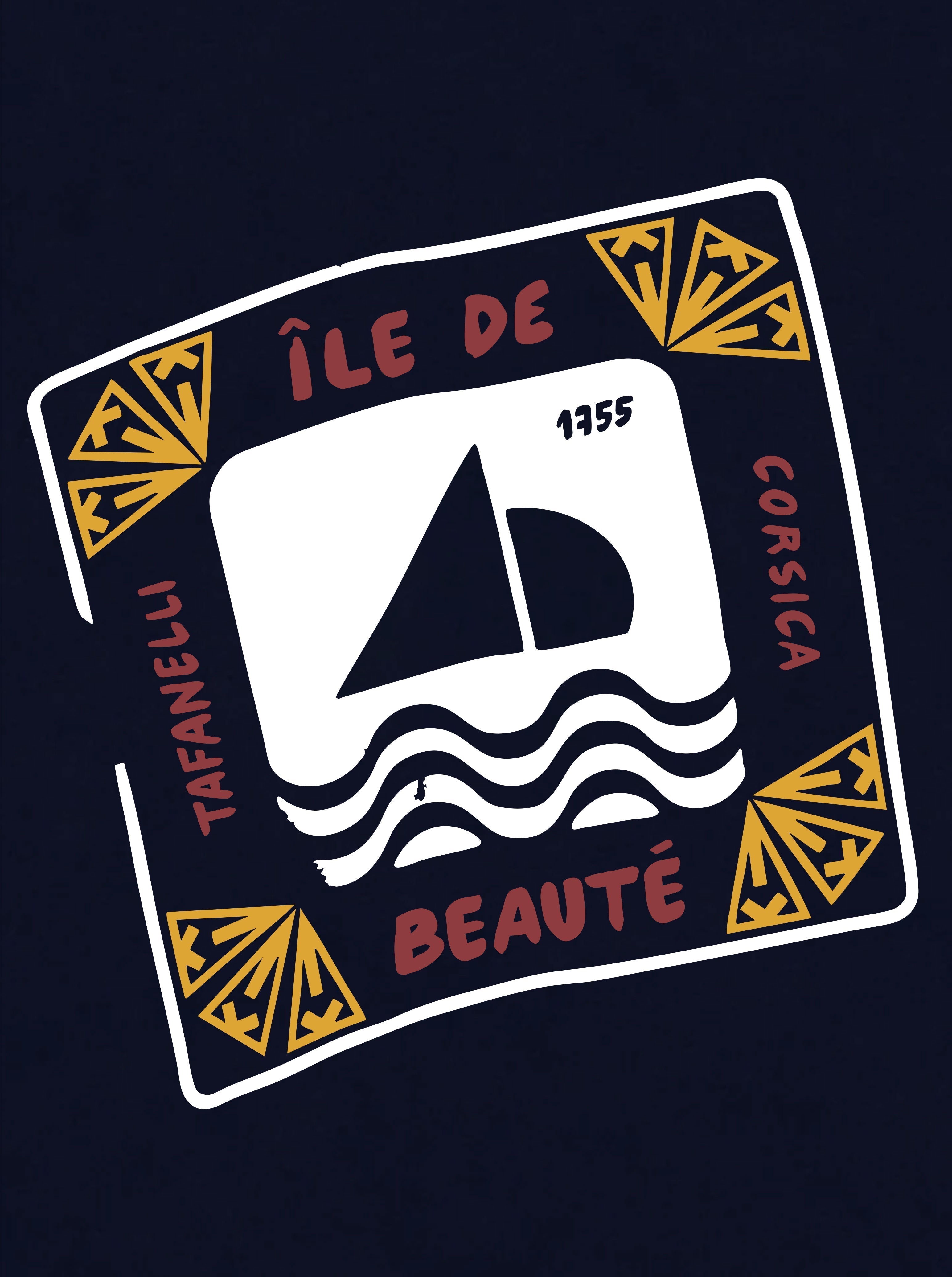
Each of our references pays tribute to an island place, figure, or memory. Le Plongeur de Calvi (The Calvi Diver) evokes the figures of southern Balagne. La Roccapina pays tribute to the rocky lion of the southern tip. Le CORSICA 704 bears the hand-drawn Moor's Head. La Trinità brings together three Corsican profiles under the banner of the Island of Beauty: a Muntagna (the mountain), a Machja (the scrubland), u Mare (the sea). La Pêche aux Oursins (Sea Urchin Fishing) celebrates a popular culinary tradition. L'Île de Beauté 1755 inscribes the proudest date in Corsican history (Pasquale Paoli's Corsican Constitution) onto a premium vintage piece.
Regarding manufacturing, we strictly apply the three questions of selection. Who designs: artists, by hand, credited on each product page. Where is it made: in France, using a 280-gram cotton jersey knitted on rare machines, with a collar calculated to prevent stretching and an interior without labels, as the size and origin are screen-printed directly onto the fabric. In what quantity: short runs of 100 pieces, hand screen-printed layer by layer, never reissued identically. This high standard is reflected in our prices (between 55 and 195 euros) and guarantees the actual lifespan of our pieces, designed to survive several summers and be passed down.
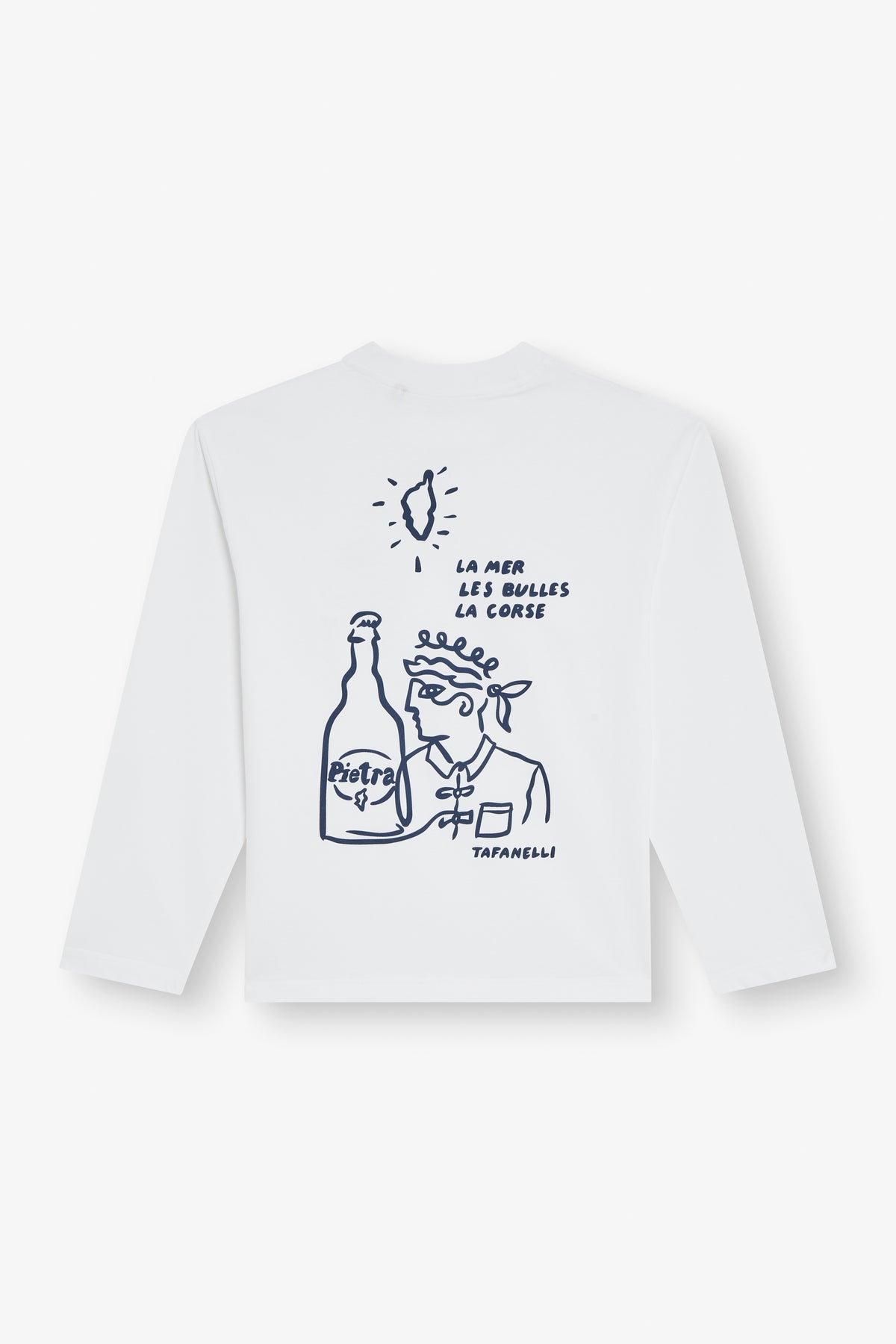
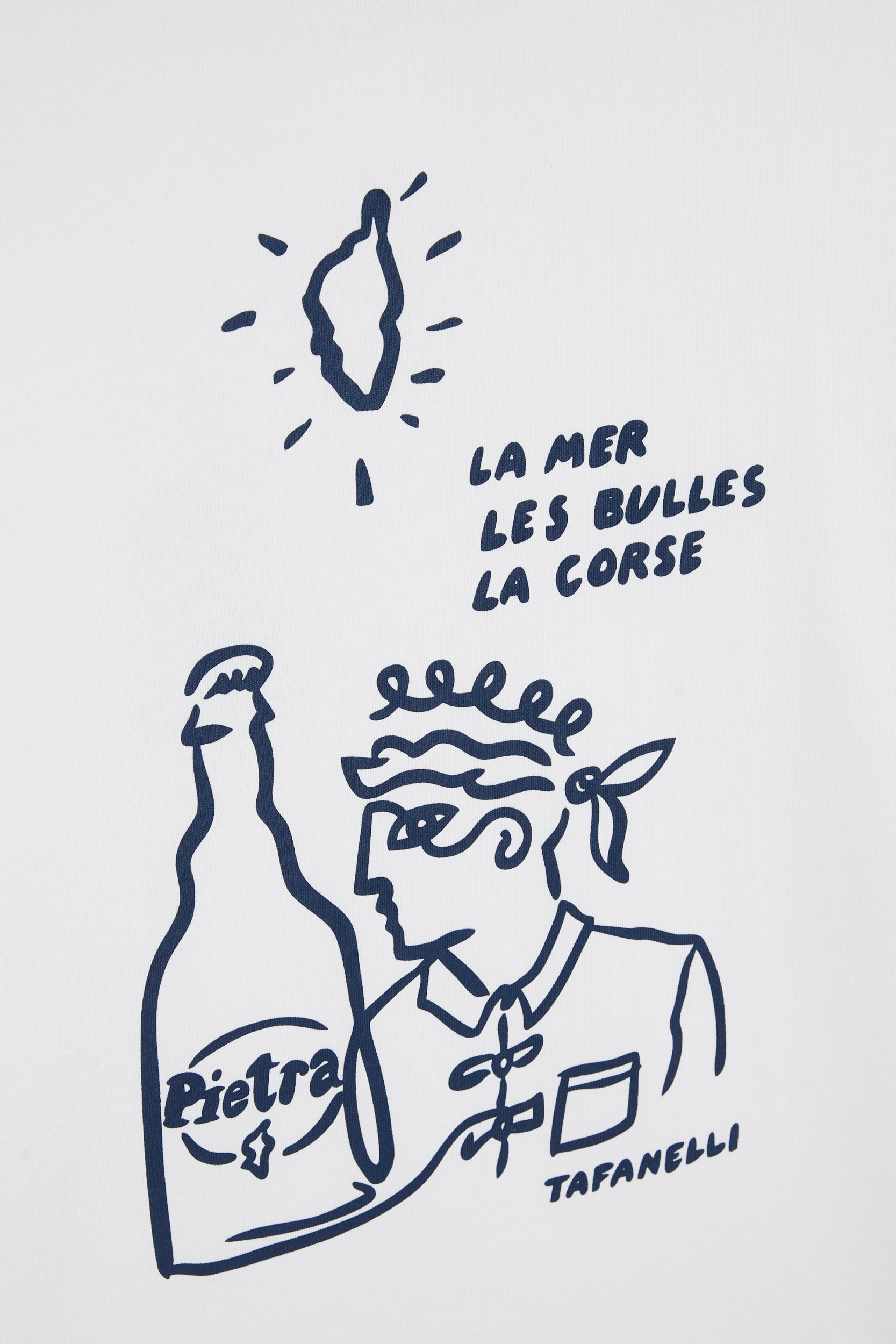
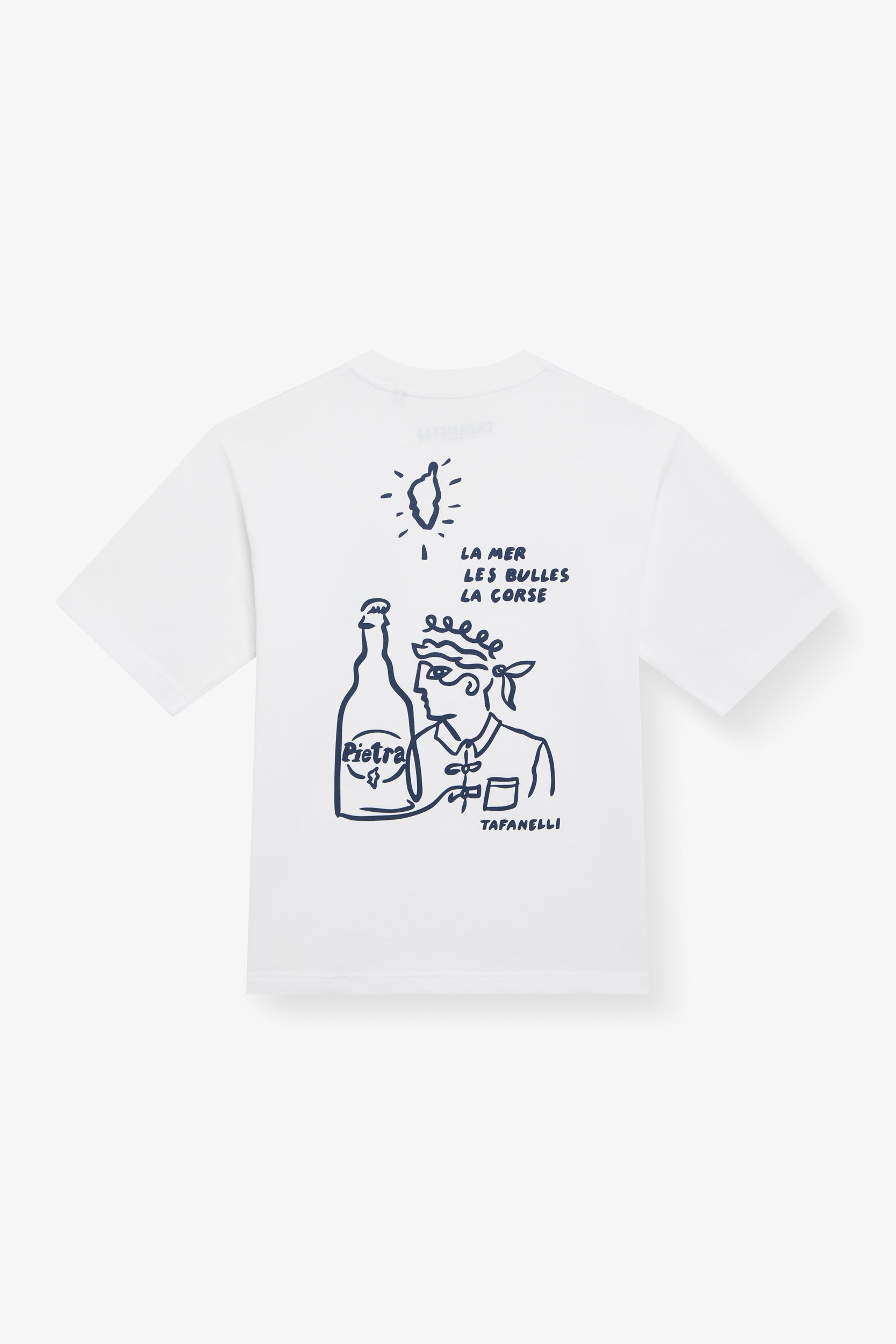
The brand was distinguished by the Ministry of Culture in 2024, an institutional recognition that validates the coherence of our approach beyond the mere commercial framework. Places like Calvi on the Rocks, the Grand Hôtel de Cala Rossa, the Pietra brewery for its 30th anniversary, or Sportmer in Saint-Tropez entrust us with the design of their stories.
How to wear Corsican clothing in everyday life
Corsican clothing is not worn only on vacation on the island. When well put together, it fits perfectly into a contemporary urban or rural wardrobe, in Paris as in Marseille, in Geneva as in Milan.
Summer at the beach
Heavy cotton t-shirt in a navy or ecru shade. Retro-cut swim shorts. Open white linen shirt. Espadrilles or barefoot. Corsican bandana around the neck. Navy flat cap. This is the canonical silhouette for Sundays by the Mediterranean.
In the city during mid-season
Blue-dyed work jacket over a heavy cotton white t-shirt. Sand-colored chinos or raw denim. Patinated leather loafers. Classic sunglasses. The silhouette works just as well for a relaxed business lunch as for an office day in a creative company.
Winter in layers
280g heavy cotton t-shirt as a base layer. Linen shirt on top. Wool sailor sweater. Blue-dyed work jacket or navy pea coat as an outer layer. Raw jeans or wool trousers. Loafers or white Stan Smiths. The Corsican winter silhouette plays on layers rather than on a single material.
For a more formal event
Corsican clothing, in its contemporary sense, is not designed for the strict suit-and-tie codes. But it can perfectly fit into a semi-formal silhouette: white linen shirt, fine grey or navy wool trousers, unlined structured jacket, black leather loafers. With a Corsican bandana as a pocket square in the jacket, the identity remains asserted without stylistic rupture.
Five mistakes to avoid when starting to integrate Corsican clothing
For those discovering the world of Corsican clothing, here are five common mistakes that distort the silhouette and make it caricatural.
1. The overly large Moor's Head logo
The Moor's Head is a respectable symbol, but it does not support excessive enlargement or garish colors. A fifteen-centimeter Moor's Head logo right on the chest of a white t-shirt immediately falls into the "airport souvenir" category. Always prefer the discreet version, embroidered or screen-printed on a small scale.
2. Multiple prints
Only one signature piece per silhouette. If you wear a screen-printed t-shirt, choose plain shorts. If you wear a printed bandana, keep the rest sober. The golden rule of Corsican style is simplification: only one visual focus per outfit.
3. Synthetic materials
Polyester, nylon, and elastane immediately distort the Corsican silhouette. Under the Mediterranean sun, these materials create a shiny plastic effect that clashes with the natural aesthetic sought after. Always favor natural fibers, even for sportswear.
4. Overly saturated colors
Bright red, neon yellow, and electric green are not part of the contemporary Corsican palette. When you want color, prefer earthy, muted, mature tones: ochre, terracotta, deep blue, olive green, brick red.
5. The "souvenir-only" purchase
Buying a single piece of Corsican clothing, beachside, as a vacation memento, is to condemn yourself to caricature. Corsican clothing works as a coherent whole. It is better to invest in two or three thoughtful pieces from serious brands than to accumulate ten tourist t-shirts. A price too good to be true always reveals its manufacturing chain: at fifteen euros, someone was sacrificed somewhere, and it is never the seller.
The future of Corsican clothing in the era of the Jacquemus wave
The year 2026 marks a major turning point for Corsican clothing. With the Jacquemus fashion show held in L'Île-Rousse on June 29, the island has become, for the first time in its recent history, a ground of global attention for fashion.
This wave will profoundly modify the landscape of Corsican brands. Several scenarios are emerging.
On one hand, authentic Corsican brands that are already established, narrative-driven, and coherent will benefit from an extraordinary validation effect. When the world discovers Corsica as a new territory of fashion imagination, it will look for local brands to embody this desire. Those that have built a solid narrative and uncompromising execution quality over time will be the natural beneficiaries of this attention.
On the other hand, the mass tourist segment (souvenir t-shirts sold in airports) will likely decline relative to the premium offering. Informed visitors, now aware that quality contemporary Corsican fashion exists, will increasingly refuse to settle for caricatural souvenir pieces.
Finally, a real risk weighs on the authenticity of the Corsican narrative. Large international brands can legitimately draw inspiration from the island, but they cannot replace brands born from within. The distinction between a Corsican brand and a brand that draws inspiration from Corsica will become an essential framework for the educated consumer.
It is in this context that the future of Corsican clothing will be played out in 2026. The coming months will tell which brands have managed to transform this sudden attention into lasting consolidation, and which ones have been swept away by the wave.
Frequently Asked Questions
What is Corsican clothing in the contemporary sense?
Corsican clothing is clothing designed by a brand whose identity claims a Corsican anchor, which bears its aesthetic codes (natural materials, earthy palette, loose cuts, discreet heritage references), and which fits into the broader grammar of contemporary Mediterranean fashion. Manufacturing is generally done in France or Europe, but the soul and narrative are insular.
What are the best Corsican clothing brands in 2026?
The ecosystem of Corsican clothing brands is structured around several currents: premium narrative brands based on heritage storytelling (including TAFANELLI, winner of the Ministry of Culture award in 2024), more urban identity-based streetwear brands, traditional workshops and independent designers, and specialized accessory makers and jewelers. To tell them apart, three questions suffice: who designs, where is it made, in what quantity.
What is the difference between Corsican clothing and souvenir clothing?
Souvenir clothing is a generic product sold at the beach or airport, manufactured in large runs (often in Asia), with caricatural prints of Corsica. Contemporary Corsican clothing is designed by a serious brand, made in France or Europe, in limited runs, with attention paid to materials, cuts, and heritage storytelling. The first costs 15 to 25 euros, the second 75 to 200 euros, and they do not target the same audience at all.
Why are clothes from Corsican brands more expensive?
A t-shirt hand-drawn by a paid artist, knitted in France from 280-gram cotton, and artisanal screen-printed costs six to eight times more to produce than an imported t-shirt. The price pays for the design, the material, and the hands, not the license for a pattern.
What is a limited edition in clothing?
It is a voluntarily restricted production, at TAFANELLI 100 pieces per design, never reissued identically. The short run guarantees the care in manufacturing and the rarity of the piece: what you are wearing exists in only one hundred copies worldwide.
What are the essential pieces of a Corsican wardrobe?
Eight pieces make up the heart of a contemporary Corsican wardrobe: the heavy cotton t-shirt, the linen shirt, the blue-dyed work jacket, linen or sand-colored chino trousers, the Corsican bandana, a flat cap or canvas bucket hat, leather espadrilles or sandals, and a signature heritage piece (narrative t-shirt, screen-printed jacket, etc.). With these eight pieces, one covers all seasons and all occasions of Corsican life.
Can you wear Corsican clothing in Paris?
Absolutely, and that is even one of the great benefits of contemporary Corsican fashion: it fits perfectly into a modern urban wardrobe, in Paris as in Marseille, in Geneva as in Milan. Its sober palette, natural materials, and loose cuts make it a clothing proposal that extends far beyond the insular summer context.
What is the color palette of Corsican clothing?
The Corsican palette is dominated by earthy and muted tones: ecru, off-white, deep navy blue, faded khaki, ochre, terracotta, matte black, stone grey. It takes up the colors of the island landscape and voluntarily opposes the bright, saturated colors of classic sportswear.
Is Corsican clothing made in Corsica?
Not necessarily. Corsica has never possessed a heavy textile industry. Almost all serious Corsican brands have their pieces manufactured in mainland France, Italy, or Portugal, in workshops recognized for their craftsmanship. It is the identity, the narrative, and the design that are insular, not the production. A few small traditional workshops still survive on the island for unique pieces or very small runs.
What is the budget for premium Corsican clothing?
To build a basic premium Corsican wardrobe (two t-shirts, a linen shirt, a blue-dyed work jacket, a bandana, a cap), the budget is between 400 and 800 euros depending on the brands chosen. It is an investment, but one that is part of a logic of sustainable purchasing: these pieces develop a patina and are passed down over time, the opposite of disposable fashion.
Where to buy Corsican clothing in mainland France?
Most serious Corsican brands now have an online sales site. A few multi-brand boutiques in Paris, Saint-Tropez, Marseille, and the south of France also distribute the main references. The network of retailers is gradually expanding, notably thanks to the increased visibility of insular fashion. At TAFANELLI, the collection of Corsican clothing is delivered free of charge in mainland France.
To go further into the TAFANELLI universe
If this article has shed light on contemporary Corsican clothing, you will find more to read in these other stories we have published about the island, its codes, and its identity:
- Island of Beauty or Corsica: the history of the two names of the most beautiful island in the Mediterranean
- The Moor's Head: history and symbolism of the Corsican flag
- The new Saint-Tropez is called Corsica: why 2026 is the pivotal year
- The 12 secret beaches of Corsica that Corsicans keep for themselves
- L'Île de Beauté 1755: the story of a vintage t-shirt that tells the most beautiful Corsican history
- Why it took us four years to perfect our t-shirt
- Corsican fashion: 5 codes that make an authentic brand of the island
- What is Bleu de Chine (Chinese Blue)
- What to wear in Corsica in the summer of 2026
To discover all our pieces, designed to embody the codes of contemporary Corsican clothing without compromising on quality or narrative, browse our collection of Corsican clothing: hand-drawn, made in France, in runs of 100 pieces.
Corsican clothing is no longer what it was twenty years ago. It has become a mature, anchored, premium clothing proposal, capable of holding its own against the best Mediterranean grammars in the world. And we are proud to be one of its voices.
A PRESTU,
TAFA