Cap Corse: the complete 2026 guide (villages, Sentier des Douaniers, wines, and addresses)
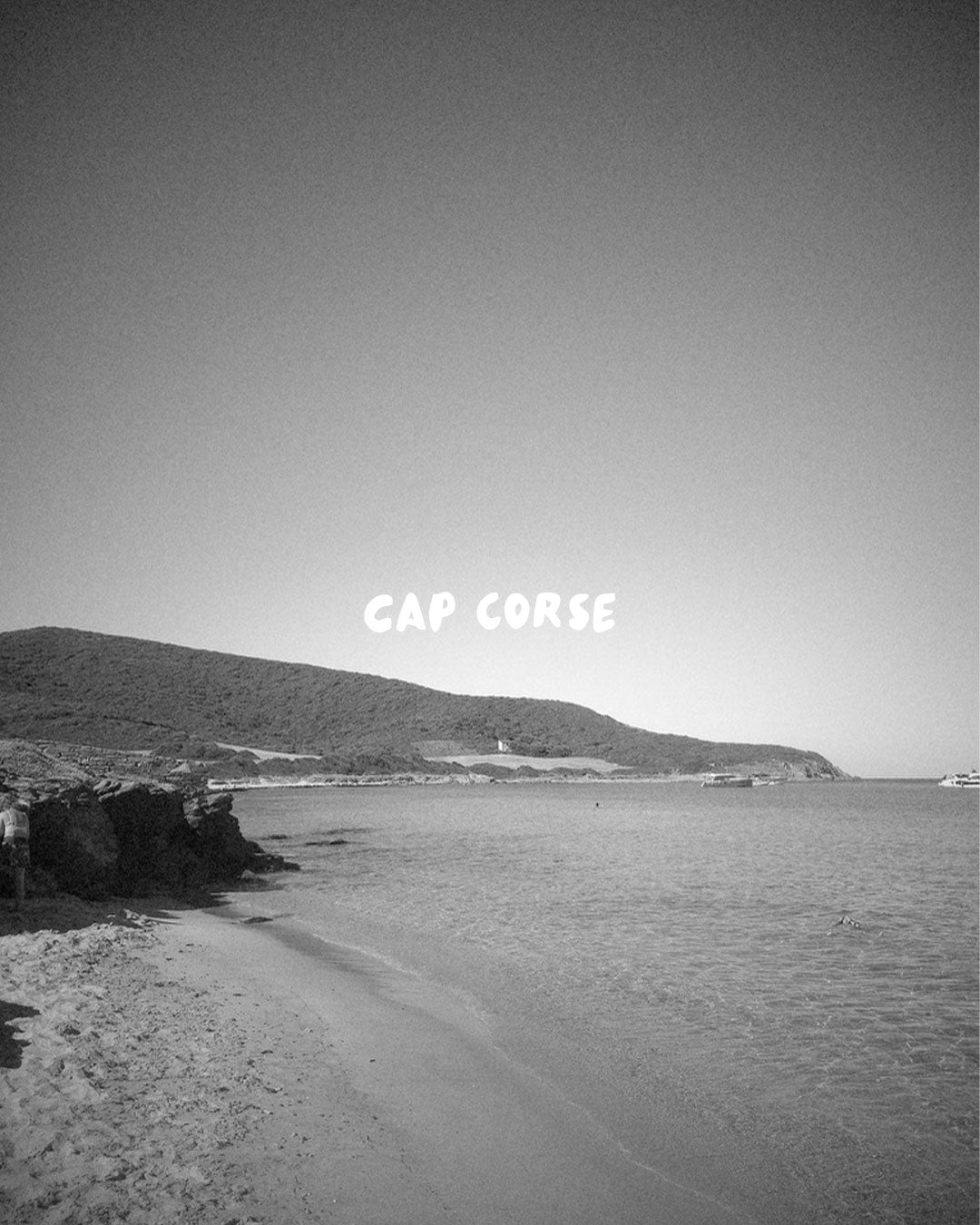
There is a region in Corsica apart, a finger of land pointing north into the Mediterranean, a wild, winemaking, and maritime peninsula that few visitors take the time to truly explore: the Cap Corse. Thirty-five kilometers long, ten kilometers wide, fifteen perched villages, two radically different maritime facades, ancient vineyards, and a legendary hiking trail. It is the Mediterranean "Finistère" (Land's End), the most Corsican and austere part of the island, the place where you go to seek silence, sunsets over abandoned marinas, and the Genoese towers that have kept watch for five centuries. Here is our complete TAFANELLI 2026 guide to Cap Corse, from the village of Erbalunga in the south to Barcaggio in the north, passing through Nonza, Centuri, Macinaggio, and Patrimonio. A region that is also preparing for the arrival of our next Misíncu x TAFANELLI capsule collection.
Cap Corse, the Mediterranean "Finistère"
There are territories that, on an already unique island, form a singularity within a singularity. Cap Corse is one of these. This peninsula, which points north from Bastia, thirty-five kilometers long and barely ten kilometers wide, constitutes a region in its own right within Corsican geography, with its own codes, a slightly distinct dialect, a particular wine economy, and a specific migratory memory.
For centuries, Cap Corse was a territory turned outward. Its inhabitants, the Capcorsins, crossed the Mediterranean much more than other Corsicans, heading to Marseille, Livorno, Genoa, and Algiers. Many of them went even further, to Puerto Rico, Venezuela, and Argentina, where they founded Corsican communities that still exist today. This memory of the crossing remains palpable in the villages, with their maisons d'Américains (those built upon the return of enriched emigrants), their cemeteries where the old captains rest, and their family stories that travel back and forth between Bastia and Buenos Aires.
Cap Corse is not a Corsican region like any other. It is a hand held out to the north, a territory of departures and returns, a peninsula that has looked more to the sea than to the mountains. To understand Corsica, you must visit Bonifacio, Corte, and Sartène. But to understand the Mediterranean soul of Corsica, the one that spans oceans, you absolutely must spend a week in the Cap.
Today, this region remains protected from the mass tourism that has affected other parts of the island. No airport, no large seaside resorts, no giant hotel complexes. The Cap retains its slow pace, its narrow roads winding between marinas and perched villages, its straw huts on dark pebble beaches, and its wine cellars open to curious visitors. It is this preserved authenticity that explains the growing appeal of the Cap for travelers looking for Corsica off the beaten path.
Geography and administration of Cap Corse
A quick word on geography and administration for those planning their visit.
A 35-km long peninsula
Cap Corse stretches for about 35 kilometers from north to south, between Bastia (in the south) and the extreme northern point marked by Punta di l'Agnellu. Its maximum width is about 10 to 12 kilometers, but it gradually narrows as you approach the north.
The spine of the peninsula is a mountain range that peaks at about 1,000 meters in altitude (Monte Stello, 1,307 m). This chain separates two radically different maritime facades: the east coast, exposed to the Tyrrhenian Sea, softer, more inhabited, with its fishing villages and sandy beaches; and the west coast, exposed to the Ligurian winds, tougher, wilder, with its black cliffs and abandoned Genoese towers.
An administrative region in Upper Corsica
Administratively, Cap Corse belongs to the Haute-Corse (2B) department and forms a community of municipalities grouping 18 communes, with Rogliano as its historic capital. The main villages of the Cap are:
- Erbalunga, a fishing marina on the east coast.
- Brando, a hilltop village linked to Erbalunga.
- Sisco, a village that gave its name to one of the Corsican Muscats.
- Pietracorbara, with its beach and Romanesque chapel.
- Luri, a winemaking hub.
- Cagnano, home to the Misíncu hotel.
- Rogliano, the historic capital of the Cap.
- Ersa, a village at the extreme northern point.
- Centuri, a lobster fishing port.
- Pino, a perched village.
- Canari, with its Genoese houses.
- Nonza, a postcard-perfect village with its black pebble beach.
- Farinole, at the gateway to the southwest Cap.
- Patrimonio, a world-famous AOC wine region.
How to get to Cap Corse
Cap Corse has neither an airport nor a train station, which contributes to the preservation of its character.
From Bastia
The natural entry point is Bastia, the main port and airport city of northern Corsica. From Bastia, two main roads allow you to reach the Cap:
- The D80 east side (Upper Corniche Road), which runs along the Tyrrhenian Sea to Macinaggio, passing through Erbalunga, Sisco, Luri, and Rogliano. Allow about 1 hour for the Bastia-Macinaggio drive.
- The D81 west side (Cap Road), which crosses the mountain range to the Col de Teghime, then descends to Saint-Florent before heading back up the Cap along its western facade to Ersa. This is a more spectacular road with exceptional viewpoints.
A full tour of Cap Corse via both roads (east then west, or vice-versa) forms a circuit of about 130 kilometers, ideally done in one full day or spread over two days with an overnight stay in the Cap.
From Saint-Florent
From Saint-Florent, you enter the Cap from the southwest, through Patrimonio, Farinole, and Nonza. This approach via the west coast is particularly recommended for those coming from Balagne or L'Île-Rousse.
Getting around the Cap
A car is essential to explore the Cap under good conditions. Public transport exists (Bastia-Macinaggio bus) but remains limited. Alternatives: scooter rental in Bastia for a discovery day, or bicycle for experienced cyclists (note the significant elevation changes).
Bastia, the southern gateway to the Cap
Every exploration of Cap Corse traditionally begins in Bastia, the historic capital of Haute-Corse. Our guide to the 15 must-sees in Bastia details everything to see in the city. Before heading up into the Cap, take the time to:
- Stroll through the old port and its colorful quays.
- Climb up to the citadel and the Saint-Jean-Baptiste Cathedral.
- Visit the Place Saint-Nicolas, the largest square in Europe according to locals.
- Stop at Toga, a modern marina at the gates of the Cap.
- Discover the Cardo neighborhood, perched on the heights of Bastia.
Bastia is the best starting point for a stay in Cap Corse: accessible by plane via Bastia-Poretta airport (30 minutes from the center), by ferry via the commercial port (Marseille, Nice, Toulon, Livorno), and by train via the central station (L'Île-Rousse-Ajaccio line).
The east coast: Erbalunga, Sisco, Pietracorbara
The east coast of Cap Corse, softer and more inhabited, offers a gradual discovery of the peninsula through several iconic villages.
Erbalunga, a dream marina
The first significant village after Bastia (12 kilometers), Erbalunga is probably one of the most photographed marinas in Corsica. It is a fishing village nestled around a small rocky cove, with ocher and blue houses plunging into the sea and a Genoese tower standing guard at the port entrance. A living postcard that has inspired many painters and photographers.
A must-see: the walk on the rocks around the Genoese tower, the village square with its cafes, the small pebble beach, and the Notre-Dame chapel. Recommended addresses: Le Pirate for lunch facing the port, Chez Antoine for Corsican gastronomy.
Sisco and its Muscats
Sisco is a village scattered on the slopes of the eponymous valley, famous for its Muscat wines. Several family estates open their doors to visitors for tastings. The marina of Sisco, by the sea, offers a pebble beach and a few restaurants.
Pietracorbara, the Corsican Tuscany
Pietracorbara is perhaps the gentlest village on the east coast, with its Romanesque chapel Sant'Agata isolated in the vineyards and its particularly beautiful blonde sand beach. People come here for swimming, the calm, and the almost Tuscan atmosphere that reigns in the surrounding vineyards.
Cagnano and Misíncu
The next village, Cagnano, is home to one of the most prestigious establishments in the Cap: the Hôtel Misíncu, a five-star Relais & Châteaux, renowned for its refined architecture, gourmet restaurant, and exceptional sea views. TAFANELLI is preparing an exclusive capsule with Misíncu for the 2026 season, which we will discuss in more detail in the dedicated section below.
The northern tip: Macinaggio, Barcaggio, Rogliano
Continuing the journey up the east coast, we reach the northern tip of Cap Corse, the wildest and most preserved region of the peninsula.
Macinaggio, historic marina
Macinaggio is the main marina of Cap Corse and the traditional starting point for the Sentier des Douaniers (Customs Trail). It is a lively village with port cafes, restaurants, and essential shops. An ideal base for those wanting to explore the northern tip.
Barcaggio, the end of the world
At the end of the road, descending toward the sea from Ersa, Barcaggio is arguably the most isolated and moving hamlet in Cap Corse. A few houses, a clear sandy beach, cows grazing by the water (an iconic image of the Cap), and a view of the Giraglia island and its lighthouse. A Mediterranean "end of the world" experience accessible by foot or car.
The beach at Barcaggio, particularly beautiful and wild, is best combined with a one-hour hike to the Punta di l'Agnellu, the northernmost tip of Corsica.
Rogliano, historic capital
Rogliano, a perched village on the heights, is the historic capital of Cap Corse. It was an ancient stronghold for the great seigneurial families of the Cap (Da Mare, Gentile), featuring towers, old palaces, and a monumental Baroque church. A village truly worth the detour for its atmosphere and heritage.
The Finocchiarola Islands and the Giraglia
Facing the northern tip, several small rocky islands complete the landscape: the Finocchiarola Islands (a protected nature reserve) and the Giraglia Island with its iconic lighthouse. Accessible by boat from Macinaggio for those looking for an excursion.
The west coast: Centuri, Pino, Nonza
The west coast of Cap Corse is, in my opinion, the most spectacular part of the peninsula. Wilder and more vertical, with landscapes that sometimes recall Liguria or parts of the Aegean islands of Greece.
Centuri, port of lobsters
Centuri is a small fishing port iconic to the Cap, famous for its lobsters caught daily by local fishermen. The port itself, with its colorful houses tightly packed around the basin, is particularly photogenic. People come here to enjoy fresh lobster at one of the quay-side restaurants (a legendary address: Le Vieux Moulin) and for the authentic ambiance of this small, preserved village.
Pino and Canari
Pino, perched on the heights, is a typical Cap Corse village with its narrow streets and monumental tombs (the famous mausoleums of the great emigrated families). Canari, further south, also features several remarkable Genoese houses and a beach just a few kilometers away.
Nonza, the iconic village
Nonza is likely the most photographed village in Cap Corse, known for its exceptional position: perched on a cliff over 100 meters above a spectacular black pebble beach, which resulted from ancient asbestos mining. The view from the Paolina tower at the top of the village, overlooking the beach and the Gulf of Saint-Florent, is one of the most memorable panoramas in Corsica.
Do not miss: the climb to the Paolina tower, the walk down to the beach (about 20 minutes), and a visit to the Sainte-Julie church that dominates the main village square. Recommended address: LA SASSA, our retail partner and friend, in collaboration with TAFANELLI, for lunch or dinner facing the sea.
The perched villages of the interior
Beyond the marinas and coastal villages, Cap Corse hides several little-visited perched villages in its mountainous interior that are well worth the detour.
Ersa and San Martino di Lota
Ersa, a village at the extreme tip, is the crossroads from which you descend toward Barcaggio or Centuri. San Martino di Lota, in the south of the Cap, is a village that overlooks Bastia, offering superb views of the city and the Marana region.
Meria and Morsiglia
Meria is an authentic, non-touristy village with its monumental tombs and preserved narrow streets. Morsiglia, on the west coast, offers several particularly well-preserved Genoese towers.
Luri, wine capital
Luri is the wine capital of Cap Corse, home to several renowned estates (Domaine Pieretti, Domaine Antoine Arena on the Patrimonio side, Domaine Gentile). A wine fair is traditionally held there in July, and the village houses the famous Wine Museum, which traces the wine-growing history of the Cape.
The Customs Officers' Path, the essential trek
No trip to Cap Corse would be complete without at least partially walking the Customs Officers' Path (Sentier des Douaniers). This mythical hiking route follows the northern coast of the Cape for about 20 kilometers, between Macinaggio and Centuri, passing through Barcaggio.
The full route
The trail can be covered in one long day of hiking (8-10 hours) or spread out over two days with an overnight stay in Barcaggio or La Chiappa. For those who do not wish to do the entire route, several short loop sections are accessible:
- Macinaggio - Tamarone (2h round trip): the most accessible, leading to the wild beach of Tamarone. Our article on U Paradisu Tamarone details this section.
- Tamarone - Barcaggio (3-4h): passing through La Chiappa and the Genoese towers.
- Barcaggio - Centuri (4-5h): the wildest part, crossing the Punta di l'Agnellu.
Highlights of the route
The trail passes through landscapes of exceptional variety: abandoned Genoese towers (Santa Maria Tower, Agnello Tower), wild beaches sometimes accessible only on foot, fragrant maquis populated by semi-free-roaming cows, views of Tuscany on clear days, old sheepfolds, and remains of agricultural operations. A distillation of Corsica in its purest form.
Practical recommendations
- Closed-toe, high-grip shoes are mandatory.
- Bring at least 2 liters of water per person (no water points on the trail).
- Complete sun protection: hat, sunscreen, sunglasses.
- Start early in summer to avoid the hottest hours.
- Check the weather: the wind can be strong and make certain sections difficult.
Patrimonio wines and Cap Corse muscats
It is impossible to talk about Cap Corse without dedicating a section to its wines, which constitute one of the territory's greatest treasures.
The historic Patrimonio AOC
Patrimonio is the first AOC (Controlled Designation of Origin) in Corsica, created in 1968. It covers the vineyards established on the schist and limestone hills surrounding the village of Patrimonio, in the Nebbio (at the southwestern gateways to the Cape). Main grape varieties: Vermentinu (white), Nielluccio (red), Sciaccarellu (red and rosé). Historic estates: Antoine Arena, Yves Leccia, Pastricciola, Clos Signadore, Gentile.
The Muscat du Cap Corse AOC
The Muscat du Cap Corse is an AOC created in 1993, specifically dedicated to natural sweet wines produced from the small-grain white Muscat grape variety. A delicate, aromatic wine, to be enjoyed chilled as an aperitif or with dessert. Reference estates: Domaine Pieretti in Luri, Domaine Gentile, Clos Nicrosi in Rogliano.
The Cape Wine Route
An official wine route runs through Cap Corse, allowing you to visit several wine estates in one day. Recommended circuit: Patrimonio - Farinole - Nonza - Canari - Pino - Centuri - return via Luri and Meria. Allow a full day, with prior reservations for tastings at reputable estates.
To learn more, our complete guide to AOC Corsican wines 2026 traces the entire wine-growing geography of the island.
The gastronomy of Cap Corse
Cap Corse has its own gastronomic identity, drawing on both maritime traditions and the Corsican mountain heritage.
Specialties of the Cape
- Centuri lobsters, caught daily by local fishermen.
- Le pescatu di rocca, Corsican-style rockfish.
- L'aziminu, a Corsican fish soup specific to the Cape.
- Figatelli grilled over embers (winter specialty).
- Brocciu, the fresh Corsican cheese omnipresent in the Cape's cuisine.
- Canistrelli and fritelli for something sweet.
Gastronomic addresses
Our address recommendations in the Cape:
- Le Vieux Moulin in Centuri, for fresh lobsters.
- Le Pirate in Erbalunga, on the harbor.
- A Merendella in Macinaggio.
- La SASSA in Nonza (our friend and retailer TAFANELLI).
- Restaurant Misíncu in Cagnano (5-star gastronomy).
- U Paradisu in Tamarone (wild beach).
Where to stay in Cap Corse
The range of accommodation in Cap Corse is intentionally limited and of high quality, consistent with the preserved spirit of the region.
Charming hotels
- Hôtel Misíncu (Cagnano): a five-star Relais & Châteaux hotel, the absolute benchmark of the Cape.
- Castel Brando (Erbalunga): a historic boutique hotel on the waterfront.
- Hôtel Le Vieux Moulin (Centuri): lobster port, family atmosphere.
Bed & Breakfasts and gîtes
Cap Corse has many B&Bs and rural gîtes, often set in restored old village houses with sea or mountain views. Recommended options in Rogliano, Luri, Sisco, Meria, Farinole.
Holiday rentals
Numerous rentals in July-August (booking well in advance is essential), especially around Erbalunga, Macinaggio, and Centuri.
Misíncu, an exceptional setting (TAFANELLI capsule to come)
We want to dedicate a specific section to the Hôtel Misíncu, located in Cagnano in eastern Cap Corse, because it is both one of the island's hotel jewels and the partner of an exclusive TAFANELLI collaboration that we are preparing for the 2026 season.
A five-star Relais & Châteaux
Misíncu is a five-star hotel, a member of the Relais & Châteaux network, set facing the sea in an exceptional landscaped environment. The architecture, contemporary yet respectful of traditional Corsican buildings, combines luxury and authenticity. The rooms and suites offer a panoramic view of the Mediterranean, with direct access to the private beach.
High-level gastronomy
The Misíncu restaurant offers gourmet cuisine that highlights Corsican and Mediterranean products, with a wine list that is particularly focused on local and international vintages. An address recommended for lovers of refined cuisine and impeccable service.
The Misíncu x TAFANELLI 2026 collaboration
For the 2026 season, TAFANELLI is preparing an exclusive capsule with Misíncu, hand-drawn in our signature graphic style. The centerpiece: a crowned mermaid holding a trident emerging from the waters of Cap Corse, with the word MISÍNCU following the curve of her tail. A drawing that captures the maritime and Mediterranean spirit of the place.
This capsule will be available only at the Hôtel Misíncu in a strictly limited edition, in keeping with a philosophy of controlled rarity. A collector's item for those who experience Misíncu and want to keep a unique textile memory.
We will officially communicate the exact launch date of this capsule as a preview through our newsletter. Subscribe to our newsletter to be notified first.
What TAFANELLI wears to visit Cap Corse
For your exploration of Cap Corse, here are the TAFANELLI pieces that particularly well accompany the experience.
The Corsica 1755, for an assertive identity
Our Le Corsica 1755 t-shirt is the signature piece to wear proudly while exploring Cap Corse, a historic region and the soul of island life.
The Requin Méditerranée Club cap
Our Requin Méditerranée Club cap is essential for the Customs Officers' Path and long days by the sea. Pre-washed cotton, soft structure, rigid visor.
The Corsican bandana
Our Corsican bandana is your versatile ally: on your forehead during a hike, around your neck for sun protection, or as a pocket square for evening elegance.
The Roccapina, for the evenings
Our Roccapina oilskin jacket is ideal for cool evenings on the heights of the Cape's villages or for a dinner facing the sea.
All our pieces are made in France, hand-drawn by paid artists, and produced in limited series. They carry the same demand for preservation and fidelity to the territory that Cap Corse has cultivated for centuries.
Continue the discovery
To extend your exploration of Corsica and discover all our partner addresses, here is a selection of complementary TAFANELLI editorial articles:
- U Paradisu Tamarone: the wild straw hut of Cap Corse
- Patrimonio Guitar Nights 2026
- The complete guide to AOC Corsican wines 2026
- What to do in Bastia: 15 must-sees July 2026
- The 20 most beautiful wild beaches in Corsica 2026
- Chez Léon and Hôtel U San Dume in Cateri
- Punta di Spanu and the Sant'Ambroggio Marine
- Corsican cultural agenda summer 2026
- The map of our eleven partner addresses in Corsica and the Var
Cap Corse is not just a region of Corsica. It is the Mediterranean soul of the island in its purest and most moving form. A peninsula turned towards the north, open to winds and travelers, preserved from mass tourism, and rich in maritime history unique in France. A region where one goes to seek silence, sunsets over abandoned marinas, Genoese towers standing guard, ancient vineyards, freshly caught lobster, and preserved perched villages.
Whether you are preparing for your first visit or your tenth stay, take the time to do the complete tour, via the east coast and then the west coast, stopping in the villages that call to you. Take the time to walk at least a portion of the Customs Officers' Path. Take the time to taste the muscats and Patrimonio wines. Take the time to contemplate Nonza from the Paolina tower and Barcaggio from the beach. You will keep a memory of it that will remain long after your return to the mainland.
And if you want to live an exceptional experience, book at least one night at the Hôtel Misíncu. You might discover our Misíncu x TAFANELLI capsule there as a preview, before it is officially unveiled to our community.
To find our entire current collection, head to tafanelli.fr. Free delivery in mainland France, shipping on the same day for all orders placed before 2 PM.
A PRESTU,
TAFA