Corsican charcuterie: coppa, lonzu, prisuttu, and figatelli, the 2026 complete guide
In Corsica, there are four products that, more than any others, embody the island's gastronomic heritage. Four charcuterie items, sourced from the same animal, cured in the same climate, and passed down through the same valleys: coppa, lonzu, prisuttu, and figatelli. Since 2012, three of these have held Protected Designation of Origin (PDO) status, the official European recognition of a thousand-year-old savoir-faire. The fourth, figatelli, remains the undisputed king of winter tables. Here is our complete TAFANELLI guide to understanding, choosing, and enjoying real Corsican charcuterie—the kind from Nustrale pork farmers in the Castagniccia and Niolu regions—the kind that has nothing to do with industrial imitations sold under a Corsican label.
A thousand-year-old heritage
Corsican charcuterie is not just another regional specialty. It is a thousand-year-old heritage that spans the entire agricultural and dietary history of the island, from Roman antiquity to the contemporary artisanal workshops of Castagniccia and Niolu.
For centuries, charcuterie was the staple food for families in the Corsican interior, in valleys where fresh meat spoiled quickly and where salting and smoking became essential survival techniques. The pig, raised semi-free-range in chestnut groves, fed on acorns and chestnuts, and fattened until autumn, was slaughtered at All Saints' Day according to a family ritual that brought the entire village together.
In Corsican culture, slaughtering the pig was no mundane gesture. It was a community event that structured the winter calendar. Families and neighbors would kill the pig together, share tasks, feast in the evening on the first fresh cuts, and know that the charcuterie produced at that time would feed the family for the entire year. A subsistence economy that also contained an ethic of sharing and transmission.
Today, this thousand-year-old tradition is kept alive by about a hundred PDO-certified farmer-charcutiers, mainly located in the historic regions of Corsican charcuterie: Castagniccia, Niolu, Cortenais, and Haute-Balagne. Each year, they produce a few thousand authentically Corsican pieces, in strict compliance with specifications that guarantee origin, methods, and quality. A preserved heritage, but one that remains fragile in the face of industrial competition that sells products made elsewhere with non-Corsican pork under a Corsican label.
The Nustrale pig, an irreplaceable raw material
No authentic Corsican charcuterie exists without the Nustrale pig. It is the Corsican pig breed par excellence, present on the island for centuries and adapted to the specific conditions of Mediterranean mountain farming.
An endemic Corsican breed
The Nustrale (literally "ours" in Corsican) is a hardy and endemic pig breed. Black coat or black spotted with white, medium size, slender silhouette, muscles with little marbling but flavorful fat. It is genetically distinct from industrial European pigs, the result of centuries of adaptation to the Corsican environment.
Its particularity: it is capable of living semi-free-range in the Corsican massifs, foraging on its own in chestnut and oak groves, and resisting harsh winters and hot summers. A breed perfectly adapted to its territory, which produces particularly tasty and fatty meat.
Traditional farming
Nustrale farming respects principles that have not changed in centuries:
- Life in semi-freedom for over two years in chestnut and oak groves.
- Natural diet consisting of acorns, chestnuts, maquis herbs, tubers, supplemented at the end of the fattening period with local cereals.
- Slow growth (24 to 36 months before slaughter, compared to 6 to 9 months for industrial pigs), which ensures denser and more flavorful meat.
- Traditional slaughter at All Saints' Day (around November 1st), the moment when the pig has accumulated maximum fat from the autumn chestnuts.
This slow growth explains, in large part, the exceptional taste quality of authentic Corsican charcuterie. A pig raised for two years in the mountains produces meat incomparable to that of a six-month-old industrial pig.
The chestnut, secret to the Corsican taste
It is impossible to understand Corsican charcuterie without devoting a section to its secret ingredient: the chestnut.
Corsica's bread tree
In Corsica, the chestnut is what wheat was to other regions: the thousand-year-old staple food. For centuries, chestnut flour was used to make pulenda, the base dish for Corsicans in the interior. The chestnut even gave its name to an entire region: the Castagniccia, which remains the historic heart of Corsican charcuterie production today.
The direct link to charcuterie
The link between the chestnut and charcuterie is direct and fundamental. Nustrale pigs feed abundantly on the chestnuts that fall to the ground in the autumn chestnut groves. This natural diet gives their meat a particular flavor, slightly sweet, with notes of hazelnut—incomparable to the meat of industrially fed pigs.
It is for this reason that PDO specifications require a significant portion of natural chestnut grove forage for all pigs intended for authentic Corsican charcuterie. Without this diet, there is no authentic taste.
This chestnut heritage is also found in another major contemporary Corsican brand: the Pietra brewery, whose signature amber beer is brewed with Corsican chestnut flour. The same ingredient, the same demand for terroir.
The four great classics
When we talk about Corsican charcuterie, four items come up tirelessly as the great classics you need to know above all others. They are derived from different parts of the pig, but all benefit from the same savoir-faire in preparation, salting, and aging.
Three PDOs, one king
Since 2012, three of them have benefited from a Protected Designation of Origin (PDO) recognized at the European level: coppa, lonzu, and prisuttu. The fourth, figatelli, is not yet PDO to this day but remains an absolute must-have of the Corsican culinary heritage.
- Coppa: from the pig's neck/collar, dried and aged.
- Lonzu: from the pig's loin, dried and aged.
- Prisuttu: Corsican ham, from the hind leg, aged for several months.
- Figatelli: liver sausage, a winter specialty to be eaten grilled.
We will now detail each product, including its history, production method, taste characteristics, and best uses.
PDO coppa: the noble loin of the pig
Coppa is likely the most consumed Corsican charcuterie as an appetizer or starter. Fine, tender, and brimming with flavorful fat, it represents the refinement of island charcuterie.
The cut and its preparation
Coppa is prepared from the pig's neck/collar (also called "the coppa"), which is the upper part of the back between the nape and the loin. It is a naturally marbled cut, alternating red meat and white fat in balanced proportions.
The cut is dry-salted for several days, spiced with a traditional mixture (pepper, garlic, maquis herbs), then lightly smoked over chestnut wood before being aged for 4 to 6 months in cool, humidity-controlled cellars. This long aging period gives the coppa its full aromatic complexity.
How to recognize it
A true Corsican PDO coppa has these characteristics:
- Dark red to purplish meat, non-uniform (natural marbling visible).
- Pure white fat, distributed in thin veins throughout the meat.
- Diameter between 6 and 12 cm.
- Powerful scent of aged charcuterie, notes of undergrowth and light smoke.
- Melt-in-the-mouth texture, without being soft.
- Mandatory PDO marking (blue and yellow European logo) and the producer's name.
How to enjoy it
Coppa is traditionally enjoyed in very thin slices, cut with a slicer or a sharp knife, served at room temperature (never cold, never hot). As an appetizer with a glass of white Patrimonio, as a starter on an assorted charcuterie platter, or as an accompaniment to a pasta or vegetable dish.
Our complete 2026 AOC Corsican wine guide will help you choose the best pairings.
PDO lonzu: the cured fillet
Lonzu is the leaner counterpart to coppa. Prepared from the pig's fillet (the tenderest and leanest cut), it is a finer, more elegant, and more delicate charcuterie.
The cut and its preparation
Lonzu is prepared from the fillet mignon or loin of the pig, a muscle from the central part of the back. It is a naturally lean and dense cut, almost without marbled fat, unlike coppa.
Like coppa, it is dry-salted, spiced (pepper, garlic, maquis herbs), smoked over chestnut wood, then aged for 3 to 5 months. Its natural leanness gives it a slightly shorter aging time than coppa.
How to recognize it
- Uniform red meat, with almost no visible fat.
- Cylindrical, regular shape, diameter between 4 and 8 cm.
- Firm texture, without being hard.
- More delicate taste than coppa, less intense but finer.
- Mandatory PDO marking.
How to enjoy it
Lonzu lends itself particularly well to refined tasting, in ultra-thin, almost transparent slices. It pairs perfectly with Corsican white wines (Vermentinu from Patrimonio, white Corsican wines). It can also be added to mixed salads, appetizer toasts, or simply enjoyed with a piece of fresh bread and a little brocciu cheese.
PDO prisuttu: Corsican ham
Prisuttu is likely the most noble and longest to produce of the Corsican charcuterie items. It is the Corsican ham, the island equivalent of Parma ham or Bayonne ham, but with characteristics all its own.
The cut and its preparation
Prisuttu is prepared from the pig's hind leg, an imposing cut that can weigh between 7 and 10 kg before salting. It is the cut that requires the longest aging and therefore the most commitment from the producer.
The process is as follows:
- Dry-salting for several weeks (the salt must penetrate deeply).
- Washing and drying at low temperature for several months.
- Cellar aging for 12 to 24 months minimum, in cool and humid cellars.
- Some high-end prisuttus are aged up to 3 years, revealing extraordinary aromatic complexities.
This exceptional aging duration explains, in large part, the high price of authentic prisuttu (often between 60 and 120 euros per kilo, or even more for the longest aged ones).
How to recognize it
- Deep red meat, with fat marbling.
- Brown outer rind, the natural result of long drying.
- Powerful and complex scent, notes of undergrowth, dried fruits, smoke.
- Melt-in-the-mouth texture, exceptional length on the palate.
- Mandatory PDO marking, with aging date indicated.
How to enjoy it
Prisuttu is enjoyed in thin slices cut by hand or with a manual slicer (never an electric slicer, which heats the meat and alters it). At room temperature, with Corsican country bread, a glass of red Patrimonio or white Ajaccio wine, and optionally a few fresh figs or melon in summer.
For a special occasion, prisuttu is served as a stand-alone platter, like an exceptional cheese, with no other competition on the plate. It is the product that deserves to be enjoyed on its own.
Figatelli: king of the winter table
Figatelli (plural: figatelli, singular: figatellu) occupies a special place in Corsican charcuterie. It is not a dry-cured charcuterie, but a fresh sausage that is eaten grilled, mainly in winter. It is the signature product of the cold season, the one shared among friends around a fireplace or an outdoor barbecue.
The product and its preparation
Figatelli is a sausage made from pig's liver (the word comes from the Corsican "figatu", liver), to which other parts of the pig (lean meat, fat) and a powerful seasoning (garlic, pepper, maquis herbs) are added.
The distinctive feature of figatelli is that it is then lightly dried for a few weeks (unlike coppa or lonzu, which are cured for several months). It is consumed within a relatively short period, which explains its seasonal nature: the pig is slaughtered around All Saints' Day, the figatelli are prepared in November-December, and they are consumed until February-March.
How to enjoy it
Figatelli is eaten grilled over a wood fire (traditionally in a fireplace) or on the barbecue. Once grilled, it is served cut into generous pieces, with fresh bread that is dipped into the dripping fat. A glass of Corsican red wine (Nielluccio from Patrimonio, red from Ajaccio) perfectly complements the experience.
Grilled figatelli is a convivial dish par excellence. It is shared with family and friends around a long winter table. It embodies Corsican gastronomy of sharing in its most authentic form.
Beware of imitations
As figatelli does not yet have PGI/PDO status, it is particularly vulnerable to industrial imitations sold under a Corsican label but made elsewhere, without Nustrale pork and without traditional know-how. A true artisanal figatelli, prepared from free-range Corsican pork, costs between 25 and 40 euros per kilo. Below 20 euros, be careful; there is a high chance it is an imitation.
Other Corsican charcuterie to know
Beyond the four great classics, Corsican charcuterie includes several other lesser-known but equally authentic specialties that are worth discovering.
Le salamu
Salamu is traditional Corsican sausage, prepared from minced, spiced lean and fatty meat, stuffed into a natural casing and then cured for several weeks. Excellent in slices as an appetizer or while hiking.
Le sanguinaccio
Sanguinaccio is Corsican blood sausage, prepared from pig's blood, fat, and spices. It is enjoyed hot or cold, often as an accompaniment to winter dishes.
La panzetta
Panzetta is dried pork belly, the Corsican equivalent of Italian pancetta or bacon. It serves as a base for many culinary preparations, notably Corsican pasta.
La bulagna
Bulagna is a rarer cured meat, prepared from more modest cuts of the pig, salted and cured. It is found mainly in family productions.
Le presciuttellu
Presciuttellu is the small Corsican shoulder ham, faster to cure than prisuttu (6 to 12 months), and therefore more accessible in price. It offers a very good value for money to discover the world of Corsican ham.
The traditional production calendar
Authentic Corsican charcuterie follows a seasonal calendar that has not changed for centuries, unlike industrial production which runs all year round.
November: the slaughter
November is the month of traditional slaughter, around All Saints' Day. The pig has then accumulated maximum fat from the autumn chestnuts. It is also the time when temperatures drop, allowing for the preparation of meats under good conditions.
December-February: preparation and smoking
From December to February, charcutiers prepare the different cuts (salting, spices, smoking with chestnut wood). Figatelli, as a fresh sausage, is consumed during this period.
March-August: curing
From March to August, the dry pieces (coppa, lonzu) are cured in cellars. Prisuttu, which takes longer to cure, continues until the following autumn or even beyond.
September-October: commercialization
September and October are the months when the coppa and lonzu from the previous season reach maturity and are put on sale. Prisuttu, meanwhile, is enjoyed all year round depending on the curing duration.
This seasonal calendar is one of the major differences between authentic Corsican charcuterie and industrial production. Corsican charcuterie offered to you all year round in massive quantities is probably industrial or imported.
How to recognize true Corsican charcuterie
Faced with the numerous imitations circulating on the market, here are the essential criteria to recognize authentic Corsican charcuterie.
Official labels
- European PDO logo (blue and yellow) for coppa, lonzu, and prisuttu.
- Precise "Charcuterie de l'Île de Beauté" or "Charcuterie de Corse" mention.
- Producer name and village of production clearly indicated.
- Registration number for the designation of origin.
Signs of authenticity
- Price consistent with real costs: coppa between €50 and €90/kg, lonzu between €50 and €90/kg, prisuttu between €60 and €120/kg, figatelli between €25 and €40/kg.
- Artisanal appearance: the pieces are not perfectly uniform; each piece has its own particularities.
- Powerful odor: true Corsican charcuterie has an intense smell of undergrowth, smoke, and curing.
- Non-uniform meat: natural marbling, white fat, deep red meat.
Warning signs
- Price too low (e.g., less than €30/kg for coppa or lonzu).
- Appearance too uniform, industrial.
- Weak odor, absence of aromatic complexity.
- Vague label: "Corsican inspiration," "Corsican recipe," without mentioning a producer.
- Plastic vacuum packaging for PDO pieces (true Corsican charcuterie is generally sold by the slice or in whole pieces).
These criteria are particularly important in continental supermarkets, where confusion between authentic Corsican charcuterie and industrial imitations is frequent.
Where to buy true Corsican charcuterie
Here are our recommendations for obtaining real Corsican charcuterie, both on the island and on the mainland.
Directly from producers (recommended)
The best option remains going directly to the producers during a stay in Corsica. Several PDO breeder-charcutiers offer direct sales and sometimes farm visits, mainly in the following regions:
- Castagniccia: the historical heart of production, with many addresses around Piedicroce, Cervione, La Porta.
- Niolu: the region of Calacuccia and high mountain valleys.
- Cortenais: around Corte, with several quality producers.
- Alta Rocca: southern villages like Zonza, Levie, Sartène.
Fairs and local markets
Several specialized fairs allow you to discover the best producers in one place:
- Foire de la Castagniccia (November in Piedicroce), around the traditional slaughter.
- Foire de Renno (August), a major agricultural fair in the south.
- Foire du village de Bocognano (December), specialized in chestnuts and charcuterie.
- Weekly markets in the main Corsican cities (Bastia, Ajaccio, L'Île-Rousse, Calvi).
Delicatessens and specialized wine shops
On the mainland, several delicatessens dedicated to Corsican products offer quality selections:
- Paris: Comptoirs corses des Halles, regional delicatessens.
- Marseille, Nice, Toulon: many Corsican addresses in Provence.
- Online sales: several Corsican producers have developed reliable direct sales websites.
Serving and tasting
Some advice for serving and tasting Corsican charcuterie under the best conditions.
Serving by the slice
Corsican charcuterie is enjoyed in thin slices, cut with a manual slicer or a sharp knife. An electric slicer is not recommended because it heats the meat and alters the aromas.
Ideally, you should cut as you eat, to prevent the slices from drying out or oxidizing upon contact with the air.
Temperature
Charcuterie should be served at room temperature (18-22°C), never cold straight from the refrigerator. Take your pieces out at least 30 minutes before serving so that the aromas can fully develop.
The ideal Corsican charcuterie platter
An authentic Corsican charcuterie platter for 4-6 people:
- 150g of coppa in thin slices.
- 150g of lonzu in thin slices.
- 150g of prisuttu in ultra-thin slices.
- Optionally, a few slices of salamu or panzetta.
- Corsican country bread (or fig bread, or chestnut bread).
- Some fresh figs in season, or melon in summer.
- A bit of brocciu or Corsican tomme cheese.
- A Corsican white wine (Vermentinu from Patrimonio) or a light red wine (Sciaccarellu).
Special occasions
Corsican charcuterie is particularly appropriate for:
- A dinner appetizer with friends.
- A family celebration meal (Christmas, New Year, August 15th, Easter).
- A picnic break in Corsica, in a natural setting.
- A welcome platter for a guest discovering Corsica.
What TAFANELLI wears for a charcuterie dinner
A Corsican charcuterie dinner deserves a wardrobe that matches the cultural dimension of the experience. Here are our recommended pieces.
Le Corsica 1755, asserted identity
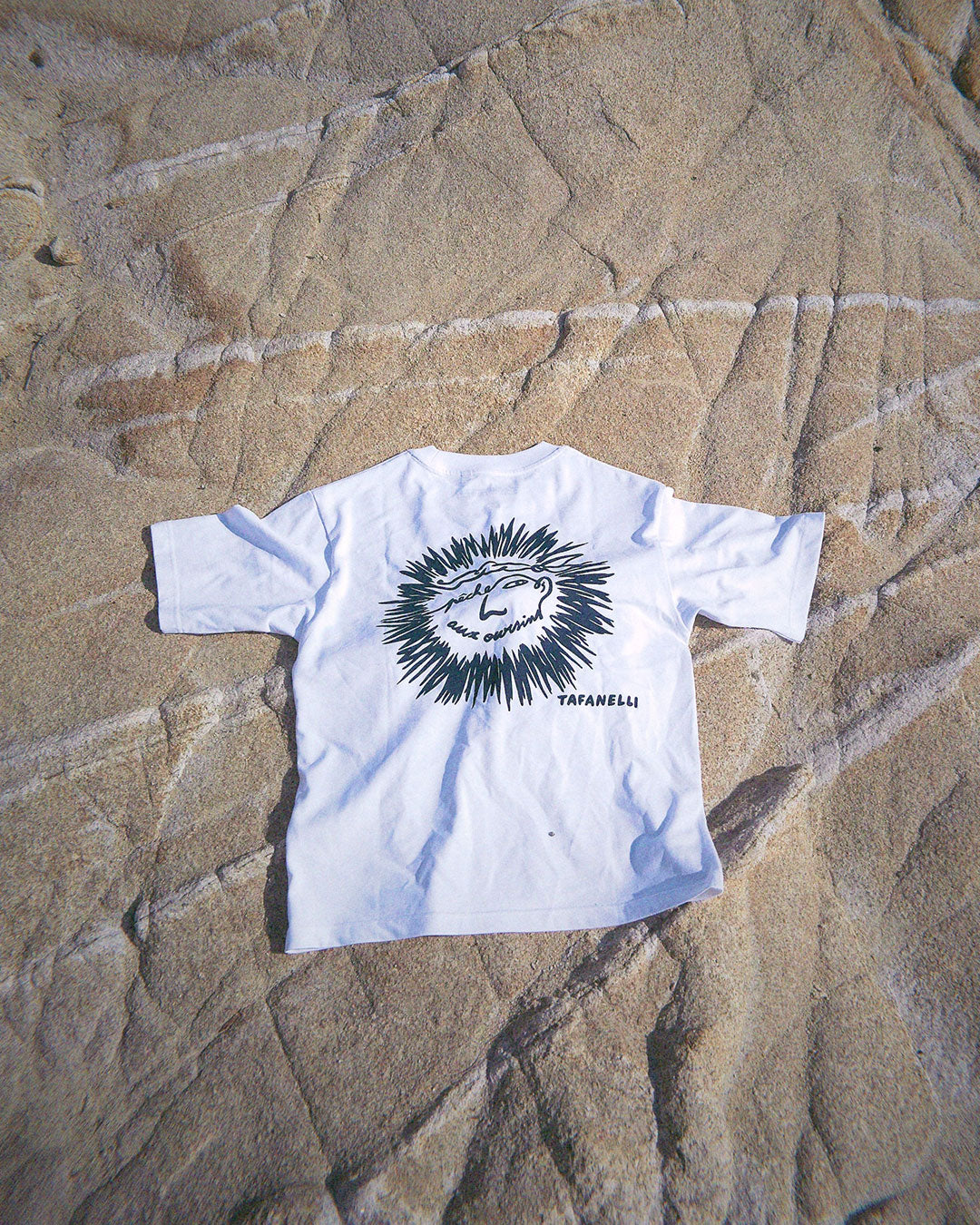
Our Le Corsica 1755 t-shirt, derived from the year of Paoli's Constitution, is the ideal identity piece for a Corsican charcuterie dinner. A garment that asserts territorial roots while simultaneously complementing the content of the plate.
The Corsican Bandana
Our Corsican bandana with its Moor's Head adds a discreet but strong identity touch to any outfit. Ideal for a convivial dinner around a charcuterie platter.
The Roccapina, for the evening
Our Roccapina oilskin jacket is perfect for a charcuterie dinner in the evening, especially in autumn and winter, the natural season for Corsican charcuterie. A statement piece that brings character to the outfit.
All our pieces are manufactured in France, hand-drawn by paid artists, and released in limited series. They carry the same requirement for preservation and tradition as the Corsican PDO charcutiers.
Continue the discovery
To deepen your knowledge of Corsican gourmet heritage and contemporary Corsica, here is a selection of TAFANELLI editorial articles that complement this one:
- The complete guide to AOC Corsican wines 2026
- Pietra, 30 years: the story of a Corsican beer
- August 15th in Corsica: Assumption, Ferragosto and traditions
- Cap Corse: the complete guide 2026
- Nuits de la Guitare de Patrimonio 2026
- Chez Léon and Hotel U San Dume in Cateri
- Corsican cultural calendar summer 2026
- Why TAFANELLI, the contemporary Corsican brand
Corsican charcuterie is not just a collection of gastronomic products. It is a living heritage that has embodied the island's entire agricultural and food culture for centuries. Every slice of coppa, every bite of figatelli, every piece of cured prisuttu tells a story that dates back to Nustrale pigs raised in free-range conditions in chestnut groves, to the family slaughter of All Saints' Day, to the curing cellars of the Castagniccia villages.
Faced with the competition of industrial imitations circulating under Corsican labels, supporting authentic and PDO producers is more than a gastronomic choice: it is a choice of cultural preservation. Every time you buy a PDO coppa, a PDO lonzu, a PDO prisuttu, or figatelli from a real Corsican producer, you contribute to keeping a millennial heritage alive that would otherwise gradually disappear under the economic pressure of fast food.
At TAFANELLI, we carry the same conviction in textiles that these artisanal charcutiers carry in charcuterie: that of refusing simplification, that of respecting the long term, that of transmitting knowledge. Our t-shirts and your PDO coppa tell, in their own way, the same Corsica: the one that lasts over time.
To see our entire current collection, head to tafanelli.fr. Free shipping in mainland France, same-day dispatch for all orders placed before 2pm.
A PRESTU,
TAFA