Sea urchins in Corsica: tradition, winter fishing, and island gastronomy
Every winter, when the Mediterranean calms down and turns a deep, almost black blue, Corsican fishermen bring out their baskets and head down to hunt for their annual treasure: the sea urchin. This little sea hedgehog, iconic to the Corsican coastline, holds a special place in island culture. A subject of traditional fishing, a delicate treat served raw straight from the water, and a symbol of winter conviviality among friends and family, the Corsican sea urchin is far more than just seafood. It is a living tradition, celebrated each year by the famous Ajaccio Sea Urchin Festival, and told in its own way on our Sea Urchin Fishing t-shirt.
The sea urchin, a Mediterranean Corsican totem
There are symbols in Corsica that are more than just culinary ingredients. They carry a memory, a way of life, and an intimate connection to the land and the sea. The sea urchin is one of these symbols. Every year, between December and April, sea urchin fishing brings Corsican families together on the coastal rocks in a winter ritual as old as Mediterranean civilization itself.
Contrary to popular belief, the sea urchin is not a summer dish. It is a winter delicacy whose tasting season coincides with the months when tourist-heavy Corsica has settled down and the island returns to its daily rhythm. Sunday fishermen head down with their baskets and gloves, open a few sea urchins right on the rocks, enjoy them with a small spoon and a glass of white Patrimonio wine, and rediscover this ancient bond between man, the sea, and its free treasures.
Eating a sea urchin fresh out of the water, on the rocks, on a January day with the low winter light and the sound of the waves, is to experience one of the purest and oldest moments that the Corsican Mediterranean offers to those who know how to respect it.
We wanted to tell the story of this deep-rooted connection between the sea urchin and island culture in our own way through our Sea Urchin Fishing t-shirt, one of our most iconic designs. A drawing that captures the gesture, the spirit, and the light of this Corsican ritual.
The Mediterranean sea urchin: biology and species
The edible sea urchin of Corsica belongs mainly to the Paracentrotus lividus species, commonly known as the purple sea urchin or edible sea urchin. It is the dominant species on Mediterranean rocks, found in abundance along all of Corsica's rocky and sandy coasts.
Paracentrotus lividus, our Corsican sea urchin
The Paracentrotus lividus measures between 4 and 7 centimeters in diameter. Its test (the rigid shell) is slightly flattened and spherical, protected by movable spines that are often purple, green, or brown depending on the individual and the area. It feeds primarily on algae, which explains the finesse and particular brininess of its flesh.
It is this flesh, or rather its gonads (the reproductive organs), that is consumed. Five coral-orange lobes arranged in a star pattern inside the test offer a sweet, briny, almost floral flavor that has made the Mediterranean sea urchin famous in global gastronomy.
A rocky and sandy habitat
The purple sea urchin is found mainly in rocky bottoms and posidonia seagrass beds at depths of up to about 20 meters. In Corsica, it is found everywhere: in the secluded coves of Cap Corse, on the rocks of Balagne, in the bays of Southern Corsica, around the Sanguinaires Islands, and in the transparent waters of Palombaggia.
An essential ecological role
Beyond its culinary interest, the sea urchin plays an essential ecological role in Mediterranean marine ecosystems. It regulates algae populations, contributes to the reproductive cycle of posidonia, and serves as a food source for several fish species (sea bass, sargo, sea bream). Overfishing can therefore have significant consequences on the balance of the Corsican seabed.
Traditional sea urchin fishing in Corsica
Sea urchin fishing in Corsica is both a popular pastime and a family tradition. Unlike other more industrial Mediterranean fisheries, it remains largely practiced in the old-fashioned way, with simple tools and a direct relationship with the sea.
Traditional techniques
Two techniques dominate sea urchin fishing in Corsica:
- Picking by hand, using thick gloves to protect against the spines, while freediving near the rocks in shallow areas (less than 3 meters). This is the most traditional technique, still widely practiced by Sunday fishermen.
- Harvesting while diving, using a mask and snorkel (sometimes fins), to retrieve sea urchins in deeper or less accessible areas. This technique requires good physical condition and knowledge of the terrain.
The gathered urchins are placed in an iron basket or a net kept at the water's surface, usually attached to a buoy. Once fishing is finished, the basket is hauled up, and the urchins are either opened on the rocks to be eaten or transported alive to be enjoyed at home.
Know-how passed down from generation to generation
Sea urchin fishing is one of those skills passed down from generation to generation in Corsican families. Children learn from a very young age how to spot the best spots, how to distinguish male from female urchins (the latter of which have more generous flesh), how to open a sea urchin with a suitable knife without getting hurt, and how to appreciate the fresh flesh.
This intergenerational transmission is one of the reasons why the sea urchin holds such a central place in the Corsican imagination. Every family has its favorite coves, its fishing anecdotes, and its specific ways of preparing the meat. It is a living heritage that is rarely documented in books but exists intensely in island family memory.
Current regulations
Sea urchin fishing is regulated in Corsica to preserve the resource. The main rules are:
- Authorized period: from December 16 to April 15 of each year (legal dates).
- Minimum size: 5 centimeters in diameter (spines excluded).
- Daily quota: maximum 4 dozen per person (i.e., 48 sea urchins).
- Prohibition in certain protected areas (marine reserves, national parks): Scandola, Bouches de Bonifacio, Pointe de Revellata, and others.
Respecting these regulations is essential to allow the resource to replenish and to keep the island tradition alive.
The sea urchin season: December to April
The legal sea urchin fishing season in Corsica runs from December 16 to April 15. This period corresponds both to the sea urchins' reproductive cycle (when the gonads are full and flavorful) and to the Corsican tourist off-season (when pressure on the resource is minimal).
Why winter?
Unlike most seafood that is consumed in summer, the Mediterranean sea urchin is enjoyed in winter for several reasons:
- The flesh is richer: it is in winter that the gonads reach their maximum maturity, filled with nutrients accumulated during the previous months.
- The taste is more intense: cold temperatures slow down the sea urchins' metabolism and concentrate the briny and sweet aromas.
- The preservation is better: the cooler water keeps the harvested urchins fresh, and they can be consumed up to 24 hours after fishing without degradation.
The best month for tasting
For enthusiasts, February and March are generally considered the prime months for tasting Corsican sea urchin. This is when the flesh reaches its peak in terms of texture (melting but firm) and flavor (briny without being bitter, sweet without being bland).
This is also the period when the popular festivals centered around the sea urchin traditionally take place, the most famous of which is in Ajaccio.
The Ajaccio Sea Urchin Festival and other events
Every winter for several decades, the city of Ajaccio has celebrated the Corsican sea urchin through a popular festival that has become a staple of the island's culinary calendar.
The Ajaccio Ursulinata
The Sea Urchin Festival, called Ursulinata in Corsican, is traditionally held in February at the Charles Ornano marina or in the Place Foch in Ajaccio. Each year, it brings together thousands of people for a collective tasting of sea urchins fished locally by partner professional and amateur fishermen.
The event structure is traditionally the same. Tables are set up in the square, baskets of freshly caught sea urchins are placed in the center, professionals open the urchins as people eat, and Corsican white wines (Vermentinu from Patrimonio, white Ajaccio, Corsican white wines) accompany the feast. The atmosphere is that of a grand, warm, and family-friendly winter festival, open to everyone.
Other sea festivals in Corsica
Beyond Ajaccio, several Corsican villages organize their own sea urchin festivals or sea festivals during the winter season:
- Bastia and its fishermen's festival at the old port, usually in February.
- Saint-Florent and its sea festival with tastings of sea urchins and local products in February-March.
- Bonifacio and its sea days, with a focus on traditional fishing.
- Several villages in Cap Corse (Centuri, Erbalunga) also offer organized tastings during the season.
To find out the specific 2026-2027 dates for the various events, check our regularly updated Corsican cultural calendar.
Where to taste the best sea urchins in Corsica
Outside of popular festivals, several Corsican restaurants offer quality sea urchin tastings during the season. Here are our recommended addresses, by region.
In Ajaccio
- Da Mamma, an essential Ajaccio eatery that serves raw sea urchins during the season.
- Le 20123, with its winter menu highlighting local seafood.
- A Nepita, creative Mediterranean cuisine with exceptional sea urchin service in February-March.
In Bastia and the North
- Le Ferry Boat at the old port of Bastia, a historic address where sea urchins arrive directly from the baskets of nearby fishermen.
- La Voile in Saint-Florent, which offers a remarkable marine winter menu.
- Chez Charles in Farinole, where the simplicity of the ingredients highlights the quality of the day's catch.
In Southern Corsica
- Le Café de la Poste in Bonifacio, a historic address that has been supporting local fishermen for decades.
- Grand Hôtel Cala Rossa in Porto-Vecchio, offering an upscale gastronomic experience focused on the Corsican sea urchin (TAFANELLI retailer).
- Domaine de Murtoli, where the sea urchin experience is particularly refined (also a TAFANELLI retailer).
Our map of our ten friendly addresses in Corsica will guide you in choosing the best establishments for an authentic sea urchin experience.
Traditional Corsican sea urchin recipes
Beyond eating them raw with a small spoon, the Corsican sea urchin lends itself to several traditional preparations that are part of the island's culinary heritage.
Raw sea urchin, the traditional way
The simplest and most authentic way to enjoy sea urchin is to eat it raw, with a small spoon, inside its test. After opening it with a pair of scissors or a suitable knife (by attacking the flat part around the mouth), you scoop out the five gonad lobes and eat them directly with the briny juice that surrounds them. Fresh bread, a drizzle of Corsican olive oil, a glass of Patrimonio white: it’s the perfect experience.
Sea urchin spaghetti
A great Mediterranean classic adopted by Corsican cuisine, sea urchin spaghetti (spaghetti ai ricci di mare) is one of the most beautiful preparations possible with this product. Thirty sea urchins for four people, opened and collected cold in a bowl. Spaghetti al dente, quickly tossed in olive oil, crushed garlic, and fresh parsley. Incorporate the sea urchins off the heat at the last moment, add a grind of black pepper, and serve immediately. A dish of disarming simplicity and rare gustatory intensity.
Sea urchin omelet
A more rustic but very Corsican recipe, the sea urchin omelet is prepared by whisking eggs with the gonads of about ten sea urchins, a bit of heavy cream, parsley, and chives. Cook it over low heat in a skillet and serve with fresh bread and white wine. A generous and fragrant winter starter.
Sea urchin toast
Aperitif version: on slices of toasted bread, spread a little semi-salted butter, place the fresh sea urchin gonads directly on top, and add a drizzle of olive oil and a pinch of fleur de sel. Serve with a crisp white wine. Simple, elegant, very Corsican.
The sea urchin, symbol of a fragile Mediterranean
It must be said clearly: the Corsican sea urchin is a fragile resource, threatened by several contemporary factors. Safeguarding this tradition requires collective reflection.
The threats facing the species
Several pressures contribute to weakening the Corsican sea urchin population:
- Overfishing, particularly by amateurs who exceed legal quotas or fish out of season.
- Climate change, which alters temperatures and marine acidification, affecting reproduction.
- Habitat destruction, particularly of seagrass meadows, which are essential for sea urchin reproduction and nutrition.
- Pollution, especially sewage discharge and hydrocarbons, which affects the flesh.
How to consume sea urchins responsibly
To perpetuate the tradition without endangering the resource, here are some principles for responsible consumption:
- Respect the legal season (December 16 - April 15).
- Respect quotas (4 dozen maximum per person per day).
- Respect the minimum size (5 cm in diameter).
- Avoid protected areas (Scandola, Bouches de Bonifacio, etc.).
- Prioritize local consumption, caught by Corsican professionals who respect the rules.
- Do not collect more than necessary: sea urchins cannot be kept in the freezer; they should be eaten fresh.
It is this ecological awareness, combined with a respect for tradition, that will allow our children and grandchildren to continue experiencing the ritual of sea urchin fishing just as we do today.
Our "La Pêche aux Oursins" T-shirt: the story behind the design
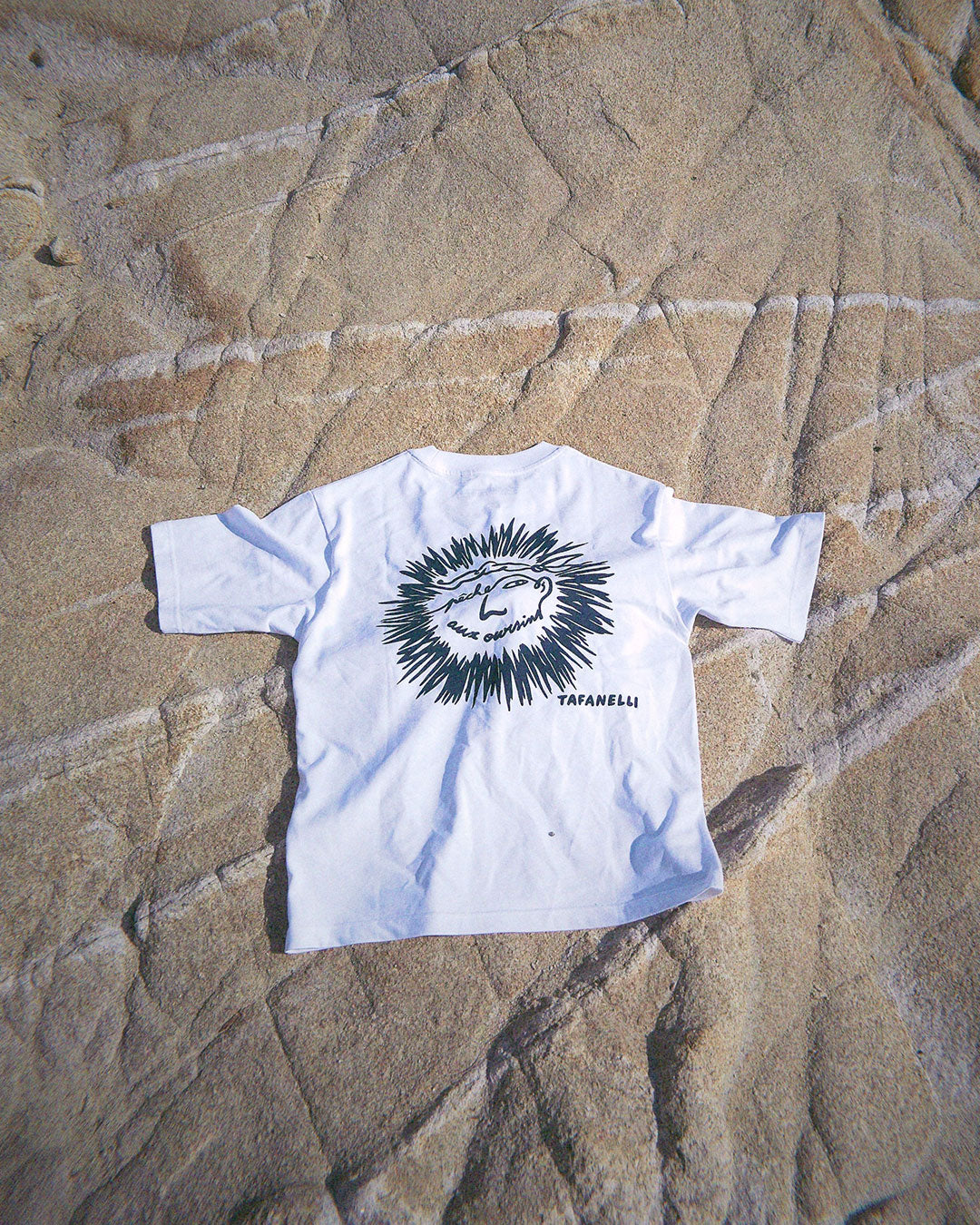
At TAFANELLI, the place of the sea urchin in the Corsican imagination is so dear to us that we wanted to dedicate one of our most iconic T-shirts to it: La Pêche aux Oursins.
The design: between tradition and modernity
Our "La Pêche aux Oursins" T-shirt depicts a Corsican free-diver, basket in hand, surfacing with his catch. A design that captures in a single image everything the tradition entails: the ancestral gesture, the direct relationship with the sea, the generosity of the Mediterranean seabed, and the beauty of an intimate moment between man and his territory.
The lines are thick and hand-drawn in our signature graphic style, inherited from Cocteau and Matisse. It is a drawing that does not seek to be photorealistic, but rather to capture the poetic essence of the act, much like an editorial illustration in a Mediterranean travel journal.
Artisanal manufacturing
Our "La Pêche aux Oursins" T-shirt is made in France from 280 g/m² Made in France cotton, woven and tailored in our partner workshops. The screen printing is applied by hand in our partner workshop, Graphitech, using resistant inks that will age with the garment, developing a beautiful patina.
Each piece is produced in a limited edition, which distinguishes it radically from the industrial T-shirts on the market. Each copy bears the artisanal standards we apply to every stage of production.
For whom, for what purpose
Our "La Pêche aux Oursins" T-shirt is particularly worn by:
- Lovers of Corsica who want to proudly wear a strong cultural identity.
- Divers, spearfishermen, and sea enthusiasts who recognize in the design a practice that touches them personally.
- Foodies who enjoy combining their passion for seafood with their wardrobe.
- Collectors of hand-drawn clothing, limited editions, and workshop-style pieces.
It can be worn perfectly in any season, but takes on a special resonance during the sea urchin fishing season (December-April), when the motif begins to tell a living, current story.
The 1755 ecru version, our rarest edition
In addition to the classic model, we wanted to offer an exceptional edition of "La Pêche aux Oursins" in our 1755 range, the line produced with our highest level of artisanal execution.
An exceptional piece
The "La Pêche aux Oursins 1755" version features the same iconic drawing of the free-diver, but in an ecru version with four-color screen printing applied by hand in a denser frame. The rendering is more stately, deeper, and more editorial.
It is our rarest "La Pêche aux Oursins" piece, produced in a run of only 30 pieces. It is a piece that we will not restock once it is sold out, following our philosophy of controlled rarity.
For whom?
This 1755 version is aimed at collectors, lovers of high-fashion textile craftsmanship, and those who want to wear a piece that is authentically rare, with a story to tell and a depth of execution that few French brands offer today.
The 1755 range, named after the year of Paoli's Corsican Constitution, embodies our commitment to making pieces last beyond seasons and trends. A line designed to last and be passed down.
→ Discover the "La Pêche aux Oursins" 1755 range (ecru edition, 30 pieces only)
Continue exploring
To deepen your knowledge of authentic Corsica and its gastronomic and maritime traditions, here is a selection of TAFANELLI editorial articles that complement this one:
- The complete guide to Corsican AOC wines 2026
- The 20 most beautiful wild beaches in Corsica 2026
- The Corsican cultural calendar Summer 2026
- August 15th in Corsica: Assumption, Ferragosto, and traditions
- Pietra, 30 years: the story of a Corsican beer
- Nuits de la Guitare de Patrimonio 2026
- Why TAFANELLI, the contemporary Corsican brand
The sea urchin in Corsica is much more than a seasonal seafood. It is a living tradition, a winter rite that has brought Corsican families together for generations around a simple and intimate gesture with the Mediterranean. In our TAFANELLI universe, it is also a symbol of everything we want to honor: respect for time, artisanal know-how, and loyalty to a territory.
Whether you are a fan of Corsican gastronomy, a passionate diver, or simply a lover of our island, our "La Pêche aux Oursins" T-shirt will allow you to wear this tradition against your skin, with the same artisanal rigor that goes into the traditional fishing itself. And for those seeking the rarest edition, our 1755 version in ecru remains available in a strictly limited series of 30 pieces.
To find our entire current collection, head to tafanelli.fr. Free shipping in mainland France, same-day dispatch for all orders placed before 2:00 PM.
A PRESTU,
TAFA