Pietra, 30 years on: the story of the Corsican beer that changed the island
In 2026, the Pietra brewery celebrates its thirtieth anniversary. Thirty years of Corsican beer made with chestnut flour, of commercial trials, of gradual recognition, and of family legacy between two generations of the Sialelli family. Thirty years that have transformed an intuition had at a concert bar in 1992 into one of the most iconic contemporary Corsican brands. Here is the full story of this adventure. And at the end of the article, the piece we designed with them for the occasion, which is now available.
A brand that has become Corsican heritage
There are brands that, at a certain point, are no longer just companies. They become cultural touchstones. They become part of the collective landscape, they join family meals, and they occupy a place in the island's memory. Pietra is one of those.
Today, it is hard to imagine a Corsican beach bar on a summer evening without a Pietra Amber on the table. A Sporting Club de Bastia match without a Colomba at halftime. A trip to an inland village without a bottle of Serena appearing at the second round of drinks. In thirty years, Pietra has gone from a craft curiosity to a daily companion of contemporary Corsica.
Today, when we talk about Corsican beer, no one asks if it actually exists anymore. That is a bet won.
This is the story of that success, told through the words of Hugo Sialelli, the current director, son of the founders, who officially joined the company eight years ago and has been at its helm for four. A story that begins, as is often the case in Corsica, with a phrase spoken aloud at a bar on a summer evening in 1992.
1992: The idea born at a concert bar
It is the summer of 1992. A concert somewhere in Corsica. A woman leans against the bar and asks for a beer. She wants something local, a beer from here, a Corsican beer. The owner smiles, shrugs his shoulders: it doesn't exist.
That woman is Armelle Sialelli. Next to her is her husband, Dominique. And that phrase, that absence of Corsican beer, will spark an idea in them that they will never let go.
"In the tone of 'macagna'"
As their son Hugo recounts today, the idea was born "somewhat in the tone of 'macagna'"—that form of Corsican humor that mixes irony and gentle provocation. A joke, almost a challenge thrown out aloud. But within that joke, there was already the intuition of a void in the Corsican economic and cultural landscape.
Because in 1992, Corsica was an island of wine. It produced exceptional wines, artisanal liqueurs, and spirits. But it did not produce beer. Beer, in the collective imagination, belonged to other regions: Belgium, Germany, Alsace, the Czech Republic.
An idea that would mature for four years
Between the intuition of 1992 and the founding of the brewery in 1996, four years of maturation would pass. Four years during which Armelle and Dominique Sialelli studied, did research, tested, and imagined what a truly Corsican beer could be. A beer that wasn't just made in Corsica. A beer that came from Corsica. A beer with roots, an origin, and a strong territorial identity.
It was during these four years that the idea that would change everything emerged: integrating a quintessentially Corsican ingredient, chestnut flour, into the beer's recipe. A move that was both technical and symbolic, which would give Pietra its singular, immediately recognizable character and embed it in a long cultural history.
1996: Armelle and Dominique Sialelli launch Pietra
In 1996, the company was officially founded. Armelle and Dominique Sialelli settled in Upper Corsica and began producing their beer according to the recipe they had developed. An amber beer, robust and aromatic, with that distinctive note of chestnut that immediately separated it from every existing European beer.
The name chosen was Pietra, which means stone in Corsican. A name that sounds like a foundation, like a bedrock, like a mineral anchoring in the territory. A name that also recalls the stones of old villages, the granite and schist walls of Corsican houses, and the unique geology of the island.
A family business in its early days
The operation was modest at first. Armelle and Dominique drove the project with sheer force of will. They went to markets, fairs, and village grocery stores to explain what their beer was, offer tastings, and persuade people. Their son Hugo, still a teenager and then a student, pitched in during school holidays. He recounts today that he "did his first seasons here, putting bottles into boxes, boxes onto pallets, pallets into trucks." An apprenticeship on the workshop floor, in the old-fashioned way, in line with Corsican family traditions.
The first bet: convincing Corsica
Contrary to what one might imagine, the first obstacle to overcome for Pietra was not convincing the mainland. It was convincing Corsica itself. On an island where beer culture was still embryonic in the mid-1990s, where wine dominated, and where consumption habits were rooted in other traditions, they had to engage in the work of education, demonstration, and persuasion.
As Hugo Sialelli summarizes, "Corsica was not a beer region, so we had to both convince the consumer that it was a good product and, at the same time, succeed in defining what a Corsican beer was." It was this dual mission, both technical and cultural, that would occupy the founders for more than a decade.
Chestnut flour, a founding gesture
Choosing chestnut flour as Pietra's signature ingredient was neither a whim nor a simple marketing gimmick. It was a deeply Corsican cultural gesture, drawing from a millennial history of agriculture and food.
The chestnut, Corsica's bread tree
For centuries, the chestnut was known in Corsica as the "bread tree." Its flour was used to make pulenda, a staple dish in many parts of the island, particularly the Castagniccia (whose name comes precisely from the chestnut). It nourished the people and the black pigs that then provided the prisuttu, coppa, lonzu, and figatelli. It was at the heart of the Corsican agricultural economy until modernization gradually relegated it to the status of a heritage product.
By choosing chestnut flour as the signature of their beer, Armelle and Dominique Sialelli were doing more than choosing a recipe. They were reconnecting a modern drink with an ancestral raw material of the island; they were placing the brewing craft back into a broader cultural continuity.
A millennial drink reinterpreted
As Hugo Sialelli recalls, "beer is the oldest drink in history. Traces of beer have been found in Mesopotamia from over 5,000 years ago." It was the way every ancient city found to preserve both water and grains: put grains in water, let the yeasts present on the grains ferment, and obtain this mixture with nutritional and hygienic virtues.
Taking this ancient technique and partially substituting traditional grains with Corsican chestnut flour is reinventing an ancestral gesture using the resources of a specific territory. It is this fidelity both to global tradition and to local identity that would, over the years, give Pietra a symbolic depth that few Corsican brands have managed to build.
In Corsica, the chestnut is not an ingredient. It is a memory. Introducing this memory into a modern drink was a political gesture in the noble sense of the term: that of placing contemporary craft in a lineage that goes back centuries before us.
The difficult early years
Despite the beauty of the gesture and the soundness of the intuition, the first years of Pietra were what Hugo Sialelli bluntly calls "a true desert crossing."
Markets, fairs, and village shops
Armelle and Dominique Sialelli would explain, over and over, what their product was. They went to markets in Ajaccio, fairs in the Balagne, and village grocery stores in Cap Corse and Castagniccia. Each time, the pedagogical work had to start over: explaining the recipe, offering tastings, and breaking down prejudices about beer not being a Corsican drink.
It was a commercial labor of Sisyphus that would have discouraged many founders. But the Sialellis held firm, carried by the intimate conviction that their product was good, that the idea was right, and that the market would eventually mature.
The pioneer's paradox
What the Sialellis experienced in the late 1990s was the classic pioneer's paradox. They were right too soon. The craft beer market, which would explode in France in the 2010s, did not yet exist. Consumers were not looking for unique regional beer: they bought their 24-packs in supermarkets, with little distinction.
But it is precisely because the Sialellis held on during those difficult years that they were able to surf the wave in a dominant position when it finally arrived. "The fact that we had already been there for 15 years allowed us to be carried by that wave," summarizes Hugo Sialelli in hindsight.
Family conviction as a driving force
Doubtless, this period would have killed a conventional business project with rushed investors and quarterly targets. But Pietra is a Corsican family business, driven by a couple living on the island who were ready to take whatever time was needed. It is this long-term perspective, this family grounding, and this absence of short-term pressure that saved the project in its toughest years. A lesson that applies beyond brewing: the great contemporary Corsican brands are almost all family-owned, patient, anchored, and have refused shortcuts.
National and international presence
At the turn of the 2010s, everything changed. The beer market in France evolved as it did everywhere in Europe. Consumers discovered craft beer, regional beer, and characterful beer. Microbreweries multiplied. Supermarket shelves opened up to more varied references.
A wave that carried Pietra
Pietra, present on its home territory for fifteen years with a singular product, was perfectly positioned to take advantage of this evolution. The brand benefited from its longevity, its credibility, its product knowledge, and its patiently built commercial network. It was already known and respected by French craft beer lovers, who readily categorized it as a major regional reference alongside the great breweries of Alsace or Northern France.
Expanding distribution
Distribution expanded. Pietra appeared on the shelves of mainland supermarkets, in Parisian beer bars, and in fine food shops dedicated to regional products. It gradually moved from the status of a tourist beer brought back in summer visitors' suitcases to that of a respected craft beer ordered all year round by knowledgeable enthusiasts.
International reach
Internationally, Pietra also began to find its place. International brewing competitions, exports to several European markets and beyond. The brand became a discreet but effective ambassador of contemporary Corsican craft, alongside Patrimonio wines, AOC charcuterie, and coppa. Every Pietra sold abroad carries with it a piece of the Corsican story.
As Hugo Sialelli summarizes with pride, "I think we can be proud of our resonance in Corsica and elsewhere."
The transition to Hugo Sialelli
Eight years ago, Hugo Sialelli officially joined the family business. Four years ago, he took over its management. A generational transition that happened slowly, smoothly, and without a brutal break.
Born into the company
As he tells it, he was "kind of born into the company." His first seasons at Pietra go back to his adolescence. He saw his parents struggle during the desert crossing, he saw the brand take off, he saw the brewery grow, hire, and professionalize. This early immersion gave him an intimate knowledge of the product and the company that no MBA could replace.
A slow and intentional transition
"We decided to have a transition happen quite slowly, because my parents are still here," he specifies. This way of doing things, respectful and unhurried, contrasts with the brutal transitions that strike so many family businesses. It testifies to an emotional intelligence and intergenerational respect that form the specific strength of certain Corsican family adventures. The founders are not leaving. They are accompanying. They are passing the torch. They continue to lend a hand as long as they can.
A long-term project
This transition is not just a transfer of power. It is a pact of continuity. "I hope we will really be in this company together for as long as possible," says Hugo. A phrase that, in the cynical universe of contemporary business, sounds like a rare declaration of attachment. A father and son who wish to continue working side by side to carry on the brand they created together. That is true Corsican transmission: not a succession, but a prolonged collaboration.
Furiani, a 100% Corsican site
Pietra's industrial site is located in Furiani, in the southern suburbs of Bastia, in Upper Corsica. A geographic choice with deep significance.
A brewery on its home soil
Furiani is in the Marana, the plain between Bastia and Biguglia. A historic industrial region of Corsica, where much of the island's processing, storage, and distribution activities have long been concentrated. Choosing Furiani means anchoring Pietra in the concrete economic fabric of Upper Corsica, near the port of Bastia through which most exports transit, near Poretta airport, and near the Bastia labor pool.
100% of production on-site
What distinguishes Pietra from many contemporary regional brands is that 100% of the production takes place here. The brand did not give in to the temptation of outsourcing all or part of its production to mainland breweries to reduce logistics costs. It made the expensive but faithful choice of doing everything at its Corsican site, with its teams, with its facilities, and with its own technical mastery.
As Hugo Sialelli says, "we try to be a big family, all while producing 100% of our beers here."
About forty employees, a family atmosphere
The brewery now has about forty employees, a figure that testifies both to the success of the project and its scale. It is not a multinational. It is a human-sized company, capable of maintaining a coherent internal culture, a constant product requirement, and a direct relationship between management and the teams.
Some employees have been there since the company's early days. Others have joined recently. This mix of veterans and newcomers, of memory and fresh energy, is one of the assets that Pietra cultivates intentionally.
The challenges of being an island and the France 2030 plaque
Producing beer on an island like Corsica in 2026 is not plain sailing. Pietra must deal with specific constraints that do not arise in the same way for its continental competitors.
Global warming and water stress
The first challenge is that of climate change. Higher temperatures, dwindling rainfall, and summer water stress complicate production. Beer is a drink that requires a lot of water, beyond what it contains: it is needed for cleaning, for cooling, and for technical steps. On an island where water becomes more precious each summer, this constraint is becoming central.
Supply chain constraints
The second challenge is that of supply. Malt, hops, chestnut flour, various raw materials: on an island, everything arrives by boat or plane, with logistical costs and delays that do not exist for an Alsatian or Belgian brewer. Pietra must anticipate more, store more, and manage more complexity than a continental competitor of comparable size.
The France 2030 plaque for the CO2 recovery unit
Faced with these constraints, the brewery did not choose the path of surrender, but that of innovation. Pietra has received the France 2030 plaque, a distinction granted by the State to companies engaged in industrial projects deemed innovative and sustainable. The distinction concerns a specific project: the CO2 recovery unit.
As Hugo Sialelli explains, "we need CO2 in beer. On one hand, we produce it. On the other, we consume it. And we thought we would try to recover it." In other words: instead of letting the CO2 produced during fermentation escape, and then importing it from the mainland for the steps that require it, Pietra has developed a device to recover and reuse its own CO2 in a loop. A miniature circular economy, adapted to the constraints of island life.
Frugality, autonomy, decarbonization
The CO2 recovery unit is not an isolated gesture. It is part of a three-pillar industrial strategy that Hugo Sialelli is happy to explain.
Pillar 1: frugality
Frugality means "consuming little energy and little water to produce beer." A principle simple to state but demanding to apply. Each technical step is rethought to reduce energy consumption. Each water circuit is optimized to recycle what can be recycled. Frugality is not just an ecological stance. It is an industrial discipline that also improves long-term profitability.
Pillar 2: autonomy
Autonomy stems directly from being an island. "Being an island pushes us to be autonomous in terms of electricity or CO2, to be masters of the way we will consume our energies," explains Hugo Sialelli. Not to depend on a mainland that can be cut off by a port strike, a storm, or a crisis. To develop on-site the skills, infrastructure, and processes that allow us to hold out without the mainland for several weeks if necessary.
Pillar 3: decarbonization
Decarbonization means "being as clean as possible for the territory in which we are located." To reduce greenhouse gas emissions at every step. To choose suppliers with a low carbon footprint. To optimize logistical circuits. Decarbonization is not just an upcoming regulatory constraint. It is an ethic of the territory: producing beer on a magnificent island implies not contributing to its degradation.
Frugality, autonomy, decarbonization: these three words could be those of a committed contemporary company. Above all, they are those of a Corsican company that has understood that being an island, far from being a constraint, is an accelerator of innovation. When you have no other choice but to invent, you invent. Pietra has been doing it for thirty years.
Our visit to the brewery
Before launching the piece, we wanted to see it. Not the photos, not the brochures: the place itself.
We therefore went to Furiani, to the brewery, where everything is made. The tanks, the bottling lines, the smell of malt, the continuous noise of the machines, the teams at work in the middle of the season.
What strikes you, when you know the history, is the distance traveled. Thirty years earlier, two people were trying to convince a village grocer to take three bottles on consignment. Today, about forty employees run a site that produces all its beers on the island and recovers its own CO2.
What also strikes you is what has not changed. The family is still there. The father and son work side by side. Chestnut flour is still in the recipe. And no one, in this brewery, talks about their beer as a product.
We screen-print by hand. They brew on their island. These are two different professions with exactly the same constraint: refusing the shortcut that would make everything simpler.
From the brewery, we returned to the workshop. And the work began.
LA PIETRA | 30 ANNI: the piece is available
That is the complete story of Pietra's thirty years. And here is what we designed with them for the occasion.
LA PIETRA | 30 ANNI, a piece in exclusive collaboration with the brewery, in a strictly limited edition.
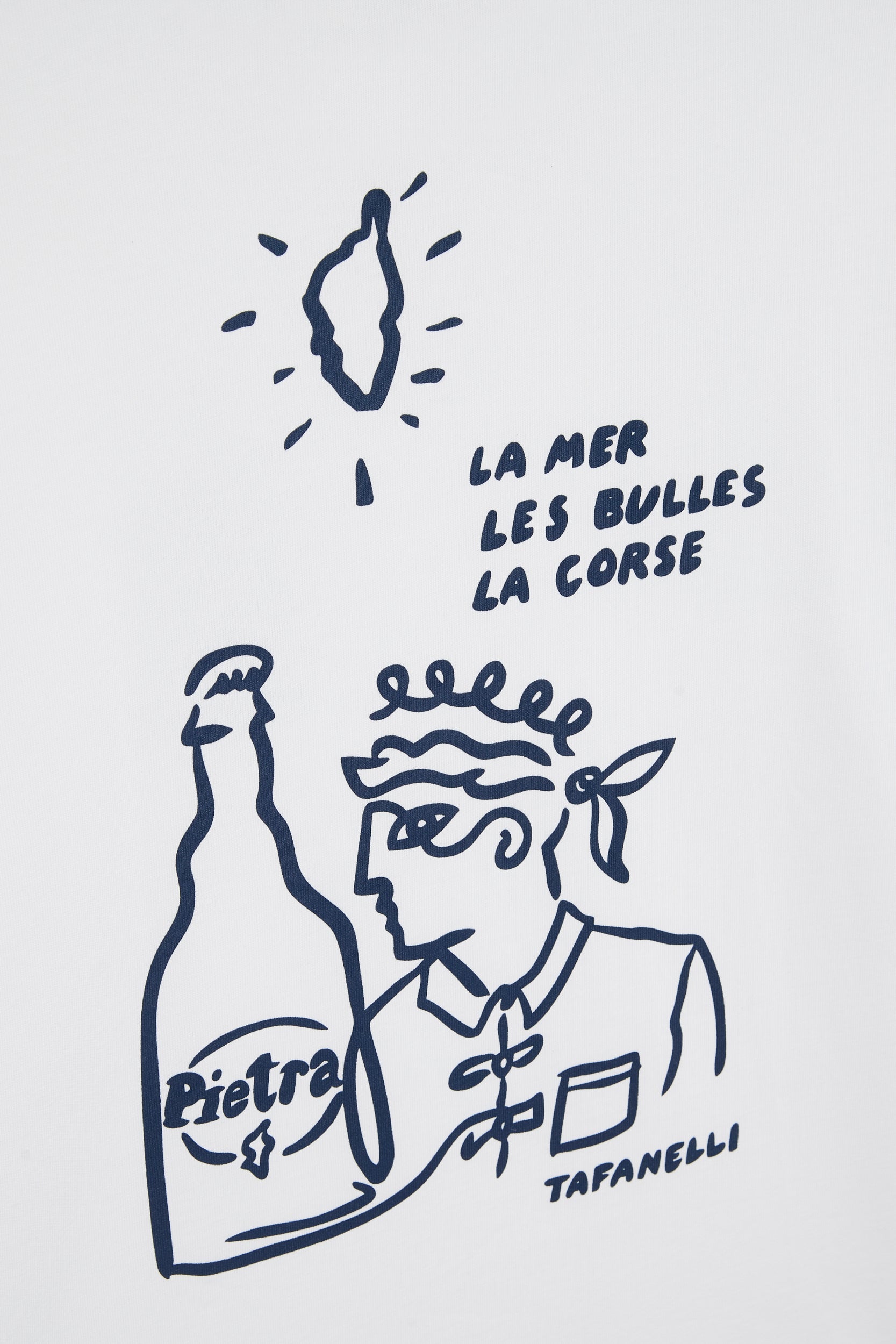
The sea, the bubbles, and Corsica
That is the phrase that guided the entire design, and it is the one that appears on the piece. Three elements, nothing more. What Pietra took thirty years to bring together in a bottle, we tried to hold in a single motif.
What it is
- 280 g/m² organic cotton, pre-washed, a combed cotton from Portugal.
- Hand screen-printed, frame by frame, in our workshop. Our founding gesture, the one on which we never compromise.
- €85, available from S to XXL.
- Limited edition. When the series is sold out, it will not return. That is the very principle of an anniversary piece.
Where to find it
It is available now at tafanelli.fr and at Casa Pietra, on-site, at the brewery.
A tribute to thirty years of Corsican adventure
This collaboration is particularly close to our hearts. Pietra paved the way for a whole generation of Corsican entrepreneurs by demonstrating that it was possible to create on the island, to produce on the island, and to reach national and international markets from the island. Without Pietra, there would probably be no TAFANELLI as it exists today.
To the Pietra brewery, to Armelle and Dominique Sialelli, to Hugo, to the teams in Furiani: happy thirtieth anniversary, and thank you for their golden trust.
Continue the discovery
To delve deeper into the world of contemporary Corsican artisans and extend the reading, here is a selection of TAFANELLI editorial articles that complement this one:
- The complete guide to Corsican wines 2026
- Plaine Orientale season 2 filmed in Bastia: the Corsica that is finally telling its own story
- François D'Haene breaks the GR20 record in 29h46
- Things to do in Bastia: 15 must-sees
- Corsican brand: what it means, and how to recognize the real thing
- Corsican cultural agenda summer 2026
- San Ghjuva in Bastia, the night of the Saint-Jean fire
- Hand screen printing, the artisan gesture that makes the difference
Thirty years of Pietra is much more than a company anniversary. It is the story of an island that, through its artisans, its brands, and its talents, has learned to speak with its own voice. An island that is no longer defined by others, but that tells its own story, with its creators, farmers, brewers, winemakers, designers, directors, and athletes.
At TAFANELLI, we are proud to be part of this lineage and to have made our contribution to this thirtieth anniversary. And if you do not yet know Pietra beers, taste one the next time you pass through Corsica or a good Corsican grocery store on the mainland.
To find our entire current collection, head to tafanelli.fr. Any order placed before 11 a.m. is shipped the same day.
A PRESTU,
TAFA