Île de Beauté 1755: the story of a vintage t-shirt that tells Corsica's greatest tale
Some dates are printed on a garment out of sheer laziness. And there are those that are engraved because they carry something greater. 1755 belongs to the latter category. It is the year that Corsica became the first in the world to write a democratic constitution based on universal suffrage. Twenty-one years before American independence. Thirty-four years before the French Revolution. Our new piece, the vintage Île de Beauté t-shirt, tells this story through a maritime crest design inherited from the great yacht clubs of yesteryear. Here is the full story behind this premium Corsican t-shirt like no other.
Île de Beauté: the origin of a millennial name
Before it was French, before it was Genoese, and even before it was Pisan, Corsica already had a name given by the Greeks: Kallisté, which literally means "the most beautiful." Around 565 BC, Phocaean sailors from Asia Minor founded the city of Aléria on the eastern coast of Corsica. Struck by the majesty of the coastline, the scents of the maquis, and the transparency of the waters, they christened the island with this Greek word that would endure for twenty-five centuries: Kallisté.
This name, translated by the Romans as Insula Pulchra, and later Gallicized into Île de Beauté (Island of Beauty), is not a tourist slogan invented in the 1980s. It is an intuition born two thousand five hundred years ago, shared by everyone who has set foot on this land since. From Seneca, exiled to the island in the first century, to Boswell who described it in the eighteenth, as well as Maupassant, Stendhal, Mérimée, and Camus, all recognized the same obvious truth: Corsica is not just one island among others. It is the island. The most beautiful one.
Putting "ÎLE DE BEAUTÉ" on a garment is, therefore, to invoke a millennial legacy. This is not a marketing hook. It is a transmission.
1755, the year Corsica invented democracy
To understand why this date appears discreetly on our t-shirt, to the right of the sail, we must go back to the mid-eighteenth century. At that time, Corsica had been officially Genoese for almost five centuries. But the island never stopped rebelling. Since 1729, the Corsicans had been rising up against the domination of Genoa in a war of independence that would last for forty years.
In 1755, after a series of decisive military victories, the Corsican insurgents convened an extraordinary assembly in the city of Corte, the island's historical interior capital. On November 16, they proclaimed the Corsican Constitution, drafted under the guidance of a thirty-year-old general: Pasquale Paoli.
This text was an absolute intellectual revolution. It is considered by historians to be the first democratic constitution in the world founded on Enlightenment principles. It established:
- A clear separation of executive, legislative, and judicial powers
- An electoral system based on universal male suffrage
- A representative assembly drawn from parishes
- Individual rights recognized for citizens
- A public and free justice system
- Public education for children
Twenty-one years later, in 1776, the American Founding Fathers would write the Declaration of Independence. Thirty-four years later, in 1789, France would proclaim the Declaration of the Rights of Man and of the Citizen. And all the while, since 1755, a small Mediterranean republic had already been living these principles every day.
This historical detail is rarely taught in French schools. Yet, it is colossal. When a Corsican speaks of island pride, they are often thinking of that precedence. Corsica was not just beautiful. It was a forerunner.
"The Corsican Constitution of 1755 is the most complete expression of the Enlightenment in practice. It preceded all other modern republican attempts."
— Dorothy Carrington, British historian, world authority on Corsican history
Pasquale Paoli, the Father of the Corsican Fatherland
Behind the Constitution of 1755 stands a singular figure whose international influence at the time went well beyond the island's borders: Pasquale Paoli (1725-1807), known in the Corsican language as U Babbu di a Patria, the Father of the Fatherland.
Born in Morosaglia, in northern Corsica, Paoli received a brilliant philosophical education in Naples. He returned to his island in 1755 to take the lead in the resistance against Genoa, and it was he who inspired the drafting of the Constitution. His reputation quickly became European. He corresponded with Voltaire and Rousseau; indeed, Jean-Jacques Rousseau would write in The Social Contract in 1762: "There is still in Europe a country capable of legislation: it is the island of Corsica."
James Boswell, the Scottish writer and biographer, came on a pilgrimage to Corsica in 1765 to meet him. From his stay, he produced a book, An Account of Corsica, which made Paoli famous throughout Europe and the Americas. The American Founding Fathers cited him as an example. So much so that in the United States, at the end of the eighteenth century, several cities and buildings still bear his name: Paoli in Pennsylvania, Paoli in Indiana, and Paoli's Tavern in Philadelphia.
Paoli embodies Corsican pride at its historical peak. He represents that rare moment when an island of three hundred thousand inhabitants influenced the political thought of an entire continent. Inscribing 1755 on a garment is a way of paying homage to this man and that moment.
Vintage inspiration: the code of the yacht clubs of old
The design of our Île de Beauté t-shirt was not born of a graphic whim. It is directly inspired by a specific sartorial tradition: the embroidered and printed patches of European yacht clubs from the 1960s to the 1990s.
At that time, every major Mediterranean port had its own yacht club, which produced polos, t-shirts, caps, and blazers adorned with a signature crest for its members. These crests all followed the same aesthetic code: a square or shield shape, a central maritime motif (sailboat, anchor, waves), an ornate frame, a hand-screen-printed typography, and a discreet date marking the club’s founding year.
The Yacht Club de Monaco, the Yacht Club Italiano in Genoa, the Royal Yacht Club of Cowes, the Yacht Club de France, the New York Yacht Club—all shared this visual grammar. Owning a t-shirt with your club's crest meant belonging to a specific nautical community, passing on codes, and signifying an attachment to a place and a collective memory.
This aesthetic reached its peak between 1965 and 1995, a period during which Mediterranean yacht clubs were still producing their textiles locally, in small batches, with imperfect screen printing that gave them an immediate patina. Today, these authentic vintage t-shirts change hands at high prices in the collectors' markets of Saint-Tropez, Porto Cervo, or Cowes.
Our Île de Beauté t-shirt is an overt homage to this grammar. With the difference that the yacht club we are celebrating does not exist in the directories. It is an imaginary yacht club that never opened its doors, but for which every Corsican holds the key. A yacht club whose statutes would have been written in 1755, in Corte, by Paoli himself.
The design decoded: every element tells a story
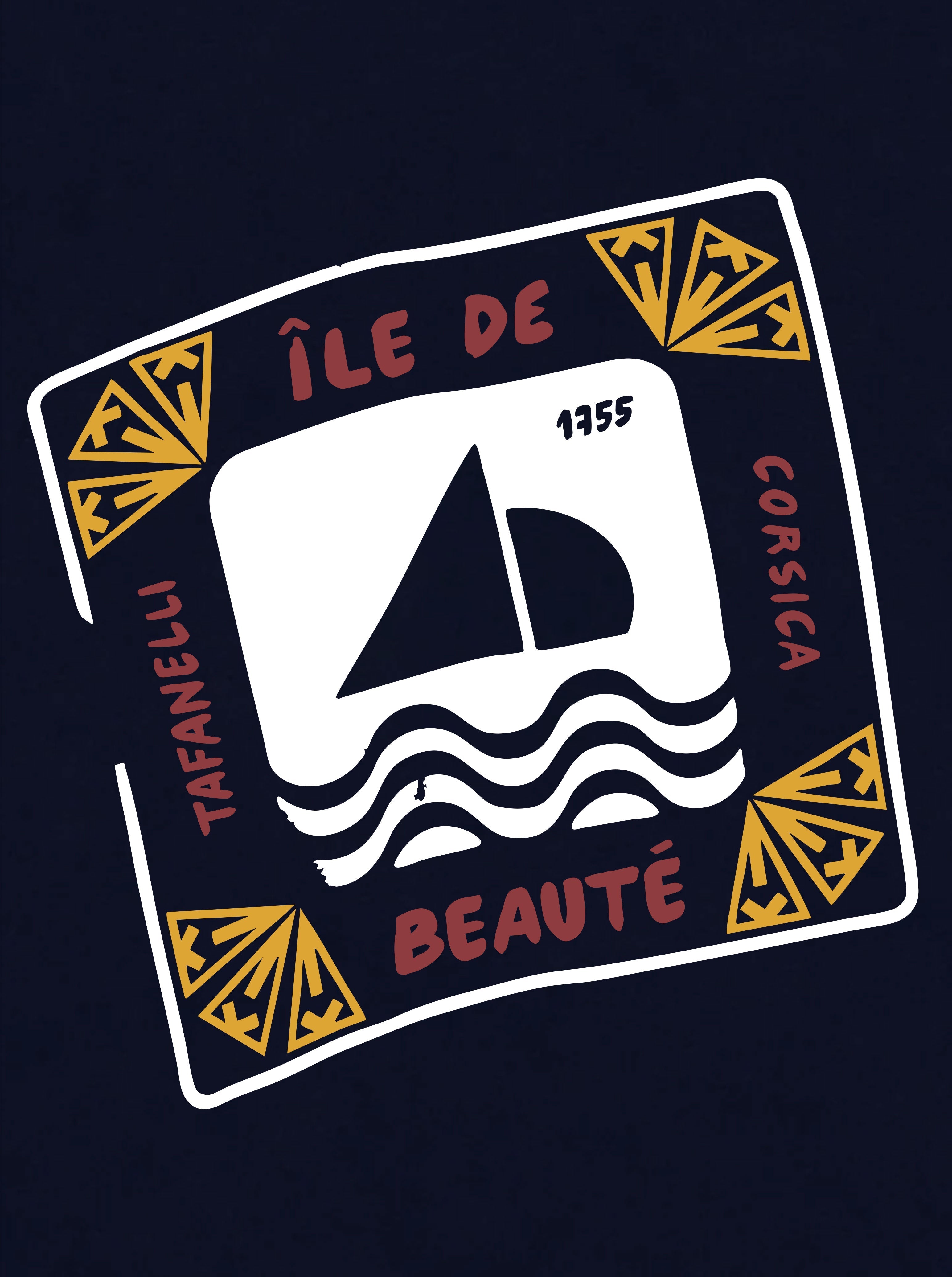
The central visual of the Île de Beauté t-shirt is a square crest that condenses several centuries of Corsican history into a single glance. Every element was chosen for its significance. Here is the full reading.
ÎLE DE BEAUTÉ, in the upper arc
Corsica’s millennial name, inherited from the Phocaeans, written in the handwritten typography of vintage screen prints. The upper arc evokes the celestial vault under which the sailboats navigate. It is the first thing you read. It is the declaration of identity.
BEAUTÉ, in the lower arc
The other half of the name, closing the composition in perfect symmetry with "ÎLE DE." This closed-arc construction is typical of heraldic shields. It gives the crest its circular structure and visual balance.
TAFANELLI on the left, CORSICA on the right, vertically
The two pillars of the crest. On the left, the name of the house providing its signature. On the right, CORSICA, in the Latin alphabet, which recalls both the official Italian name (the island's historical language until the nineteenth century) and the modern international name. This double pillar acts like a yacht club signature written vertically.
The sailboat in the center
The main graphic element. A stylized sailboat, treated in the manner of pre-war maritime drawings, with the sail rigged toward the front. It evokes Corsican gozzi, the traditional sailboats that traveled between Bastia, Calvi, Bonifacio, and the Italian mainland until the mid-twentieth century. It is also a universal reference to the Mediterranean leisure sailing culture.
The waves, under the hull
Three lines of stylized waves, in the tradition of maritime coats of arms. The triple wave is an ancient heraldic code that signifies "deep-sea navigation." It evokes the open sea, not the lagoon or the harbor. It is a detail that immediately separates the amateur t-shirt from the informed one.
1755, at the top right of the sail
The date, in small, discreet characters, exactly where traditional yacht clubs inscribed their founding year. This positioning is not trivial: it turns Corsica itself into a great historical yacht club founded in 1755 by Paoli. A poetic fiction. But a fiction that speaks the truth of what Corsicans feel: their island is an exclusive club whose membership is passed on through blood and memory.
The four ornaments in the corners
In the four corners of the crest, there are golden geometric ornaments inspired by traditional Corsican patterns: tribal, shepherd's crest, heraldic anchor. They frame the crest like the corners of an ancient shield and give it the look of a collector's item. The gold contrasts elegantly with the red of the text and the white of the background.
The hand-drawn white frame
The border of the crest is intentionally irregular, as if drawn with a quick stroke. It is the artisanal screen-printing effect of the 1970s, where every piece had its own singularity. It is this detail that separates the perfectly clean industrial piece from an authentic vintage t-shirt.
Premium French manufacturing
Like all TAFANELLI pieces, the Île de Beauté t-shirt is made in France, with particular attention to every detail.
280 g/m² cotton, thick jersey
We chose heavy cotton, in a thick 280-gram-per-square-meter jersey. This weight offers a perfect drape on the torso, total opacity even in the sun, and resistance over time. It is the reference weight for contemporary premium t-shirts, halfway between a light summer t-shirt (160–180g) and a thin sweatshirt (320–350g).
Boxy fit
The fit is intentionally straight, slightly relaxed at the shoulders, in the spirit of vintage 1980s yacht club t-shirts. Not oversized to the point of looking baggy. Not slim to the point of clinging. A balanced fit that flatters all body types and patinas well over time.
High-density screen printing
The central visual is hand-screen-printed with high-density ink that penetrates the fabric rather than staying on the surface. This technique allows the print to hold up over time, wash after wash, naturally patining with the t-shirt instead of flaking off.
Flat-stitched finishes
The seams are finished flat, the bottom hem is double-stitched, and the ribbed neckline was chosen so as not to lose its shape after several washes. Every piece undergoes a quality check before shipping.
Limited edition
Like all our pieces, the Île de Beauté t-shirt is produced only in small batches. Once the batch is sold out, the piece will not necessarily be reissued exactly the same way. This limited-edition logic is part of the TAFANELLI DNA: we prefer to produce less, but better, and offer those who choose our pieces the feeling of holding a rare object.
How to wear the Île de Beauté t-shirt
Like any great heritage t-shirt, the Île de Beauté is worn simply, without excess. Here are some ways to naturally integrate it into your wardrobe.
In summer, by the seaside
With light linen shorts, in sand or cream, natural canvas espadrilles, and classic sunglasses (Persol 649, black Ray-Ban Wayfarers). An optional navy cap. It’s the typical silhouette for a day in Calvi, Saint-Florent, or Bonifacio, between a lunch on the harbor and an aperitif at sunset.
In the city, mid-season
Under an open white linen shirt or an unlined navy blue blazer. Beige chinos or raw denim, leather loafers, or white Stan Smiths. The silhouette works just as well in Paris as it does in Milan or Bastia.
On board a boat
It is without a doubt its most natural context. On a sailboat, a Riva, a semi-rigid Zodiac, or a yacht. With washed-cotton Bermuda shorts, boat shoes or barefoot, and a cap for the sun. The Île de Beauté t-shirt is designed for those days.
In winter, layered
Under a virgin wool sailor sweater, a thick sweatshirt, or a sheepskin-lined denim jacket. Navy blends with all winter tones, and the 280 g/m² weight offers true additional thermal protection.
What this t-shirt says about TAFANELLI's philosophy
At TAFANELLI, every piece is designed with the same conviction: a premium garment is never just a garment. It is an object of transmission. It carries a history, a geography, a collective memory. When you wear one of our t-shirts, you are also wearing something that transcends you.
The "Île de Beauté" t-shirt takes this logic to its peak. It does not just tell the story of Corsica as seen by tourists, or the Corsica of postcards. It tells the story of deep Corsica: the one that wrote a constitution before the United States, the one that invented modern democracy in a mountain town called Corte, the one that was admired by Rousseau and the American Founding Fathers. Very few people know that side of Corsica today. That is exactly why we are inscribing it onto cotton.
Our philosophy is clear: luxury is not measured by price or a logo. It is measured by the density of history that an object carries. A vintage Swiss watch, a Savile Row blazer, a Louis XV piece of furniture, a Ming Chinese vase: all these objects are precious because they condense time, culture, and craftsmanship. A t-shirt can do the same, if it is designed with that ambition.
The "Île de Beauté 1755" is our most accomplished version of this conviction. It is a t-shirt to be worn for twenty years, passed on to a son or a friend, and recognized at first glance in a crowd. A t-shirt that does not need to shout to exist.
"Corsica is a nation that did not have the good fortune to become a State. But it has remained, throughout the centuries, one of the most beautiful homelands of the Mediterranean."
— Fernand Braudel, French historian of the Mediterranean
Frequently asked questions
Why is the date 1755 on the t-shirt?
1755 is the year when Corsica, under the impetus of Pasquale Paoli, proclaimed the Corsican Constitution in Corte, considered by historians to be the first democratic constitution in the world based on the principles of the Enlightenment. It predates American independence by 21 years and the French Revolution by 34 years. This date represents the historical peak of Corsican pride and the island's major contribution to modern political thought.
What does the name "Île de Beauté" actually mean?
Île de Beauté is the French translation of the Greek term Kallisté, which literally means "the most beautiful." This name was given to Corsica by Phocaean sailors from Asia Minor around 565 BC, when they founded the city of Aléria on the east coast. The name has crossed the centuries, translated by the Romans as Insula Pulchra, and then Gallicized into Île de Beauté.
What is the visual inspiration for the design?
The design is directly inspired by the embroidered and printed patches of the great European yacht clubs of the 1960s to 1990s (Yacht Club de Monaco, Yacht Club Italiano of Genoa, Royal Yacht Club, Yacht Club de France). A crest format, a central maritime motif, ornate framing, hand-screen-printed typography, and a discreet date are the visual codes we have faithfully adopted, repurposing them for an imaginary yacht club: Corsica itself, founded in 1755 by Paoli.
Why does the t-shirt only exist in navy?
Three reasons. First, navy blue has been the historic color of the Corsican navy since the 18th century, used by fishermen, Cap sailors, and sailboat skippers. Second, navy makes the red and gold of the design vibrate like no other shade: this trichromatic palette is iconic to European yacht clubs. Finally, navy develops a magnificent patina over time, unlike white which gets stained or black which turns a dull grey.
Who was Pasquale Paoli?
Pasquale Paoli (1725-1807), nicknamed in the Corsican language U Babbu di a Patria (the Father of the Fatherland), is one of the greatest Corsican politicians of all time. Born in Morosaglia in northern Corsica and trained in Naples, he took the lead in the resistance against Genoa in 1755 and inspired the drafting of the Corsican Constitution. His reputation became European. Rousseau, Voltaire, and later the American Founding Fathers were inspired by his ideas. Several cities in the United States still bear his name today.
What is the exact weight of the fabric?
The t-shirt is made of a heavy 280 g/m² cotton jersey. This weight is the benchmark for contemporary premium t-shirts: thick enough to offer a perfect drape and total opacity, yet supple enough to be worn comfortably in any temperature.
Is the t-shirt made in France?
Yes, entirely. All TAFANELLI pieces are made in France, from the weaving of the jersey to the screen printing. This French production logic is one of the brand's founding pillars. It implies a higher cost than delocalized production, but it guarantees local know-how, quality controlled at every step, and coherence with our commitment to heritage transmission.
How many units are produced?
Like all our pieces, the Île de Beauté is produced in a limited series. Once the first batch is sold out, the piece will not necessarily be reissued in the same form. This restricted production logic helps maintain the rarity of each t-shirt and prevents the trivialization of TAFANELLI designs.
How do I care for the t-shirt so it lasts a long time?
Wash at 30 degrees Celsius inside out, with dark colors. No tumble drying (air drying is more than enough for 280 g/m² cotton). Do not iron directly on the screen printing. With these simple precautions, the t-shirt will develop a natural patina that will make it more beautiful season after season.
Which sizes are available?
The Île de Beauté t-shirt is available from S to XXL. The cut is intentionally boxy, slightly relaxed at the shoulders. For a more fitted look, take your usual size. For a more oversized effect, go up a size.
What is the price point?
The Île de Beauté t-shirt is offered at 95 euros. This price reflects the French manufacturing, the premium weight, the high-density screen printing, the limited run, and of course the history carried by each piece. To discover the full conditions and place an order, visit the dedicated product page.
To delve deeper into the TAFANELLI universe
The "Île de Beauté 1755" t-shirt is part of a lineage of pieces designed as chapters of the great Corsican history. For further reading:
- The sky, the sea, and Corsica: essence of an island lifestyle
- Corsican wines: a complete guide to the island's nine AOCs
- Bastia celebrates San Ghjuva: the story of the Saint John's fire
- U Paradisu in Tamarone: the secret table of Cap Corse
- Offshore in Saint-Tropez: history of a Mediterranean culture
- What to wear in Corsica in summer 2026: a timeless style guide
To discover the Île de Beauté 1755 t-shirt directly, along with all our pieces, browse the dedicated product page or our complete collection. Free delivery in mainland France, same-day shipping for all orders placed before 2:00 PM.
Wearing a TAFANELLI Île de Beauté t-shirt means wearing a fragment of Corsica's proudest history. It also serves to remind those who see it, without having to say a word, that there is an island in the Mediterranean that invented modern democracy. Twenty-one years before America. Thirty-four years before France.
A PRESTU,
TAFA