The 10 most beautiful perched villages of Corsica (2026)
They cling to mountainsides, hang over dizzying valleys, and perch on ridges that plunge into the sea. These are the perched villages of Corsica, gems of Mediterranean architecture, witnesses to a thousand-year history of resistance to invasion and adaptation to the terrain. Some are classified among the Most Beautiful Villages in France, while others remain well-kept secrets. Here is our TAFANELLI selection of the 10 most beautiful perched villages on the island, from Balagne to Cap Corse, from Niolu to Alta Rocca. A guide for lovers of old stone, panoramic views, and authentic Corsica.
Why Corsica has perched villages
Before diving into our selection, a word on what makes Corsican perched villages so special. Unlike Provençal or Tuscan perched villages, which often follow a specific defensive logic, Corsican perched villages follow a deeper historical and cultural logic.
A geography that demands height
For centuries, Corsica was an island constantly invaded: by the Romans, Saracens, Pisans, Genoese, and French. Facing these repeated raids, coastal populations refuged in the heights, in naturally defensive villages, often invisible from the sea and accessible only by difficult paths. This flight toward the interior created a unique human geography in the Mediterranean: Corsica is probably the island with the highest density of perched villages in the world.
The Barbary invasions of the 17th century
The movement intensified particularly in the 16th and 17th centuries with raids by Barbary corsairs from the Maghreb coast. These repeated attacks pushed almost the entire Corsican population to abandon the coast and settle permanently in the heights, in the hills and mountain ranges.
Perched villages multiplied, built in dry stone with houses intertwined, narrow alleys that complicated the movements of invaders, central squares around a Baroque church, and often a watchtower overlooking everything.
Preserved architecture
This architecture, born of necessity, survived remarkably well into the 20th century. Unlike other Mediterranean regions where modern urbanization has erased traditional villages, Corsica has preserved its perched villages in an exceptional state of conservation. Today, they constitute one of the richest architectural heritages in the European Mediterranean and one of the island's greatest tourist attractions for those looking beyond the beaches.
Here is our selection of the ten most beautiful, presented in alphabetical order within each region so as not to rank places that cannot truly be compared.
1. Sant'Antonino, the eagle's nest of Balagne
If we had to choose just one perched village to represent Corsica, it would undoubtedly be Sant'Antonino. Classified as one of the Most Beautiful Villages in France, it is perhaps the most photographed perched village on the island, the one that invariably appears on all postcards and guidebook covers.
A rocky promontory at 500 meters
Sant'Antonino is situated at an altitude of 500 meters on a rocky promontory that overlooks all of Balagne. From its cobbled alleys, you can see the Mediterranean Sea, the vineyard plains, the other perched villages of Balagne (Aregno, Cateri, Corbara, Pigna), and the Corsican mountain ranges in the background.
One of the oldest villages in Corsica
Founded in the 9th century, Sant'Antonino is considered one of the oldest continuously inhabited villages in Corsica. Its narrow alleys, stone arches, and interlocking houses that seem to emerge directly from the rock: everything bears witness to medieval architecture preserved in an exceptional state of conservation.
What to see
- The 360-degree panorama from the top of the village (allow at least 30 minutes to enjoy it).
- The recently restored Baroque church of the Annunciation.
- The central square with its cafés and shaded tables.
- The artisan workshops selling local products and handicrafts.
- The old communal bread oven, still used for festivals.
Best time to come
Late afternoon, when the crowd of day-trippers heads back down and the light takes on golden hues on the stone. Sant'Antonino at sunset is an experience to be lived at least once.
Access: from Calvi or L'Île-Rousse, by car, about 20 minutes. Note: the village is not accessible by car; you must park below and walk up (about 15 minutes).
2. Pigna, the artisan village-workshop
A few kilometers from Sant'Antonino, on another Balagne promontory, lies Pigna. This village has the distinction of having become, in the 1980s, a true village-workshop dedicated to Corsican artisans.
A cultural renaissance
At the end of the 1970s, Pigna was a village in decline, almost abandoned. A local movement led by artists and artisans decided to make it a place of Corsican cultural renaissance. Workshops for luthiers (specialists in the cetera, a traditional Corsican instrument), ceramists, painters, engravers, and jewelers were set up in the restored old houses.
Today, Pigna houses a dense artistic community that lives and works on-site in a unique Mediterranean setting. The village is classified as a Most Beautiful Village of France.
What to see
- The artisan workshops open to the public (luthiers, ceramists, painters).
- The Casa Musicale, an artist residency and concert venue.
- The Baroque church of the Immaculate Conception.
- The cobbled alleys with colorful facades.
- The panorama of Sant'Antonino and the sea.
Event not to be missed
Festivoce, a Corsican music festival held each year in July in Pigna. A major cultural event that brings together the best Corsican and international performers.
3. Speloncato, the light of inner Balagne
Perched at an altitude of 600 meters on a rocky spur, Speloncato is probably the Balagne perched village that offers the most spectacular light. Its location, with a direct view of the Reginu valley and the sea in the distance, makes it a prime observation point for sunsets.
A village of history
Founded in the 11th century, Speloncato takes its name from the spelonche (caves) present in the surrounding mountain. In the 15th and 16th centuries, the village was an important stronghold of Balagne, with several noble families leaving behind remarkable palaces and houses.
The phenomenon of "la sole"
Speloncato is famous for a remarkable astronomical phenomenon: twice a year, in April and August, the setting sun passes through a naturally pierced rock above the village, briefly illuminating the church bell tower. A magical moment called "la sole", which brings together residents and visitors to photograph it.
What to see
- The central square with its Baroque church and remarkable clock.
- The noble palaces that bear witness to the village's historical wealth.
- The panoramas over the valley and the sea.
- The central café for a moment of rest.
4. Nonza, the village above the black beach
Let's move on to Cap Corse, with one of the most spectacular perched villages in the Mediterranean: Nonza.
A promontory above the sea
Nonza is perched on a cliff of over 100 meters that overlooks the Tyrrhenian Sea. Below lies a spectacular black pebble beach, the result of old asbestos mining that marked the village in the 20th century. The contrast between the green cliff, the black beach, and the blue sea creates a unique landscape in France.
The Paolina Tower
At the top of the village stands the Paolina Tower, a 17th-century watchtower. It offers one of the most impressive panoramas in Corsica: of the Gulf of Saint-Florent, the Balagne hills in the distance, and the black beach below. An absolute must-photograph viewpoint.
What to see
- The Paolina Tower and its panorama.
- The church of Sainte-Julie, patron saint of the village.
- The walk down to the black pebble beach (about a 20-minute walk from the village).
- La Sassa, our friend and TAFANELLI retailer, for lunch or dinner.
Our article Cap Corse full guide 2026 provides more details on this exceptional region.
5. Ota, sentinel of the Gulf of Porto
Let's move to western Corsica with a little-known but spectacular village: Ota, sentinel of the Gulf of Porto and gateway to the famous Spelunca Gorges.
A strategic position
Ota is situated at an altitude of about 400 meters, halfway between the Gulf of Porto (a UNESCO-listed site) and the granite massifs of the interior. Its exceptional position historically made it a major defensive stronghold, controlling access between the coast and the interior.
The Spelunca Gorges
From Ota, a marked trail descends into the Spelunca Gorges, a granite canyon of rare beauty. Three 16th-century Genoese bridges span the river: the Ponte Vecchiu, the Ponte Zaglia, and the Ponte a Pianella. A half-day hike that will take you to the heart of one of the most impressive landscapes in Corsica.
What to see
- The old alleys of the village with their traditional facades.
- The church of Sant'Alexiu, a remarkable local heritage site.
- The hike to the Genoese bridges in the Spelunca Gorges.
- The panorama of the Gulf of Porto from the heights.
6. Cateri, between vineyards and a view of Sant'Antonino
Back to Balagne with Cateri, a perched village at an altitude of about 500 meters that offers one of the most moving panoramas of Sant'Antonino and the Gulf of Calvi.
A village between sea and mountains
Cateri enjoys a doubly privileged geographical position: on one side, the view of the Aregno valley descending toward the sea; on the other, the view of the Balagne hills and the village of Sant'Antonino silhouetted against the light. A place that has always been appreciated for its exceptional setting.
An iconic address: Chez Léon
The village is home to one of the most famous tables in Balagne: the Chez Léon restaurant and the Hôtel U San Dume, a family address offering authentic Corsican cuisine in an exceptional setting. In 2026, TAFANELLI created an exclusive collaboration with the establishment, materialized by a piece designed for them, available on-site.
Our dedicated article Chez Léon and Hôtel U San Dume in Cateri details the entire experience.
What to see
- The panorama of Sant'Antonino from Chez Léon.
- The ancient alleys of the village.
- The Baroque church and its square.
- The hiking trails that connect Cateri to the neighboring villages.
7. Sartène, the most Corsican of Corsican towns
Heading to Southern Corsica now, with a village somewhat apart in our selection: Sartène. It is not technically a "village" (it is a small town of 3,500 inhabitants), but its architecture, atmosphere, and perched position make it one of the most iconic places on the island.
The Corsican expression par excellence
It was Prosper Mérimée who described Sartène as the "most Corsican of Corsican towns," a phrase that has remained famous. This designation reflects the particularly authentic atmosphere of the place: cobbled alleys, dark granite houses, an intimate ambiance, and the preservation of traditions.
The Catenacciu procession
Sartène is famous for its Catenacciu procession, a Good Friday religious ceremony that remains one of the most impressive in Corsica. A man, chosen in secret, carries a 30kg cross barefoot through the village alleys, accompanied by a brotherhood. A medieval ceremony that has lost none of its emotional power.
What to see
- The Place de la Libération, the historical heart of the town.
- The church of Santa Maria Assunta and its Catenacciu cross.
- The Museum of Corsican Prehistory, one of the most important in Europe for this period.
- The Manichella district, with its medieval houses.
- The panoramas over the Rizzanese valley.
8. Corscia, hidden jewel of the Niolu
Heading now to the Niolu, one of the most authentic and least frequented regions of Corsica, for a truly little-known perched village: Corscia.
A summer pasture village
Corscia is a village perched at an altitude of 800 meters, historically occupied by summer shepherds who would spend the summer with their herds in the heights before descending towards the coast for the winter. This transhumant pastoralism has left its mark on the entire architecture and organization of the village.
An exceptional natural setting
The village is set in the heart of a spectacular mountain cirque, dominated by peaks reaching over 2,500 meters (Monte Cinto, Paglia Orba). An exceptional setting for lovers of wild nature and medium-altitude mountains.
What to see
- The characteristic dry-stone houses.
- The baroque church with its ancient frescoes.
- The surrounding sheepfolds, still in use.
- The hiking trailheads towards Monte Cinto and the mountain lakes.
Don't miss the Niolu Fair in Casamaccioli, just a few kilometers away, every year in September: one of the most authentic agricultural fairs in Corsica.
9. Palneca, Alta Rocca in its purest form
Back to the south for the Alta Rocca, a mountainous region of Southern Corsica, and its iconic village: Palneca.
A village perched at 800 meters
Palneca is located at an altitude of approximately 800 meters, on the heights of the Incudine massif. A village that has preserved its traditional mountain character, with its stone houses, baroque church, and intimate atmosphere.
The Bavella forest nearby
Palneca is the ideal starting point for exploring the famous Bavella Needles, an absolute natural monument of Southern Corsica. These seven pink granite needles, peaking at over 1,800 meters, form one of the most impressive landscapes in the Mediterranean Europe.
What to see
- The village itself and its preserved narrow streets.
- The hikes towards the Incudine and the Bavella Needles.
- The PDO Corsican charcuterie producers around the village.
- The viewpoints over the Corsican hinterland.
10. Erbalunga, a perched harbor of Cap Corse
Our selection ends with a village that plays with both the codes of a perched village and those of a fishing port: Erbalunga, on the east coast of Cap Corse.
A harbor on a human scale
Erbalunga is not a perched village in the strict sense (it is at sea level), but it occupies a rocky cove resembling a sheltered nest, dominated by a Genoese tower that has kept watch for five centuries. This maritime and defensive dimension gives it a unique character in our selection.
One of the most photographed villages in France
With its colorful houses huddled around the port, its cobblestone streets, its iconic Genoese tower, and its seaside restaurants, Erbalunga is arguably one of the most photographed villages in contemporary Corsica. A place that has inspired numerous painters and photographers, whose paintings of Erbalunga are sought after by collectors.
What to see
- The Genoese tower at the entrance to the port.
- The ancient narrow streets that rise in an amphitheater.
- The small port and its traditional boats.
- The seaside restaurants for a lunch facing the waves.
- The baroque church that dominates the village.
How to visit them as a tour
These ten perched villages are scattered across all regions of Corsica. Here is our suggestion for visiting them gradually over several trips, or during a complete tour of the island.
Short circuit (3 days): Balagne
For those staying in Balagne: Sant'Antonino, Pigna, Speloncato, Cateri. These four villages can be visited in a one-day tour from Calvi or L'Île-Rousse. Finish with a dinner at Chez Léon.
Medium circuit (5 days): Northern Corsica
For a stay in Bastia and its region: add Erbalunga and Nonza to the previous circuit, with a day dedicated to Cap Corse. Our complete guide to Cap Corse will accompany you.
Full circuit (7-10 days): Tour of Corsica
For a full tour of the island, add: Corscia (Niolu), Ota (west), Palneca, and Sartène (south). Allow several days of driving to cover everything, with possible stops in each region.
Practical tips
- Car essential: perched villages are not served by public transport.
- Comfortable shoes: cobblestone streets are often sloped and poorly suited for heels.
- Avoid the heat of the day in summer: perched villages are particularly hot in the afternoon. Opt for the morning or late afternoon.
- Sun protection: most villages offer little shade.
- Booking essential for restaurants in high season.
What TAFANELLI wears to visit
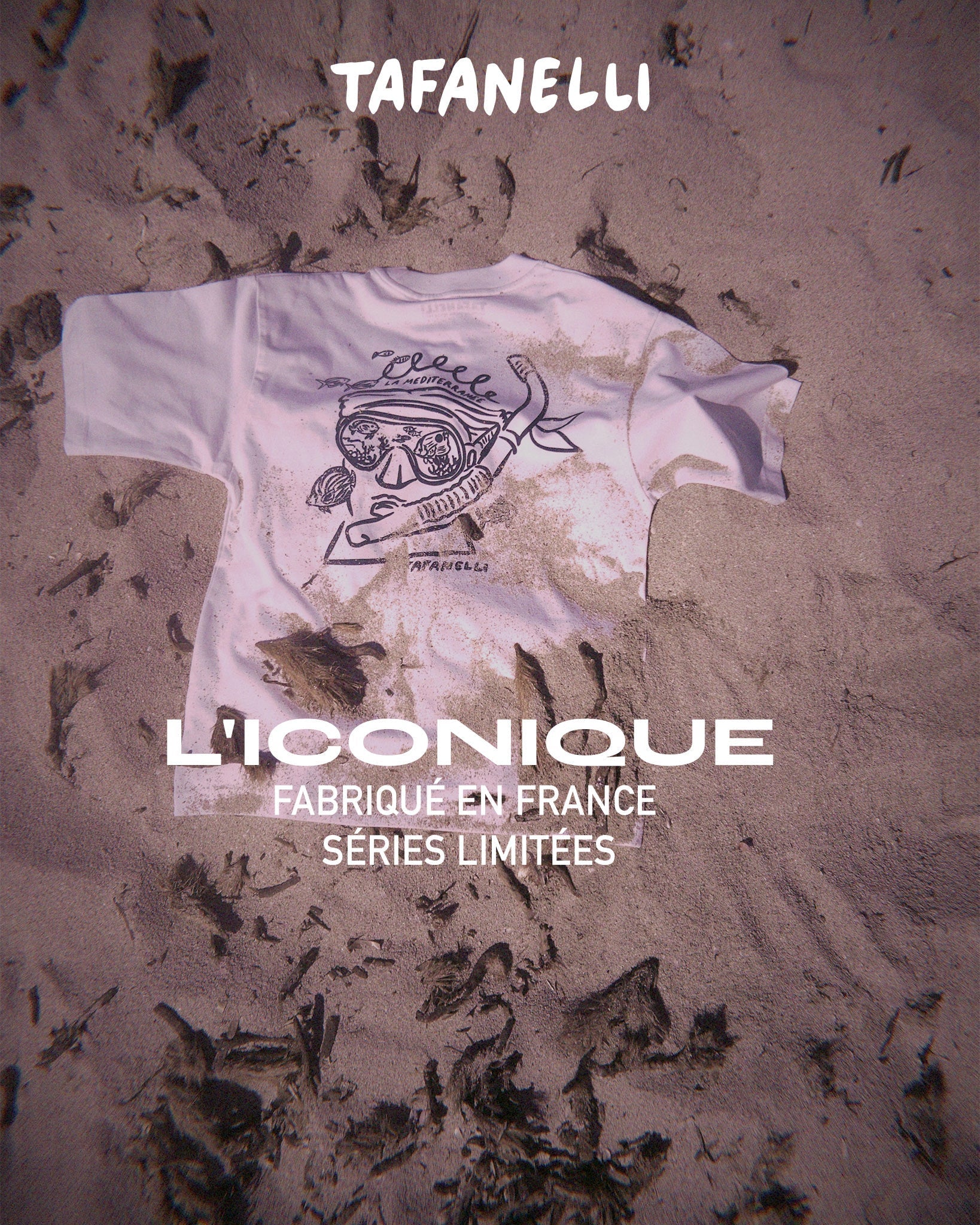
Corsican perched villages are places where wearing TAFANELLI takes on special meaning, in respect for the territory and its heritage.
The Corsica 1755, for identity
Our Le Corsica 1755 t-shirt, drawn from the year of Paoli's Constitution, is the identity piece to wear when visiting these villages, most of which were contemporary to the Paoline Republic. A garment that extends the historical dimension of the visit.
The Corsican Bandana
Our Corsican bandana is your versatile ally: on the forehead to absorb sweat during visits, around the neck for sun protection, or as a pocket square for evening elegance.
The Requin Méditerranée Club cap
Our Requin Méditerranée Club cap provides sun protection in exposed villages (Sant'Antonino, Nonza, Speloncato). Pre-washed cotton, soft structure, rigid brim.
The Roccapina, for the evenings
Our Roccapina oilskin jacket is ideal for evenings in Sartène, Corscia, Palneca, and other high-altitude villages where the chill sets in quickly after sunset.
Continue the discovery
To deepen your exploration of Corsican villages, regions, and addresses, here is a selection of TAFANELLI editorial articles that complement this one:
- Cap Corse: the 2026 complete guide
- Chez Léon and Hôtel U San Dume in Cateri
- Corte: the guide to the historic capital
- Balagne: the 2026 complete guide
- Punta di Spanu and Sant'Ambroggio
- Corsican charcuterie: coppa, lonzu, prisuttu, figatelli
- The complete guide to Corsican AOC wines 2026
- Why TAFANELLI, the contemporary Corsican brand
Corsican perched villages are not just pretty places to photograph. They are the living guardians of a millennial history of resistance, adaptation to the land, and preservation of a specific island culture. Each cobblestone street, each baroque church, each Genoese tower, each panorama discovered from a promontory tells a fraction of this long history.
Whether you visit one or ten, take the time to sit in a square, chat with a local, or taste local products in a cafe. It is there, in these simple moments, that the authentic Corsica truly reveals itself, beyond postcards and standardized tourist flows.
At TAFANELLI, we carry this loyalty to our territories in every piece we manufacture. Our clothing, like these perched villages, rejects the logic of volume and defends a demand for quality that spans the decades.
To find our entire current collection, head to tafanelli.fr. Free shipping in mainland France, same-day dispatch for all orders placed before 2 PM.
A PRESTU,
TAFA