Corte: the complete guide to the historic capital of Corsica (2026)
In the geographical heart of the island, halfway between Bastia and Ajaccio, a town rises above two spectacular gorges, surrounded by mountains that reach over 2,700 meters. That town is Corte. The former capital of independent Corsica under Pascal Paoli between 1755 and 1769, a university town since 1981, and today the intellectual and symbolic capital of the island. Its citadel perched like an eagle's nest, its regional museum, the Restonica Gorges, and Lake Melo make it one of the essential stops for any trip to Corsica. Here is our complete TAFANELLI guide to Corte, the place that gave Corsica its modern political consciousness.
Corte, the beating heart of Corsica
There are towns that, more than others, embody the soul of a territory. Corte is one of those for Corsica. It is neither the most populous town (it has about 7,500 inhabitants), nor the most visited in summer (tourism is less concentrated there than in Calvi or Bonifacio), nor the richest in seaside infrastructure (it is an hour from the coast). And yet, it occupies a special place in the hearts of Corsicans.
Corte is the historic capital of Corsica. The one where Pascal Paoli established his government when he proclaimed the independent Corsican Republic in 1755. The one where he created the island's first university in 1765. The one where, two centuries later, the university was refounded in 1981 to give Corsica a youth educated locally rather than expatriated. The one that remains, in the contemporary island imagination, the geographical and symbolic center of the island.
For Corsicans, Corte is a word that carries weight. It is not just a town; it is a political and cultural project that dates back to the 18th century and continues to nourish contemporary identity. Going to Corte is making a pilgrimage to the source. It is also discovering one of the most spectacular natural geographies in Europe.
Beyond its political and historical dimension, Corte offers exceptional natural landscapes. The town is nestled at the confluence of two high-mountain valleys: the Tavignano valley and the Restonica valley. The latter leads to spectacular gorges that head toward Lake Melo and Lake Capitellu, two glacial jewels perched at over 1,700 meters above sea level. A natural setting that alone justifies the visit.
Where is Corte and how to get there
A quick word on geography and access for those planning their visit.
The geographical center of the island
Corte is located almost exactly at the geographical center of Corsica, halfway between Bastia (to the northeast, 70 kilometers) and Ajaccio (to the southwest, 85 kilometers). This central position historically led Paoli to choose it as his capital: difficult to conquer from any port, yet accessible from all regions of the island.
The town is located at about 400 meters of altitude, on a rocky promontory that overlooks two valleys. The Genoese citadel crowns the top of the rock, in a particularly advantageous natural defensive position.
How to get there
- By car from Bastia: about 1 hour via the N193, passing through Ponte Leccia and the Golo valley.
- By car from Ajaccio: about 1 hour 30 minutes via the N193, passing over the Vizzavona pass.
- By car from Calvi or L'Île-Rousse: about 1 hour 30 minutes to 2 hours, via Ponte Leccia.
- By train: Corte is served by the Bastia-Ajaccio railway line. A particularly picturesque train that crosses the Corsican mountain ranges. Allow 1 hour 30 minutes from Bastia, 2 hours from Ajaccio.
The train is highly recommended for those who want to discover Corte without a car: the station is in the town center, and most of the interesting sites are accessible on foot.
Corte and Pascal Paoli: capital of the Corsican Republic
It is impossible to understand Corte without looking back at its founding political history, which transformed it in 1755 into the capital of a modern democratic republic, at a time when democracy did not yet exist elsewhere in Europe.
1755: Paoli elected General of the Nation
On July 15, 1755, a Corsican assembly meeting at the Saint-Antoine convent in Casabianca (in Castagniccia) elected Pascal Paoli as "General of the Nation". A decision that would radically transform the island's destiny. Paoli, a young Corsican intellectual trained at the University of Naples, would use his position to build a true independent Corsican state, with a constitution, a government, an army, a currency, and a university.
Paoli quickly chose Corte as the capital of this independent Corsica, for several strategic reasons:
- Its central position, equidistant from the main Corsican regions.
- Its natural defensibility, with the rock, the citadel, and the surrounding mountains.
- Its distance from ports, which made rapid maritime conquest difficult.
- Its ancient history as a stronghold (occupied by the Saracens, then the Genoese).
The Corsican Constitution of 1755
Under Paoli's leadership, Corsica adopted a democratic Constitution in 1755 that predated that of the French Revolution by several decades. This Corsican Constitution:
- Established the separation of powers (legislative, executive, judicial).
- Instituted universal male suffrage for the election of representatives.
- Guaranteed equality before the law.
- Protected freedom of expression and religious freedom.
- Made Corsica a modern democratic republic, the first in European history.
This Constitution was studied throughout Enlightenment Europe. Jean-Jacques Rousseau wrote his Project for a Constitution for Corsica in 1765. Voltaire, Diderot, and Benjamin Franklin hailed the Corsican experiment as a model. For a few years, Corte became a political beacon for emerging European and American democratic movements.
1765: The first University of Corsica
In 1765, Paoli made a major political and cultural gesture: he founded the first University of Corsica in Corte. A visionary project for the time, which aimed to train the intellectual and administrative elite that the young republic needed on the island.
This university, unfortunately, would have a brief destiny. It functioned for only four years before the French conquest of 1769 brought an end to the Corsican Republic and therefore its university project. It would take until 1981 for it to be refounded and reclaim its place in the island's intellectual landscape.
1769: the end of the Corsican Republic
On May 8, 1769, at the Battle of Ponte Novu (a few kilometers north of Corte), French troops definitively defeated the Paolist forces. Paoli went into exile in Great Britain, Corsica became a French possession, and Corte lost its status as capital. A defeat that marked the end of the Corsican republican experiment, but which failed to erase its founding memory in the island's consciousness.
It is this history, with the date 1755 as its central anchor, that directly inspires our signature TAFANELLI Corsica 1755 range. An identity-defining piece to wear in Corte more than anywhere else.
The citadel of Corte, a historic eagle's nest
The iconic monument of Corte, the one visible from every entrance to the town, is its citadel. A spectacular fortress installed on a rocky promontory that dominates the town and both valleys.
A natural defensive position
The citadel of Corte rises about 100 meters above the town level, on a steep rock that makes access almost impossible from the north and west sides. This exceptional natural position made it one of the most impregnable strongholds in Corsica for centuries.
History of the citadel
The citadel was built gradually starting in the 15th century by the Genoese, who controlled Corsica at that time. It was reinforced several times, notably under the Paolist Republic (1755-1769), which made it its military and political center.
After the French conquest of 1769, it remained a military site until the 20th century. In 1962, it was classified as a Historical Monument, and since the 1990s, it has housed the Museum of Corsica, giving it a major cultural purpose once again.
Visit and panorama
A visit to the citadel is essential during a stay in Corte. It is reached via a staircase from the upper town, with several exceptional viewpoints over the two valleys, the town, and the surrounding mountains.
The eagle's nest, the highest part of the citadel, offers a 360-degree panorama found nowhere else in Corsica. On a clear day, one can clearly see the Aiguilles de Bavella to the south, Monte Cinto to the west, and sometimes even the Tyrrhenian Sea to the east. A place to photograph without fail.
The Museum of Corsica, a heritage landmark
Housed in the citadel buildings since 1997, the Museum of Corsica (officially the Regional Museum of Anthropology of Corsica) is arguably the most important museum on the island.
A major heritage institution
The museum presents, over several floors, anthropological and ethnographic collections that document Corsican history and culture from antiquity to the 20th century. Everyday objects, agricultural tools, traditional costumes, religious works, and historical documents: everything that makes up the island's material memory is presented with a contemporary and educational design.
Permanent collections
The permanent exhibition is organized around several themes:
- Rural Corsica and its traditional agricultural economy (livestock, farming, chestnut groves).
- Arts and popular traditions (music, dance, crafts, costumes).
- Corsican emigration and diasporas around the world.
- Religious life and confraternities.
- Political history and the Paolist adventure.
Temporary exhibitions
The museum regularly offers temporary exhibitions that delve into various aspects of Corsican culture. An ambitious program, often in collaboration with other French or European museums, that is worth following.
Practical information
- Hours: open year-round, with variations according to the season. Closed on certain public holidays.
- Rates: approximately 8-10 euros for an adult, free for those under 18.
- Recommended visit duration: 2 to 3 hours for a complete tour.
- Official website: check before your visit for detailed info.
The Governors' Palace and the upper town
Beyond the citadel, the upper town of Corte houses several monuments and places of interest that should be taken time to discover.
The National Palace
On the Place du Poilu, below the citadel, stands the National Palace, the former palace of the Genoese governors, which also served as the seat of Paoli's government between 1755 and 1769. A major historical building with immense memorial importance.
The palace now houses various administrative services and a museum dedicated to Paoli that presents his life, his political work, and the functioning of the Corsican Republic. A must-visit for those interested in the founding history of modern Corsica.
The narrow streets and squares of the upper town
The upper town of Corte features a maze of cobbled alleys, stone staircases, and small shaded squares. A preserved medieval atmosphere that contrasts with the modernity of the university below. It is a pleasant place to stroll, discovering quiet cafés, craft shops, and murals that tell the history of the town.
The statue of Paoli
On the Place Paoli, in the heart of the upper town, stands the statue of Pascal Paoli, the work of sculptor Victor Segoffin, inaugurated in 1911. A central landmark around which the Cortenais traditionally meet.
The Restonica Gorges, a natural jewel
Beyond the town itself, Corte is the mandatory starting point for one of the natural wonders of Corsica: the Restonica Gorges.
An exceptional canyon
The Restonica river flows down from the heights of the Rotondo massif, carving spectacular gorges through the granite rock along its path. Over a distance of about fifteen kilometers, between Corte and the top of the massif, these gorges offer some of the most impressive landscapes in Europe.
The water is of an almost unreal emerald green, the granite rocks take on ochre and white hues, and the Mediterranean vegetation gradually mingles with high-altitude black pines. A landscape that sometimes resembles Norwegian fjords or parts of the Swiss Alps, but with the unique light of Corsica.
The gorge road
A narrow and winding road goes up the gorges from Corte to the Grotelle sheepfold, the starting point for hikes to the lakes. This road, about 15 kilometers long, is particularly photogenic but also tricky to drive (difficult passing points, sharp turns). In the peak summer season, it is regulated with a shuttle system to prevent congestion.
Swimming in the Restonica
Several swimming spots line the Restonica trail. The clear pools, constantly fed by glacial meltwater, offer refreshing swims even in the height of summer. Be careful, however: the water remains very cold (12-14°C), which limits how long you can stay in. Sturdy shoes are recommended, as the rocks can be slippery.
The most recommended swimming spots:
- Natural pool near the Uganu bridge, a few kilometers from Corte.
- Restonica pools, halfway through the gorge.
- Grotelle sheepfold, the end of the road, with several accessible basins.
The Melo and Capitellu lakes, a legendary hike
At the end of the gorge road, at the Grotelle sheepfold (1,375 m altitude), begins one of the most legendary hikes in Corsica: the climb to the Melo and Capitellu lakes.
Lake Melo (1,711 m)
From the Grotelle sheepfold, a marked trail leads in 1.5 to 2 hours of walking to Lake Melo, at an altitude of 1,711 meters. A glacial lake with transparent waters, surrounded by granite peaks rising to over 2,200 meters. The landscape is spectacular, with the rugged mineral beauty of the Corsican high mountains.
The hike is classified as moderate to difficult. The trail climbs steadily, with several sections requiring the use of hands and the help of fixed chains over the final 300 meters before the lake. Closed-toe shoes are mandatory, along with plenty of water and essential sun protection.
Lake Capitellu (1,930 m)
For more experienced hikers, an extension allows you to reach Lake Capitellu, at an altitude of 1,930 meters, located about 45 minutes of additional walking above Lake Melo. Even wilder, even more alpine, and even more impressive. A place that gives the impression of being in a miniature Himalayas.
The GR20 passes through here
These lakes are on the route of the GR20, the most difficult long-distance hiking trail in Europe. Hikers doing the GR20 traditionally pass through in the late afternoon, which gives these lakes a unique atmosphere at that time of day (trail runners, long-distance hikers).
Practical advice
- Leave early in the morning to avoid the heat and afternoon thunderstorms.
- Carry at least 2 liters of water per person.
- High-top hiking boots, never flip-flops or sandals.
- Full sun protection: hat, sunscreen, sunglasses.
- Warm clothing for the lake, even in summer (winds can be chilly).
- Avoid hiking if thunderstorms are forecast: lightning in the high mountains is a real danger.
The University of Corte, youth and vitality
Refounded in 1981 at the initiative of Corsican cultural movements that wished to give the island back a university on its own soil, the Università Pasquale Paoli now occupies a central place in the life of Corte.
A political and cultural refounding
The refounding of the university was a major political and cultural project for contemporary Corsica. Since the closure of the Paoline university in 1769, young Corsicans were forced to leave for the continent for their higher education. A situation that contributed to the island's demographic and cultural decline.
The refounded university adopted the Paoline lineage (it officially bears the name Università Pasquale Paoli). Today it offers programs in several disciplines (law, economics, humanities, science, engineering, Corsican language), with a special focus on island and Mediterranean themes.
About 4,000 students
The university currently has about 4,000 students, which represents a significant portion of Corte's population. This student presence gives the town a unique vitality, with lively cafes, cultural events, and a rhythm of life that contrasts with other small Corsican towns.
Student life in Corte
Corte offers a unique student atmosphere, between the intellectual vitality brought by 18-25-year-olds and the town's exceptional setting (nature, heritage, mountains). The town center cafes, the Place Paoli, and the bars in the old alleys particularly come alive in the evenings during the academic term.
The gastronomy of Corte and the Cortenais
The Cortenais, the historic region around Corte, offers a particularly authentic mid-mountain gastronomy that draws on local resources: livestock farming, chestnuts, maquis herbs, and dairy products.
Cortenais specialties
- AOP Corsican charcuterie (coppa, lonzu, prisuttu, figatelli) is particularly prevalent around Corte, a historic production region. Our complete guide to Corsican charcuterie details everything you need to know.
- Brocciu, a fresh Corsican cheese made from sheep or goat milk, is omnipresent in local cuisine.
- Stews (wild boar, lamb) simmered in Corsican wine and maquis herbs.
- Pulenda, a traditional dish made from chestnut flour.
- Corte cheese, a farmhouse tomme produced in high-altitude sheepfolds.
- Corsican pastries: canistrelli, fritelli, castagnaccio.
Our recommended addresses
- Restaurant U Museu next to the citadel, authentic Corsican cuisine.
- Le 24 on Place Paoli, warm atmosphere.
- A Rimessa for family-style cooking.
- The Restonica inns, for a lunch by the river.
Where to stay and eat in Corte
The supply of accommodation in Corte is more limited than in seaside resorts, but sufficient for a quality stay.
Charming hotels
- Hôtel Duc de Padoue, a historic address in the town, with a view of the citadel.
- Hôtel HR, more contemporary, in the town center.
- Hôtel de la Restonica, at the entrance to the gorges, an exceptional natural setting.
Bed and breakfasts and rural gîtes
Numerous B&Bs in the surrounding villages (Omessa, Casanova, Santa Lucia di Mercurio) offer a more rural and intimate experience.
Inns of the Restonica Gorges
Several rustic inns line the road to the Restonica gorges. They offer simple rooms and authentic cuisine in a unique natural setting. Recommended for hiking enthusiasts.
When to come
- Spring: ideal for hiking and exploration, with mild temperatures.
- Summer: heat is possible in town, but freshness is guaranteed at the lakes. Beware of tourist saturation in the gorges.
- Autumn: stunning colors in the chestnut groves, weather still mild.
- Winter: snow on the heights, intimate atmosphere in the town. Some high mountain roads are closed.
What TAFANELLI wears to visit Corte
Corte is a place where wearing TAFANELLI takes on a special meaning, as the history of the brand and that of the town intersect through the legacy of Paoli.
The Corsica 1755, the essential piece
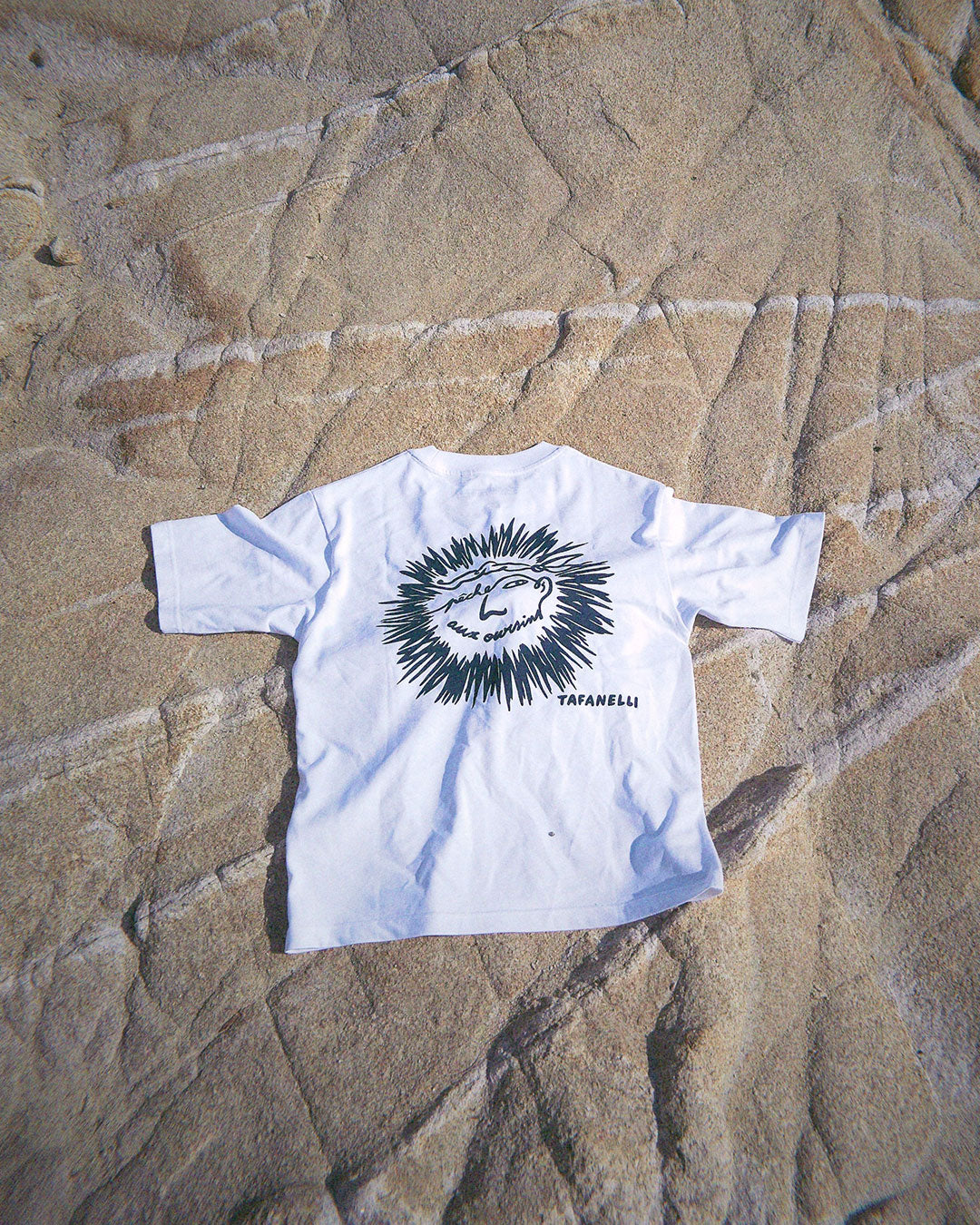
Our Le Corsica 1755 t-shirt is the piece to wear in Corte. The date 1755 directly echoes when Paoli established his government in the town. A garment of identity that takes on its full historical depth in the streets of the Corsican republican capital.
The Corsican bandana
Our Corsican bandana with its Moor's Head adds a subtle identity touch to any outfit. Ideal for a lunch on Place Paoli or a stroll in the upper town.
The Mediterranean Shark Club cap
Essential for hiking to the Melo and Capitellu lakes, where the sun can be intense above 1,700 meters altitude. Our Shark cap combines sun protection with Mediterranean style.
The Roccapina, for altitude
Our Roccapina oilskin jacket is perfect for evenings in Corte, which are particularly cool even in summer (the town is at 400 meters altitude and the winds come down from the mountains). A status piece for a dinner on a terrace or a night walk.
All our pieces are made in France, hand-drawn by paid artists, and produced in limited series. They carry the same cultural demand that Corte has defended since 1755: that of fidelity to the territory, anchoring in long-term memory, and the rejection of convenience.
Continuing the discovery
To deepen your knowledge of Corsica and its history, here is a selection of TAFANELLI editorial articles that complement this one:
- July 14th in Corsica: celebrations and island identity
- Napoleon 2026: 10 places to visit in Corsica
- Cap Corse: the 2026 complete guide
- Corsican charcuterie: coppa, lonzu, prisuttu, figatelli
- GR20 2026 complete guide: the 16 stages
- The complete guide to AOC Corsican wines 2026
- Pietra, 30 years: the story of a Corsican beer
- Why TAFANELLI, the contemporary Corsican brand
Corte is not just a small mountain town in the center of Corsica. It is the symbolic and intellectual heart of an entire island. It is the place where, between 1755 and 1769, a modern democratic republic was invented before the rest of Europe followed suit. It is the place where, since 1981, a university has been training young Corsicans on their own soil, in fidelity to this foundational history. It is also the place where one can, in a single day, go from the historic citadel to glacial lakes perched at 1,900 meters, in a geography that exists nowhere else.
Whether you are preparing for your first visit or your tenth stay, take the time to go beyond simple tourist discovery. Visit the citadel and its museum. Take the time to sit in Place Paoli, facing his statue, and reflect on what this founding moment means for all of contemporary Corsica. Hike up to the Melo lakes, if your physical condition allows, to see the Corsican high mountains in their purest form. You will come away with a deeper understanding of what the island is, beyond its beaches and beach bars.
And if you are wearing a TAFANELLI garment at that time, especially our Corsica 1755, you will embody, in your own modest way, the continuity of this history. You will be wearing the date that made Corte, nearly three centuries ago, the capital of a pioneering republic. You will be helping to keep this memory alive in the 21st century.
To find our entire current collection, head to tafanelli.fr. Free delivery in mainland France, same-day shipping for all orders placed before 2 p.m.
A PRESTU,
TAFA