Sharks, sperm whales, and dolphins of Corsica: the megafauna of France’s largest marine park
There are twenty-one species of sharks and twenty-three species of rays in the waters of Cap Corse. A sperm whale descends over two thousand meters there and stays for more than an hour. A five-meter-wide devil ray entered the old port of Bastia on June 26, 2024. And almost no one, on the island or elsewhere, knows that all this is happening just a few miles from the beach where they are swimming.
Are there sharks in Corsica? Yes, and many
That is the question everyone asks, so we might as well answer it frankly.
Within the perimeter of the Cap Corse and Agriate Marine Natural Park alone, there are twenty-one species of sharks and twenty-three species of rays.
And yet, you will never see them from the beach.
The reason is simple: almost all of these species live offshore and at depth. They frequent the continental slope, underwater canyons, and pelagic zones several miles from the coast. The swimmer and the Mediterranean shark simply do not share the same space.
The real issue isn't the fear they inspire in us. It's that they are disappearing without anyone having ever seen them.
The most iconic shark in these waters, the blue shark, is classified as critically endangered in the Mediterranean. It is the highest alert level before extinction in the wild.
The largest marine park in France
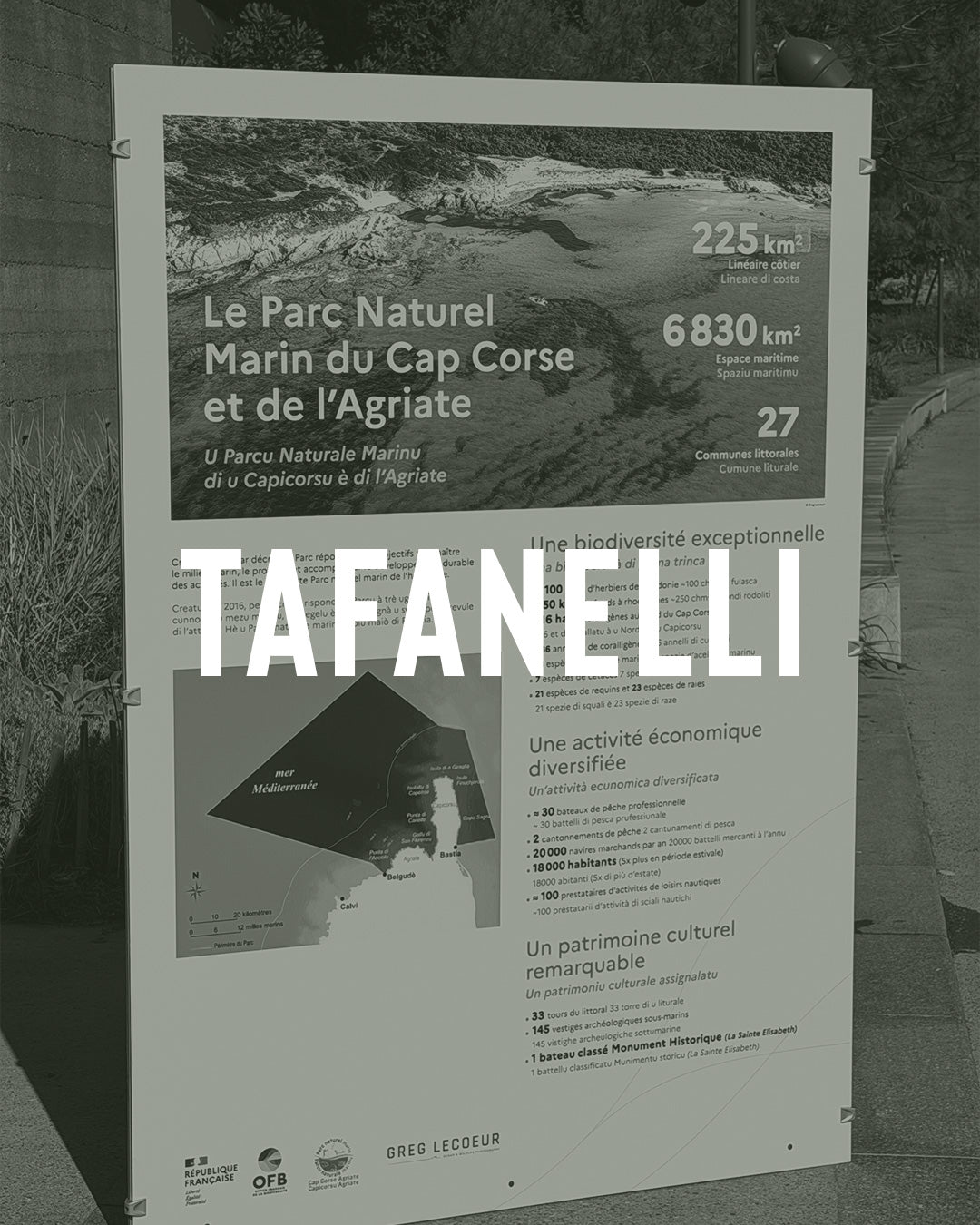
Created by decree in 2016, the Cap Corse and Agriate Marine Natural Park is the largest in France. The figures are staggering.
- 6,830 km² of maritime space
- 225 km² of coastline
- 27 coastal municipalities
- 7 species of cetaceans, 21 of sharks, 23 of rays, 14 of marine birds
- 145 underwater archaeological sites and one boat classified as a Historical Monument, La Sainte Elisabeth
- 33 coastal towers
- 18,000 inhabitants, five times that in the summer season
- 20,000 merchant ships passing through each year
It is managed by the French Office for Biodiversity, in collaboration with the Environment Office of Corsica. Its management plan, approved in July 2019, runs until 2034.
Three words sum it up, in Corsican: Sapè, to know. Prutege, to protect. Per accumpagnà, to accompany.
Corsican names, that forgotten treasure
Every species in these waters has a name in the Corsican language. These words are rarely written, almost never used, and they are magnificent.
| French | Corsican | Mediterranean status |
|---|---|---|
| Sperm whale | U Capudogliu | Endangered |
| Fin whale | U Rorqual Cumunu | Endangered |
| Long-finned pilot whale | U Globicefalu Negru | Endangered |
| Risso's dolphin | U Delfinu di Risso | Endangered |
| Striped dolphin | U Delfinu Turchinu è Biancu | Vulnerable |
| Common bottlenose dolphin | U Delfinu | Vulnerable |
| Devil ray | U Diavule di Mare | Endangered |
| Blue shark | U Squalu Turchinu | Critically endangered |
| Common stingray | A Raza Ferazza, Ciocciu | Vulnerable |
| Loggerhead turtle | A Tartaruca di Mare | Vulnerable |
A language that has words for ten species of marine megafauna is a language of people who have spent centuries watching the sea.
Descending: megafauna by depth
The best way to understand these waters is not to travel over them. It is to go down into them.
- 30 meters. A Raza Ferazza, the stingray, buried in the sand of the shallows.
- 100 to 200 meters. U Rorqual Cumunu descends to filter krill.
- 600 meters. U Globicefalu Negru hunts squid in the dark.
- 700 meters. U Delfinu Turchinu è Biancu, the striped dolphin.
- 600 to 1,000 meters. U Delfinu di Risso, along the underwater canyons.
- Over 2,000 meters. U Capudogliu, alone, for over an hour without breathing.
Between the surface where we swim and the sperm whale, there are two kilometers of vertical void. They are right there, under the ferry's hull.
U Capudogliu, the one that goes deepest
The sperm whale is the largest odontocete in the world, that is, the largest toothed cetacean. Its average lifespan is eighty years.
It lives along the Park’s continental slope, alone or in small groups. Its diving abilities are hard to believe: it stays underwater for more than an hour and reaches depths of over two thousand meters. At these depths, there is no more light. It hunts by echolocation.
What it is looking for down there: giant squid and large fish.
An animal that lives as long as a human, descends twice as deep as the deepest recreational submarine, and spends most of its life in total darkness. A few miles from Bastia.
It is threatened by driftnets, maritime traffic and collisions, and noise and chemical pollution. Classified as endangered in the Mediterranean.
U Delfinu di Risso, the one that whitens with age
Of all the stories in these waters, this is the most beautiful.
At birth, the Risso's dolphin has a light gray coloring that darkens gradually with age. Then, over the years, white scars appear on its body, linked to social interactions and reproductive behaviors.
They do not fade. They accumulate.
The oldest individuals can become almost entirely white. An animal whose life is written on its skin, and whose age can be read by the amount of white.
It frequents the deep areas of the Park, between 600 and 1,000 meters, along the continental slope and underwater canyons, where it feeds on fish and cephalopods. Very sociable, it lives in small groups and readily mixes with other cetaceans, pilot whales, or striped dolphins.
It is threatened by illegal driftnets and chemical pollution. Classified as endangered.
The seven cetaceans of the Park
U Rorqual Cumunu, the giant
Eleven to fourteen meters, in groups of two to eight individuals. It dives between one hundred and two hundred meters and feeds by filtering, mainly on krill, sardines, and capelin. It is an indicator species: where it is found, the water is rich.
Since 2018, sixty-eight observations have been recorded within the Park, representing about a hundred individuals. Threatened by collisions, accidental catches, climate change, and noise pollution.
U Globicefalu Negru
Dives reaching up to six hundred meters to capture squid in the depths. In the Mediterranean, births occur mainly in summer. Threatened mainly by driftnets, noise, and pollution.
U Delfinu Turchinu è Biancu
The most common offshore. It moves in groups of tens of individuals, sometimes reaching a hundred. Sociable, curious, playful, and acrobatic, it is often observed surfing in the bow waves of boats, a behavior called bow-riding. It dives up to seven hundred meters and remains observable year-round.
U Delfinu, the bottlenose dolphin
The most coastal, and therefore the most frequently encountered. It lives in a group and is distinguished by its sensitivity to noise generated by human activities at sea. Maritime traffic directly disrupts its communication and behavior, with consequences for its feeding, reproduction, and survival. Protected in France.
U Diavule di Mare, and the day it entered Bastia
The devil ray is the largest species of ray in the Mediterranean. Its wingspan can exceed five meters.
It is recognized by its wide wing-shaped fins and its two cephalic lobes, those growths curled on either side of the mouth that look like horns and gave it its name. Despite this look, it is a filter-feeder: it feeds on plankton and small fish that it filters from the water.
It is a rare species, protected and threatened by navigation, pollution, and the degradation of its habitat. It normally lives in offshore areas.
This makes the following event remarkable.
On June 26, 2024, an individual was observed inside the very enclosure of the old port of Bastia.
A ray with a wingspan of several meters, between the boats, in the oldest port of the city. Those who were there that day saw something that no one will likely see again.
Sharks and rays
U Squalu Turchinu, the blue shark
A pelagic species, it frequents offshore areas where it feeds on fish and squid. It has a slender body and a deep blue coloring on its back.
It is often described as a curious shark, and that is precisely what dooms it: this behavior makes it particularly exposed to accidental catches by fishing activities. Its slow growth and low reproduction rate make the species very vulnerable to decline.
Classified as critically endangered in the Mediterranean.
A Raza Ferazza, the stingray
One of the easiest rays to observe in these waters, because it is essentially coastal. It frequents shallow sandy bottoms, where it partially buries itself for camouflage. It usually moves around thirty meters and rarely exceeds one hundred meters.
This is the one that divers and free-divers encounter, often without seeing it immediately.
The Park participates in the European project LIFE European Sharks, dedicated to the conservation of shark and ray populations in the Mediterranean.
A Tartaruca, the one that returns to lay eggs
The loggerhead turtle uses certain Corsican coastal areas as refuges for feeding and resting. And for a few years now, it has been doing much more than that.
Females reach beaches mostly at night to lay their eggs. In 2023, the beach of Pietracorbara, in Cap Corse, was one of the egg-laying and hatching sites recorded on the island. The Corsican coastline, and the Mediterranean more generally, has become the scene of regular egg-laying.
The threats are specific: accidental catches during fishing, collisions with ferries, and ingestion of plastic waste, which represents a significant risk of mortality. On land, disturbance and high beach attendance disrupt the egg-laying process and the survival of the eggs.
In concrete terms: a beach that is lit, trampled, or occupied at night in summer is a beach where a turtle will not lay its eggs.
The setting: posidonia, coralligenous, rhodoliths
This fauna exists only because a setting supports it, and this setting is also exceptional.
- About 100 km² of posidonia meadows. The underwater flowering plant endemic to the Mediterranean, a nursery and lung of the shallows.
- 250 km² of rhodolith beds. Concretions of calcareous algae that form complex habitats, still poorly known to the general public.
- 116 hectares of coralligenous north of Cap Corse, distributed in 436 rings. It is the habitat of red coral, and one of the richest ecosystems in the Mediterranean.
These three habitats take decades to form and a few minutes to be destroyed by a poorly placed anchor.
What threatens them
One figure summarizes the difficulty: twenty thousand merchant ships pass through the Park each year, and the human population of the territory is multiplied by five in the summer.
The pressures are consistently the same from one species to another.
- Collisions with ships, particularly for large cetaceans and turtles.
- Accidental catches, the primary threat to the blue shark, the striped dolphin, and the loggerhead turtle.
- Driftnets, including illegal ones, cited for the sperm whale, the pilot whale, and the Risso's dolphin.
- Noise pollution. Noise disrupts the communication of the bottlenose dolphin and the behavior of the megafauna.
- Plastics, a major cause of mortality in loggerhead turtles.
- Disturbance, on egg-laying beaches as well as at sea.
The Park runs several programs to address this. Orizonte documents the presence of megafauna throughout the territory via boat observations, overflights, aerial photography, and acoustics. LIFE EMM aims to reduce the accidental capture of sensitive species. LIFE European Sharks targets sharks and rays. The implementation of strict protection zones rounds out these efforts.
Where and when to observe, without disturbing
Seeing a cetacean in Corsica is not guaranteed, but it is far from impossible.
- Off the coast of Cap Corse, both east and west, is the most productive area. This is where most of the photographs in the Park's exhibition were taken.
- The Agriates Desert coastline for the bottlenose dolphin, which is more coastal.
- Shallow sandy bottoms for the stingray, accessible via diving or even snorkeling.
- The season. The striped dolphin can be observed year-round. Ferry crossings, early in the morning and on calm seas, offer excellent chances.
The rules, and they are non-negotiable
- Never pursue an animal. Cut the engine, let them come to you, or let them leave.
- Never cross the path of a group, or separate a calf from its mother.
- No swimming with cetaceans. It is regulated and causes disturbance.
- On nesting beaches in summer, no lights, no fires, no nocturnal presence.
- Report your observations to the Park. Field reports genuinely contribute to scientific monitoring.
Why we are telling this story
We design clothes. We are neither biologists nor wildlife photographers.
But there is something in this list that concerns us directly. An island that has words for ten species of marine megafauna is an island that has spent centuries watching the sea. U Capudogliu, u squalu turchinu, a tartaruca di mare: these words exist because local people saw them, named them, and passed them down. And they are falling into disuse at the same time as the animals they describe.
And then there is the Risso's dolphin. An animal whose skin keeps a record of everything it has experienced, turning white with the passing years. This is exactly what we aim to do with clothing: pieces that hold the memory of those who wear them, and that look more beautiful worn than new. We explain this in our guide on what it means to be a Corsican brand.
Our Shark Cap was born from that side of Corsica. Not the one of the July beaches, but the one you don't see.
Frequently Asked Questions
Are there sharks in Corsica?
Yes. Twenty-one species of sharks and twenty-three species of rays are recorded in the Cap Corse and Agriate Marine Natural Park alone. Almost all of them live offshore and in deep water, which explains why you never encounter them from a beach.
Are Corsican sharks dangerous to swimmers?
The species present are primarily pelagic and deep-sea. The blue shark, the most iconic of these waters, lives offshore and is itself classified as critically endangered. The real issue is not the risk to humans, but the rapid disappearance of these species.
Can you see whales and dolphins in Corsica?
Yes. Seven species of cetaceans frequent the Park: sperm whale, fin whale, long-finned pilot whale, Risso's dolphin, striped dolphin, and bottlenose dolphin. The striped dolphin can be observed year-round offshore. Since 2018, sixty-eight fin whale sightings have been recorded within the Park's perimeter.
What is the largest marine park in France?
The Cap Corse and Agriate Marine Natural Park, created in 2016, with 6,830 km² of maritime space and 225 km² of coastline spread across 27 municipalities.
How deep can a sperm whale dive?
Over two thousand meters, staying underwater for more than an hour. It captures giant squid and large fish there, in total darkness, by hunting using echolocation. Its average lifespan is eighty years.
Why does the Risso's dolphin turn white?
Because scars accumulate. It is born light gray, darkens with age, and then white scars related to social interactions and reproductive behavior appear gradually. The oldest individuals can become almost entirely white.
What is the devil ray?
Mobula mobular, the largest ray in the Mediterranean, whose wingspan can exceed five meters. Its two cephalic lobes look like devil's horns, hence its name. It is a harmless filter-feeder that eats plankton. On June 26, 2024, an individual was observed in the old port of Bastia.
Do turtles nest in Corsica?
Yes, and increasingly so. In 2023, the beach of Pietracorbara in Cap Corse was one of the documented nesting and emergence sites. Females reach the beaches mainly at night. Disturbance and nighttime beach traffic directly disrupt nesting.
How can I observe cetaceans without disturbing them?
Never pursue an animal, never cross a group's path, never separate a young one from its mother, and do not swim with them. Cut the engine and let the animal decide. Reporting your observations to the Park helps scientific monitoring.
How do you say sperm whale in Corsican?
U Capudogliu. The blue shark is called u squalu turchinu, the devil ray u diavule di mare, the sea turtle a tartaruca di mare, and the striped dolphin u delfinu turchinu è biancu.
To learn more
- Red coral from Corsica, the red gold of the Mediterranean
- Diving in Corsica, the greatest underwater paradise in the Mediterranean
- Cap Corse, the complete guide
- The Agriates Desert
- Gulf of Porto, Girolata and Scandola
- Centuri, the fishing port at the end of Cap Corse
- Jellyfish in Corsica
- The Corsican mouflon, the emblem of the mountains
To discover our Mediterranean wardrobe, browse the complete collection.
Six thousand eight hundred and thirty square kilometers, seven cetaceans, twenty-one sharks, twenty-three rays. And one sperm whale who, as you read this sentence, is holding its breath two thousand meters beneath the Bastia ferry.
A DOPU,
TAFA
When passing through Corsica, the customer becomes a friend.
Sources: Cap Corse and Agriate Marine Natural Park, French Office for Biodiversity, Environment Office of Corsica. Biodiv'EXPO exhibition panels, Bastia port, photographs by Greg Lecoeur. Protection status: IUCN Red List. Article written in September 2026.